


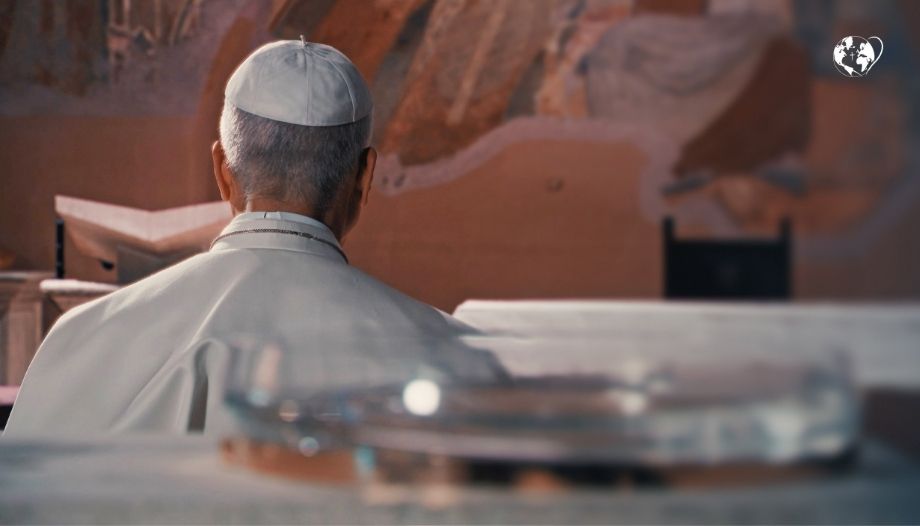
The Second Vatican Council’s Constitution *Gaudium et Spes*, on which Pope Leo XIV began a new series of catechesis this Wednesday, opens by declaring that the Church takes as her own ‘the joys and hopes, the sorrows and anxieties of the people of our time, especially the poor and all who suffer’ (GS 1).
“This message calls on us to cast aside all passivity and indifference in the face of current events, in the face of history and people’s lives, and above all in the face of the rapid and profound changes we are experiencing today,” the Pontiff emphasized in St. Peter’s Square before thousands of faithful, more than 15,000, who attended the General Audience.
“Be open to dialogue, get involved”
“We cannot remain ”disinterested spectators“; rather, we must ”listen with our hearts, allow ourselves to be challenged, and get involved,'" he added.
“With Christ and sustained by the power of his Spirit, believers are called to take on the burdens of their brothers and sisters, especially those who are oppressed by injustice, discrimination, and violence.”.
The Church and believers must walk alongside humanity
“This sharing with humanity is the path that Christ asks of the Church,” which cannot remain passive or indifferent to what is happening in the world, but rather “is called to walk alongside humanity, especially in light of the rapid and profound changes we are experiencing,” the Pope reflected.
Therefore, “believers, united with Christ and sustained by his Spirit, must commit themselves to listening with their hearts and allowing themselves to be challenged, accompanying and helping those in need, especially the poor and those who suffer from injustice, discrimination, and violence.”.
Neither prophets of doom nor naive optimism
At the beginning of the Audience, the Successor of Peter recalled that St. John XXIII, in his inaugural address on October 11, 1962, “wished to express his disagreement with the ‘prophets of doom,’ who “even in their ardent zeal […] go about saying that our age, compared to past ones, has been getting worse; and behave as if they had learned nothing from history” (Address Gaudet Mater Ecclesia, October 11, 1962, 4.2).
“This is not a matter of naive optimism,” the Holy Father said, “but of a renewed fidelity to the Mystery of Christ, who, by becoming incarnate, chose to share our life: He «had to be made like his brothers in every way» (Heb 2:17; cf. 4:15) and took upon himself the consequences of sin, dying «as a ransom for all» (1 Tim 2:6).”.
The Pope's Double Appeal
Finally, the Pope issued a twofold appeal to the Church and to the faithful.
On the one hand, he has called on the Church to “a conversion commitment (as it has done in the Message (for the Day of Prayer for the Care of Creation), to bear witness that he is not motivated by ‘any earthly ambition,’ but rather «desires only one thing: to continue, under the guidance of the Spirit, the very work of Christ, who came into the world to bear witness to the truth, to save and not to judge, to serve and not to be served» (GS 3).”.
On the other hand, service and the option for the poor. “Pope Francis reminded us that for the Church, ‘the option for the poor is a theological category rather than a cultural, sociological, political, or philosophical one […] We are called to discover Christ in them, to speak out on their behalf, but also to be their friends, to listen to them, to understand them, and to draw upon the mysterious wisdom that God wishes to communicate to us through them» (Apostolic Exhortation *Evangelii gaudium*, 198).
Unmasking the Contradictions of the Contemporary World
Christian commitment, the Pontiff emphasized in conclusion, “commits us to facing reality and also to exposing the contradictions that characterize personal and social life in the contemporary world: for example, Scientific and technological progress, which constantly offers new possibilities—but only to some—and which human beings are not always able to put ‘to their use.’.
Or a clearer understanding of the ‘laws of social life,’ but accompanied by uncertainties “about the direction in which it should be steered.” Or still, a greater abundance of “wealth, so many possibilities, so much economic power,” and unfortunately, today as in the days of the Council, «a large part of humanity suffers from hunger and misery» (GS 4) (…)”.
“The Church is called to serve human beings, listening to and embracing the deepest questions of their hearts and the longings that dwell within them, pointing to Christ as ‘the key, the center, and the goal of all human history’ (GS 10),” the Pope concluded.
Pilgrims from Senegal, England, Scotland, Malta, Canada, and the United States, and close ties with the Platform for Dialogue in the Arab World
In his remarks to pilgrims speaking various languages, Leo XIV extended a special welcome to those from Senegal, England, Scotland, Malta, Canada, and the United States of America, among others.
He also greeted the delegation from the Interfaith Platform for Dialogue and Cooperation in the Arab World. He expressed his deep gratitude, prayers, and spiritual solidarity for the work of the King Abdullah bin Abdulaziz International Center for Interfaith and Intercultural Dialogue.
Tomorrow, St. Gregory the Great
Tomorrow we will celebrate the feast day of Pope Saint Gregory the Great, whose body rests in St. Peter’s Basilica, as Leo XIV has reminded us. He is known as “the Great” for his exceptional work as a shepherd during very difficult times for society and the Church: a “greatness” that drew its strength and vigor from a living faith in Christ. May his example inspire in each of you a renewed and deep trust in God, the source of grace and hope for the entire world, the Pope encouraged.
The conclusion was dedicated to the Virgin Mary, as the Pontiff usually does, asking her to “intercede for the entire Church, so that it may proclaim the Gospel with joy and hope, drawing close to the men and women of our time, and know how to guide everyone to Christ, «the key, the center, and the goal of all human history» (GS 10).”.





 Español
  English
  Italiano
  Français
  Deutsch
  Polski