



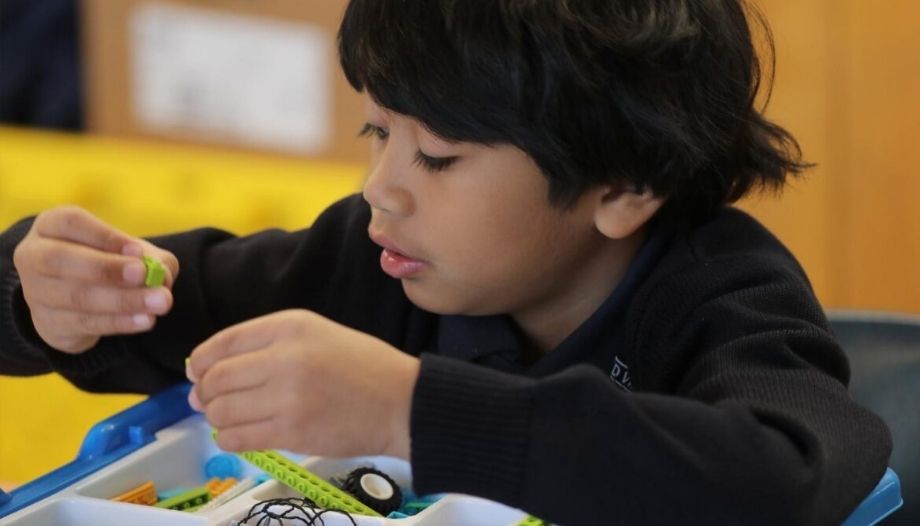
It automatically corrects your emails. It lets Siri and Alexa answer your questions or respond to your commands. It recommends what to watch next on your streaming service. It helps you find your way with navigation apps. It can generate images, videos, term papers, and even novels.
It's AI (Artificial Intelligence), and its rapid rise as part of everyday life also extends to the field of Catholic education.
So, as the new school year begins, OSV News spoke with educators and thought leaders who discussed how AI works—or doesn't work—in Catholic classrooms.
What is human development like in a world shaped by AI?
“A few years ago, most conversations revolved around academic cheating, institutional policies, and whether students should be allowed to use AI tools,” Meaghan Crowley-Sullivan tells OSV News. She is a curriculum and professional learning developer at the Institute for Innovation in Digital Education and Leadership at Loyola Marymount University in Los Angeles, known as iDEAL.
“Those questions haven’t gone away; they’ve matured,” he explained. “We’re seeing more schools asking themselves: What does good teaching look like in this new digital age? What do students need to learn? What should we protect—not only in our teaching, but also in the way we approach teaching? And, ultimately, what does human education look like in an AI-shaped world?”.
Benefits and Assistance for Parents
Crowley-Sullivan stated that there has also been an increased emphasis on inclusion, while at the same time it has become clear that parents could benefit from support from schools.
“They’re helping parents understand what these technologies are and what their children are encountering,” Crowley-Sullivan added. “And how they can set healthy boundaries and have more meaningful conversations about AI at home.”.
Teachers need to be trained in the use of AI
It's not just students and parents who need guidance. “When we teach teachers how to use this and how to incorporate it into their classrooms, we rely heavily on that conversation about ‘the human element in the loop,’” said Shannon Tabaldo, director of iDEAL.
“Human-centered AI is just a tool: it’s there to give you additional resources and capabilities that you’ve never had before,” he continued. “But you’re still the expert. We always focus on the human person in Catholic schools. We always ask ourselves, ”What are we really trying to do with this tool?’”.
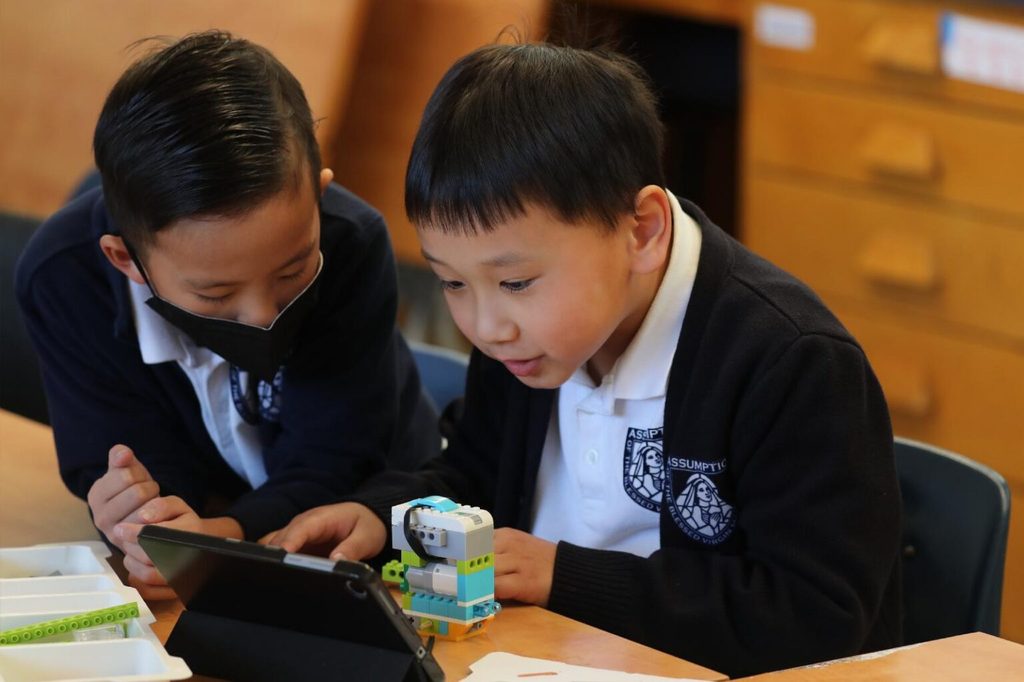
AI: An Opportunity for Personalized Learning
Crowley-Sullivan and Tabaldo—who are also mothers—have seen AI being used more and more for personalized learning.
Students can critique an AI-generated piece of work or image, or ask it to transform their attempts at poetry into perfect iambic pentameter; the AI can easily generate materials tailored to a specific course level and reading level or simulate a «conversation» with a historical figure; teachers can use it to assess students’ learning patterns and personalize instruction in small groups and other teaching formats.
“The Catholic approach is not about being afraid of technology or refusing to innovate,» Crowley-Sullivan emphasized. «It’s really about discernment—recognizing the possibilities and asking ourselves if we can use this in ways that promote our values.”.
We are ill-prepared
Crowley-Sullivan more than reflects Pope Leo XIV’s view on the role of AI in education, as recently expressed in his landmark encyclical ‘Magnificent Humanity: ’On the Protection of the Human Person in the Age of Artificial Intelligence.”.
“Rapid technological changes reveal how ill-prepared we are in terms of education. Educating people about the use of AI, then, means teaching them to decide when and for what purpose it should not be used,» wrote the Pontiff. «The speed and ease with which answers or summaries can be obtained risk extinguishing the desire to ask questions.”.
“Schools are not called to keep pace with the digital world,» the Pope advised, “but to offer what the digital realm alone cannot provide—namely, shared time to learn and build trusting relationships.”.
A Catholic framework is needed to address new technologies
In response to these concerns, Crowley-Sullivan developed the “Catholic Companion Framework for Technology and Innovation” to help educators, leaders, and families navigate emerging technologies.
Used by dioceses across the country and downloaded worldwide, it will soon be introduced in the Diocese of Arlington, Virginia—just outside Washington—to help integrate AI into its 51 schools, serving nearly 13,000 students.
Leslie Lipovski — assistant superintendent for student learning and teaching excellence in the diocese — told OSV News that the diocese formed a working group to help develop a policy on AI.
“From kindergarten through eighth grade, we only talk about AI literacy; students don’t log in to ChatGPT or use it,” Lipovski said. “But even preschoolers are familiar with AI. So we ask ourselves, what is AI? How can it be used—for good or for ill?”.
Some teachers say, “Let’s go back to pen and paper.” Others embrace it.
In middle school, Lipovski added, teachers are «very careful about how they use it. ‘I have some teachers who say, ’Let’s go back to pen and paper—that’s how we’re writing essays right now.» But we also have teachers who are embracing it and showing the kids how to use it responsibly.”.
The Diocese of Arlington uses PowerSchool, a cloud-based student information system that manages data, grades, attendance, and communication among educators, students, and families, as well as LUMA, a smart classroom assistant developed by edtech expert Michael Hargadon, which supports both teachers and students.
Awareness of AI has evolved
According to Lily Abadal, a partner at the Catholic school consulting firm Partners in Mission, a professor at the University of South Florida, and a research associate on a project at the University of Notre Dame called DELTA (Human Formation in the Age of AI), awareness of artificial intelligence has been evolving.
“During the first couple of years after ChatGPT’s launch, many people thought it might just be a fad,” Abadal said.
“Nor were they necessarily aware of how it actually worked, or to what extent students had access to it, or what kinds of things they were able to produce with it.”.
“There are places where the quickest and easiest option isn’t good or educational.”
“Obviously, it’s something that can make things go faster and more smoothly,” Abadal continued. “But there are situations where the fastest and easiest option isn’t good—nor is it educational in terms of how it shapes students.”.
“We learn that things are often not easy, and we must be able to face the challenges head-on in order to instill the Catholic virtues we want students to develop throughout their time in Catholic education.”.
“One of the best gifts we can give students when it comes to interacting with AI,” concluded consultant Abadal, “is to show them where the technology fits into their lives—and where it doesn’t.”.
We're talking about reflective material
Stephen Eschenfelder, director of university ministry at Bishop McLaughlin Catholic High School in Spring Hill, Florida, in the Diocese of St. Petersburg, plans to invite Abadal to speak at an upcoming conference on artificial intelligence.
And, as a former seminarian with a degree in moral philosophy who teaches classes on leadership and the sacraments, he has very specific ideas about the use of artificial intelligence in education.
“There has to be a limit to AI, and I believe that turning to God in prayer has to be that limit,” he emphasized. “I can’t use this as a means to have a life of prayer and to connect with God. In our theology classes, when we have reflection assignments, many students use AI. So we have to change things and the way we assign homework, because it’s reflective material. Part of it involves gathering data, but a large part focuses on: ”What do you think about this? How do you feel about that?’”.
The professional lives of today's students may be affected
Eschenfelder is also concerned about the potential “huge iceberg of change” on the horizon for his students« careers, noting that »their jobs could change significantly due to artificial intelligence in a few years.”.
One student even shyly revealed to Eschenfelder that his slide presentation had been generated by AI.
«They deprived themselves of the ability to learn anything,» said Eschenfelder, who also noticed that the students were surprised that he wrote a novel on his own rather than simply asking the AI to write it. «I couldn’t understand that,» he added, with a touch of exasperation.
AI is here to stay. “Our goal: to preserve that humanity”
“We’ll have to adapt our schools, teaching, and learning. It’s going to be completely different,” Lipovski suggested. “Our goal as Catholic schools is to preserve that humanity, because the teacher is the most important element; teachers are needed to guide students on when it’s appropriate to use AI and when it isn’t.”.
«They need that humanity,» he concluded. «We can’t just hand this over to machines.».
———————
– Kimberley Heatherington is a correspondent for OSV News. She writes from Virginia.
– This article was originally published in OSV News, and you can read it here.






 Español
  English
  Italiano
  Français
  Deutsch
  Polski