



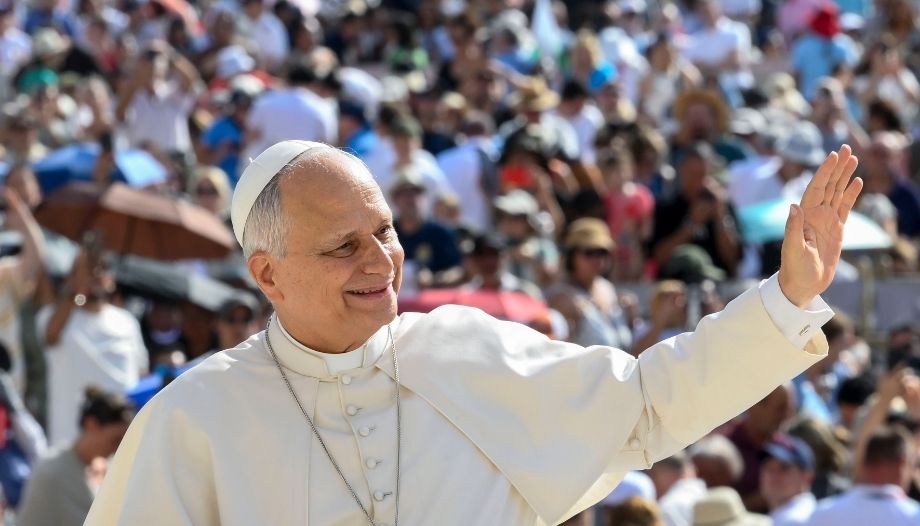
Wednesday’s General Audience, which began with the Holy Father taking a brief tour in the popemobile to greet thousands of Romans and pilgrims gathered in St. Peter’s Square, had a family-oriented atmosphere. Several readers in various languages congratulated the Pope on his birthday and on his name day tomorrow, Thursday the 17th, when the Church celebrates St. Robert Bellarmine.
Pilgrims from Nazareth, from Paris…
In addition, while last Wednesday’s event featured a Croatian translation, this time Slovak has been added. The Pope extended a special greeting to the group of pilgrims from Paris and to those from the Parish of the Annunciation in Nazareth.
He also mentioned saints from other countries, such as Saint Stanislaus Kostka. “I cordially greet the Poles, especially the pilgrims and seminarians from the Diocese of Płock, together with their bishop, who have followed in the footsteps of St. Stanislaus Kostka from Vienna, through Dillingen, to Rome.”
“In the year marking the third centenary of his canonization alongside Louis Gonzaga,” said the Holy Father, “let us not fail to pray for young people, so that, through the intercession of these patron saints, they may not be afraid to make courageous decisions in their lives, placing themselves at the service of God and their neighbor.”.
One Human Family
In its catechesis, the Pontiff continued his reflection on the Pastoral Constitution *Gaudium et spes*, saying: “I would like to address the topic of the human community. The Council reminds us that God “willed that all people should form one family and treat one another as brothers and sisters” (GS 24).”.
The Risk of Relying on Algorithms
"Technological development, the spread of the media and social media, and the ever-increasing use of artificial intelligence are opening up new possibilities, breaking down barriers and distances," the Pope continued.
On the other hand, however, relationships tend to become less and less personal and more virtual, and “there is a risk of getting used to delegating to algorithms decisions that should be made solely by human conscience.”.
In this context, the Pope would later recall that “these days, many Latin American countries are celebrating their national holidays. Let us ask the Lord that, as we cherish the identity of our homeland, the Gospel may open our minds and hearts to recognize that we are part of a greater divine plan, that we are part of the human family created by God.”.
May social relationships have personal depth
With these premises in mind, the Holy Father emphasized: “Giving social relationships real substance and personal depth is, in this sense, the contribution that the Christian community seeks to offer.”.
Later, continuing with the topic of the son of the human family, Leo XIV recalled in the Audience The teaching of *Gaudium et Spes*: The diversity of individuals and peoples throughout the world should not be viewed as a danger or a threat, but rather as a source of enrichment and growth.
Opening Up to Sharing and Caring
It is therefore necessary to “become increasingly open to the logic of reciprocity, sharing, and care, just as is the case among the different members of the human body (cf. 1 Cor 12:21–25).”.
At the same time, recalling the concise definition of the “common good” (“conditions of social life that enable associations and each of their members to achieve their own perfection more fully and more easily”), the Pope has emphasized certain ”practical consequences of the utmost urgency.“.
Respect for Human Dignity
This is the first point that Leo XIV emphasized, according to *Gaudium et spes*: respect for the human person.
– “Anything that threatens life—homicides of any kind, genocide, abortion, euthanasia, and even deliberate suicide”;
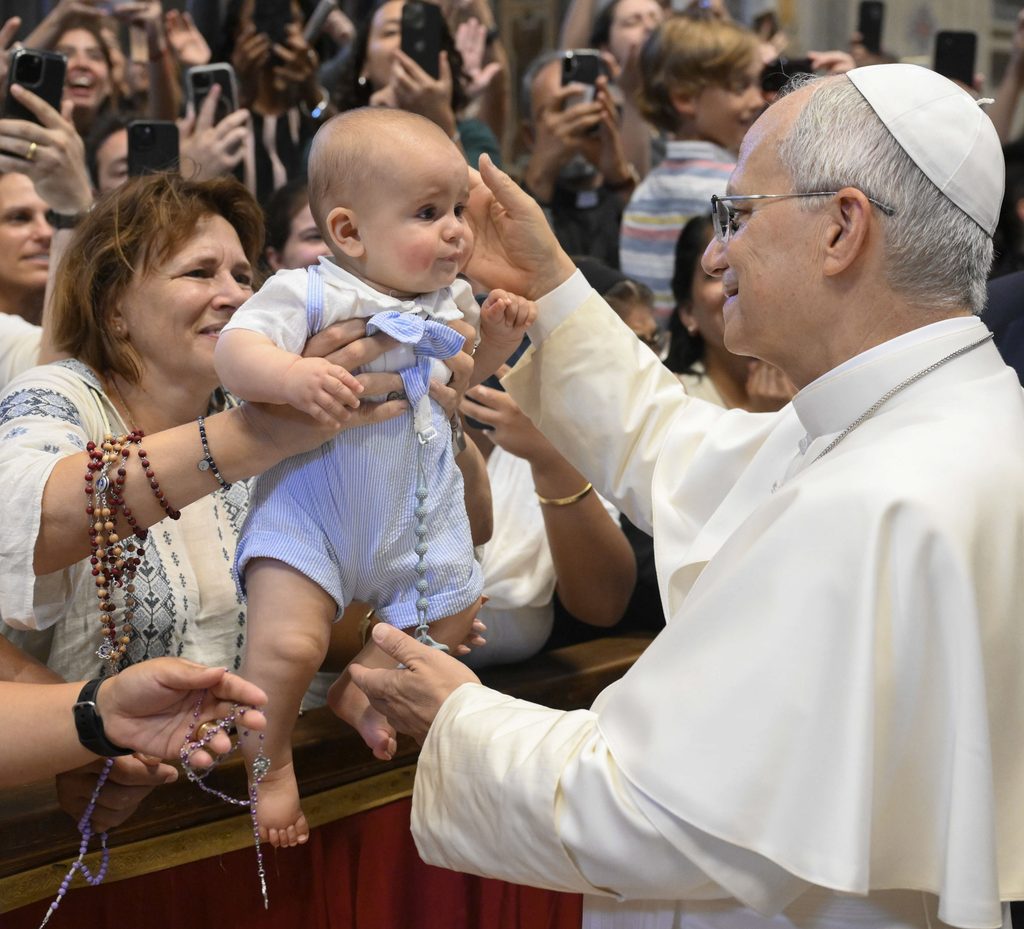
– “anything that violates the integrity of the human person, such as, for example, mutilation, mental or physical torture, and systematic attempts to control the minds of others”;
–” anything that offends human dignity, such as subhuman living conditions, arbitrary detentions, deportations, slavery, prostitution, and the trafficking of women and young people; or degrading working conditions, which reduce the worker to the status of a mere instrument of profit, without respect for the freedom and responsibility of the human person: »all these practices and others like them are in themselves shameful” (ibid.).”.
Respect for opponents and for those who think or act differently
The second consequence, the Pope has pointed out, is “respect and love even for one’s adversaries or for those whose ways of thinking and acting differ from one’s own (cf. GS, 28).”.
And third: the fundamental equality of all people, which demands social justice. The Document states: “Every form of discrimination against a person’s fundamental rights—whether social or cultural—on the basis of sex, race, color, social status, language, or religion—must be overcome and eliminated, as it is contrary to God’s plan.”
Finally, as he noted in English, the Council Fathers urge us to overcome an individualistic mindset and adopt an attitude of responsibility and participation (cf. GS, 30–31).
Humanity is a “community of people”
Dear brothers and sisters, as the Successor of Peter has concluded on this point, this vision of humanity as a “community of persons” is a valuable legacy left to us by the Second Vatican Council.
Evaluate social and political projects based on human dignity
This conception of the “human family” and the “community of persons,” “helps all of us to engage in personal and communal discernment, so that we may responsibly evaluate today’s social and political initiatives based on the criteria of human dignity, social justice, and free participation in building the common good,” the Pope noted in his closing remarks.
Because, he concluded, the future of humanity “depends on each person’s commitment to collaborate with God and with our brothers and sisters to build a more humane world (cf. GS, 30).”.






 Español
  English
  Italiano