


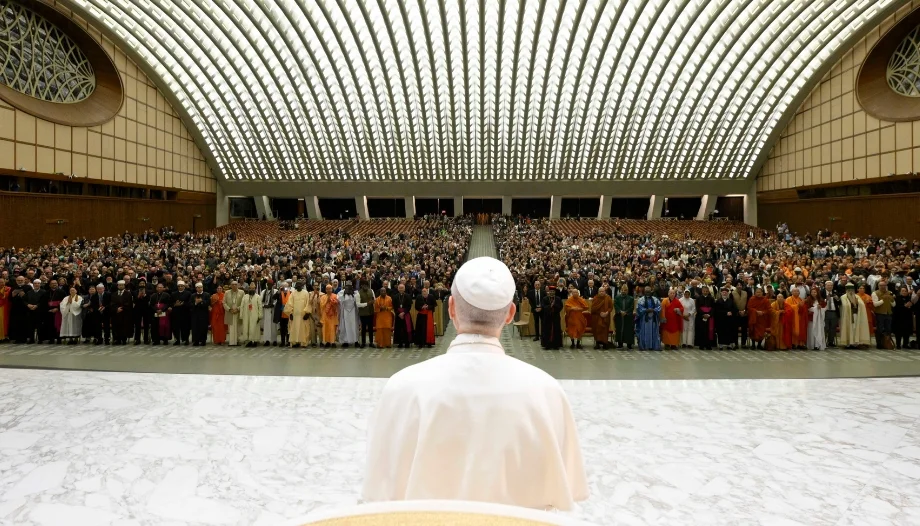
On October 28, 1965, amid the excitement surrounding the Second Vatican Council, the Catholic Church issued the Declaration Nostra aetate «On the Church’s Relations with Non-Christian Religions.» That brief but extremely bold text marked an irreversible turning point by affirming that the Church «rejects nothing that is true and holy in these religions» (NA 2).
Sixty years later, the Dicasteries for the Doctrine of the Faith, for the Promotion of Christian Unity, and for Interreligious Dialogue have jointly published the commemorative note «A Path of Hope.» The document, approved by Pope Leo XIV following his audience with the prefects and secretaries of the three dicasteries, is not presented as a bureaucratic report, but as a vibrant and urgent manifesto for a planet threatened by polarization, identity-based isolation, and the aftermath of war.
Jewish Roots and the Essential Remembrance of the Holocaust
The article recalls with journalistic and historiographical precision that Nostra aetate It did not begin as an academic exercise, but rather as a direct response to the horrific consequences of anti-Semitism and the Holocaust. The document recounts how St. John XXIII, deeply moved by his providential encounter with the Jewish historian Jules Isaac and thanks to the mediation of María Vingiani, commissioned Cardinal Augustin Bea to draft a text intended to heal relations between the Church and the Jewish people.
In its theological discussion, the Note emphasizes that Jesus was Jewish and never ceased to be so. Citing 20th-century theology, he asserts that in the Incarnation, the Word became «Jewish flesh.» For this reason, Jewish-Christian dialogue is neither a diplomatic option nor a secondary practice, but an intrinsic element so that the Church may understand its own identity, and an essential component of its mission.
God's covenant with the Jewish people is irrevocable (cf. Rom 11:29). At the same time, the text upholds the confession of Christ as the sole Redeemer. It clarifies that this does not imply advocating two parallel paths to salvation, but rather recognizing that Jewish religiosity as lived today remains an active value that enriches Christians. «What Jesus brought to Christianity as a Jewish heritage is part of the theological structure of Christianity itself» (A Path of Hope, 11).
Furthermore, the document reiterates its condemnation of anti-Semitism and highlights the memory of the Holocaust as a constant warning against the danger of racial and religious hatred.
A Masterful Symphony: From the «Logic of Assisi» to the Polyhedron Paradigm
The text offers an educational overview of the teachings of the last six popes, showing how dialogue became a way of life for the Church:
- St. Paul VI: He established the institutional framework for dialogue by creating the Secretariat for Non-Christians in 1964 and proposed in Ecclesiam suam the methodology of concentric circles of conversation with the world.
- St. John Paul II: He brought this insight to the world’s attention by convening the historic Assisi Meeting in 1986, where leaders of various religions prayed for peace from within their own faith traditions. He articulated the two inseparable requirements of the mission: unwavering fidelity to Jesus Christ and genuine openness to sincere dialogue. In his encyclical Redemptoris mIssio (1990) reaffirmed the enduring value of the missionary mandate. During his visit to the synagogue in Rome (1986), he referred to the Jews as «our elder brothers.».
- Benedict XVI: He linked dialogue to the demands of reason and truth, denouncing fundamentalism and violence committed in the name of God as a radical distortion of religion. He regarded the Jews as «fathers in the faith.».
- Francis: He ushered in the era of «universal brotherhood» as reflected in the encyclical Fratelli tutti. He introduced the polyhedron model and established an ethical compass for evaluating the authenticity of any religion: concrete attention to the wounded person on the side of the road and care for the poorest.
- León XIV: He reaffirms that «those who use God’s name to legitimize terrorism, violence, or war betray His image.» He proposes three key words for all dialogue: peace, justice, and truth.
Highlights, Shadows, and the Four Levels of Interreligious Dialogue
With remarkable realism, the Note does not shy away from existing resistance. It denounces the persistence of prejudice, the growing indifference in many countries toward any form of spirituality, the fear of doctrinal relativism, the resurgence of fundamentalism, the political instrumentalization of religion, and the severe persecution suffered by many Christian communities around the world.
First and foremost, it reaffirms the Council’s teaching in Nostra aetate: «We cannot invoke God, the Father of all, if we refuse to treat certain people—who are created in God’s image—as brothers and sisters. […] The Church, therefore, condemns as contrary to the spirit of Christ any discrimination or oppression based on race or color, social status, or religion» (NA, 5).
For its part, this Note states: «Dialogue presupposes a clear awareness of one’s own religious and cultural identity, together with a genuine openness to otherness, an indispensable condition for coexistence in pluralistic societies. It must be free of ambiguities, avoiding relativism and syncretism, while respecting the greatest possible identity and committing to the greatest possible dialogue» (A Path of Hope, 22).
In the face of challenges, the document highlights the quiet, everyday achievements through the four approaches outlined in the document Dialogue and Announcement (1991): 1) The Dialogue of Life: peaceful coexistence among neighbors of different faiths in towns and cities; 2) The Dialogue of Action: collaboration on projects related to justice, solidarity, and ecology; 3) theological dialogue: rigorous doctrinal exchange among experts; 4) The Dialogue on Religious Experience: the contemplative and spiritual communion fostered by monks and nuns.
That same document emphasizes that, since the proclamation of Christ is at the heart of the Christian mission, interreligious dialogue is not only compatible with this proclamation but also constitutes an essential and complementary dimension of it, serving as a channel for Christian witness.
In addition to those four levels, there are recent achievements such as the Women's Network for Interfaith Dialogue and an openness to fraternal discernment with those who are exploring new religious experiences.
Why Read This Note Today? A «Pedagogy of Hope»
Reading *A Path of Hope* is essential for theologians, educators, pastoral workers, and any reader eager to understand the key aspects of the current sociocultural landscape. The document categorically rejects the idea of creating a syncretic world religion that erases differences. On the contrary, it invites us to examine our attitudes in order to move from a logic of isolation to a culture of encounter.
This text shows that to talk It does not mean renouncing the truth or compromising one’s identity. Rather, it is the art of communicating with patience and courage, recognizing in those who are different a conversation partner and a fellow traveler.
«The dialogue that begins in the wake of Nostra aetate »—as the Note states—it is not merely a theoretical exercise, but a shared ethical and spiritual commitment, oriented toward peace, justice, and the care of our common home” (A Path of Hope, 35). It states that believers—united in some way—are witnesses to God’s love and are also capable of engaging in dialogue with everyone.
As for the pedagogy of dialogue, This entails, first and foremost, «a thorough formation in seminaries, theological institutes, and pastoral programs. It is no longer enough to proclaim the importance of dialogue: now we must live it out, providing the faithful with the tools to participate in it in an informed, critical, and serene manner.» Among the factors that foster and sustain interreligious encounter and dialogue, the following are cited: «knowledge of religions, the history of interreligious relations, the development of guidelines for dialogue, and the promotion of religious literacy (religious literacy)» just as it is necessary to integrate an understanding of contemporary cultural and geopolitical issues into Christian education (Ibid., 48).
As readers turn the pages, they will find in this document an antidote to disillusionment and a call to become «bridge-builders and peacemakers» in a world ravaged by violence.






 Español
  English
  Italiano