


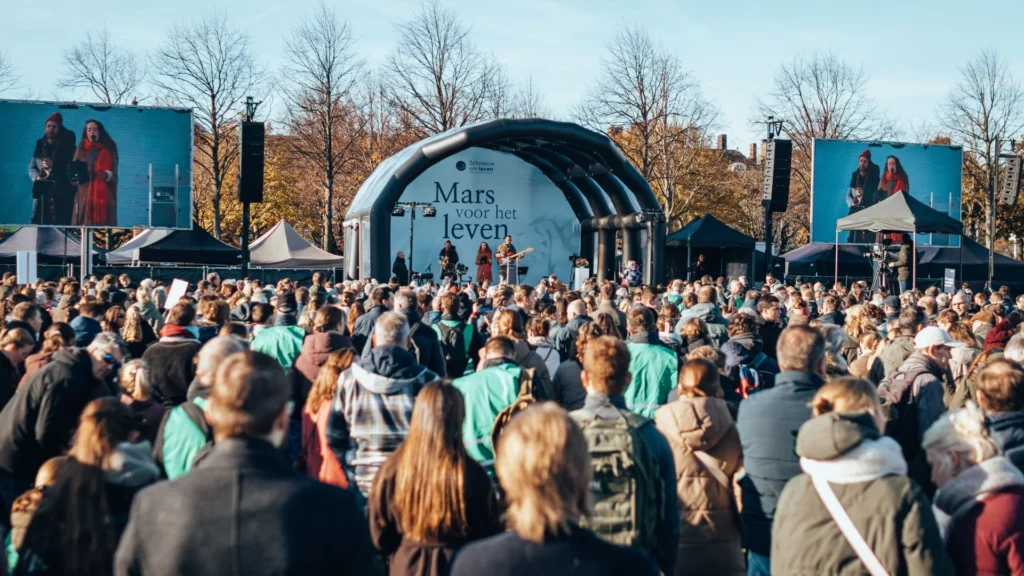
On Saturday, November 14, the 34th annual Dutch March for Life drew a record turnout of 15,000 participants, surpassing last year's 11,000, as citizens, families, politicians, and bishops converged on The Hague, the seat of Government in the Netherlands, to call for the protection of the unborn. The event has been organised by the pro-life group Schreeuw om Leven since 1992..
The historic mobilization comes on the heels of a rapid succession of ethical scandals that have alarmed pro-life advocates.
Just days prior, the Dutch Senate voted to permit the creation of human embryos for scientific research, while public tensions continue to simmer over commercial surrogacy and the nation's first documented euthanasia of a child under 12, a toddler who was 2 years old.
Additionally with national abortion figures nearing 40,000 annually, these developments have driven a renewed pro-life movement determined to defend human dignity at every stage.
Silence for the Voiceless
Speaking before the crowd, Schreeuw om Leven director Arthur Alderliesten presented an empty bookshelf from his office, which he calls his “silence shelf”, as a symbol that listening must precede speaking. He stressed the need to listen to women facing unintended pregnancies, voiceless unborn children, and God, he noted that “listening guards against overly simplistic statements or slogans” and enables genuine empathy.
Alderliesten also urged attendees to pair legal protection for the unborn with concrete care for mothers, saying “Today we say no to abortion and yes to good help and support for an unintended pregnancy; no to abortion and yes to unborn children.”
Afterwards the march made its procession towards the city centre. Participants carried black and yellow banners that read “For an abortion-free society” and “Every person is a marvel of creation. Children were also given little flags that read “I am the pro-life generation”.
In keeping with its character as a silent march, the procession moved through the streets without chants or shouted slogans, dedicating its quiet witness to the voiceless unborn. Along the route, some participants sang the Salve Regina and prayed the rosary in both Dutch and Latin for the lives lost due to abortion.
Signs of a Cultural Shift
Despite the Netherlands’ reputation as a pioneer of progressive bioethical policy, having legalized abortion up to 24 weeks in 1984, decriminalized altruistic surrogacy in 1994, while becoming the first nation to legalize euthanasia in 2002, signs of a cultural shift are emerging.
Roos Sparreboom, ProLife Europe's regional coordinator for the Netherlands, told Omnes that public consensus is beginning to soften toward the pro-life cause. “The pro-life movement is definitely growing”, she said, noting a surge in grassroots initiatives and closer cooperation among organizations.
During her recent appearance on a secular talk show examining Dutch euthanasia policies, she recalled that the hosts “were shocked to hear about a two-year-old who was euthanised”.
According to Sparreboom, most Dutch citizens are “pro-choice by default, without having spent much time examining why”. That passive consensus, she said, leaves room for minds to change when people are confronted with the concrete realities of abortion. “Most people aren’t radical,” she noted. “They don’t support abortion up to nine months, and they wouldn’t want to change the law to allow it”.
For Sparreboom, who leads student volunteers in regular public outreach sessions with ProLife Europe across Dutch cities and university campuses, reaching that passive majority requires secular arguments grounded in science and human rights rather than religious appeals. “People often assume our movement bases its arguments on religion,” she said, adding that passersby “are surprised when we make a secular argument and tell me it’s refreshing to hear one based on human rights rather than religion.”
Critics also frequently assume she is uninformed or was raised in a conservative household, when in reality she grew up pro-choice and took nearly five years to change her mind. Drawing on her own experience, Sparreboom noted that a single outreach conversation rarely shifts someone’s view overnight; instead, the goal is to spark reflection and encourage people to investigate the issue themselves.
Ultimately, she argued, cultural transformation must precede legal reform in Parliament. While roughly 85 percent of Dutch citizens currently support abortion in principle, Sparreboom maintained that legal bans alone are neither sufficient nor sustainable without genuine community support.
“Making abortion unthinkable means more than having laws that protect the unborn,” she said, calling on citizens to support women facing unplanned pregnancies “with love rather than judgment, and celebrating every life, regardless of the circumstances of conception.”
True cultural change, she stressed, demands shared responsibility, “We can’t make abortion illegal while ignoring women’s practical and emotional needs, including housing, financial support, and a caring community.”
Reaching a Generation Raised on ‘My Body, My Choice’
Meanwhile Irmgard Averesch, the General Coordinator of the Dutch Centre for Bio-Ethical Reform (DCBR), told Omnes that while many young people in the Netherlands grew up viewing abortion through a default pro-choice lens, they are often more receptive to open dialogue than older generations.
Because most young adults have mainly encountered “‘my body, my choice’ rhetoric on social media”, Averesch said pro-life volunteers are frequently the first opposing voices they ever meet in person. “By asking the right questions, we can encourage them to think more deeply about the issue and recognize that an unborn child is more than just a clump of cells”, she explained, adding that shifting youth perspectives will ultimately shape the country’s future direction and legislation.
At the same time, Averesch pointed to a growing willingness among young Christians to step forward, noting that most of her organization’s volunteers are young people who “recognize that they can no longer look away from this injustice”.
She warned that the broader Dutch pro-life movement suffers from a lack of visibility, with many believers treating the issue as a lost cause. “While pro-choice advocates will always try to discredit our movement, we should not allow fear of public opinion to silence us”, she said.
Addressing common stereotypes, Averesch said pro-life advocates are frequently cast as “women-haters who simply want to control women”, yet in-person conversations quickly dispel that image when people realize volunteers “genuinely care about women and their children”.
While urging advocates to approach others with love and compassion, she stressed that courtesy cannot mean silence when “every single day, 108 unborn children lose their lives in the Netherlands.”
Looking ahead, Averesch outlined a vision of a society that protects human life from conception to old age and “never presents death as the solution” to difficult circumstances.
Alongside legal protection for the unborn, she recommended practical support for mothers facing unexpected pregnancies and encouraging men to embrace fatherhood.
“Ultimately, we want to see a society in which abortion is no longer considered a normal or acceptable solution to an unexpected pregnancy, but rather becomes unthinkable”, Averesch said, where “every mother feels supported, every father takes responsibility, and every child is welcomed and protected”.






 Español
 English
 Italiano
 Français
 Deutsch
 Polski