



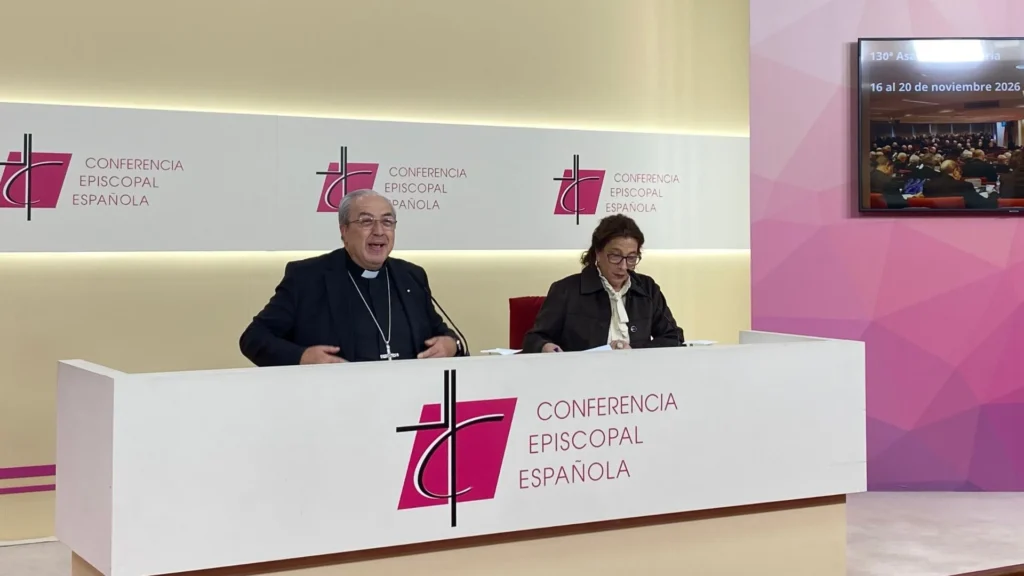
It concludes 130th Plenary Assembly The Spanish bishops held their meeting from November 16 to 20 at the headquarters of the Spanish Episcopal Conference (CEE). During these days, they addressed issues related to the pastoral life of the Church, the formation of priests, youth and family, and approved several documents and proposals.
At a press conference at the headquarters of the Spanish Episcopal Conference (CEE), the Secretary General, Francisco César García Magán, summarized the main issues addressed during the Plenary Assembly and explained some of the decisions adopted by the bishops. One of the first topics he addressed was the upcoming elections, releasing a statement from the Plenary Assembly.
The bishops call for voting according to conscience.
In anticipation of the upcoming general elections on November 29, the bishops have published a statement reminding everyone of the duty to vote according to their conscience, based on the recognition of the inviolable dignity of the person and the promotion of the common good, «the social form of human dignity.».
The Assembly has decided not to issue its own declaration on this matter, but to refer to the speech that Pope Leo XIV delivered last June 8th before the Cortes Generales. The bishops thus encourage people to read or reread their words in order to form a moral judgment in accordance with the Social Doctrine of the Church and to discern the decision involved in exercising the right to vote.
García Magán wanted to make it clear that «no political party is the party of the Church. And it would be appreciated if no one used the Church as a bargaining chip, or as a weapon in political debates or in the rhetoric prior to an election.».
«As we also stated in the press release, our roadmap, the roadmap of a Catholic, is the social doctrine of the Church. There are parties that, in some respects, may be closer to that social doctrine of the Church,» he added.
Changes to the Roman Missal and ecumenical agreement on Baptism
Another of the highlights has been the revision of the third edition of the Roman Missal in Spanish for Spain, in use since 2017. The modification, requested by the Plenary in November 2022, affects 369 prayers and two prefaces and seeks to combine fidelity to the Latin original with a clearer and more fluid expression in Spanish.
The approved revision does not constitute a complete new translation of the Missal. Among the agreed-upon changes is the reinstatement of the previous translation of the concluding formulas of the prefaces, considered simpler than the current ones. The text will now be submitted to the Dicastery for Divine Worship and the Discipline of the Sacraments for its approval. recognitio. Once received, the work will be published by Liturgical Books as a «third amended edition in Spanish for Spain».
The Plenary Assembly also approved the signing of a Mutual Recognition Agreement for Baptism with the Spanish Evangelical Church (IEE). The document recognizes the validity of Baptism administered by this community and is the result of work initiated in February 2026.
A team of four theologians—two Catholic and two Protestant—appointed by the Episcopal Subcommittee for Interconfessional Relations and Interreligious Dialogue and the president of the Permanent Council of the IEE, Pastor Alfredo Abad Heras, was formed to draft the agreement. Church authorities from both denominations will soon set a date for the public signing.
Synodality and the pastoral guidelines of the CEE
The synodal approach of the Episcopal Conference was another topic addressed at the press conference. According to García Magán, the bishops participated in a session of «conversation in the spirit,» beginning with presentations by Bishop Luis Argüello and Bishop Francisco Conesa, the Spanish Episcopal Conference's designated representative for the Synod. Subsequently, divided into working groups, they formulated three agreed-upon suggestions, which were then shared in a plenary session.
Conesa also offered guidelines for dioceses to incorporate the Diocesan Assemblies evaluating the Implementation Phase of the Synod into their pastoral plans. The work will conclude in June, with the aim of compiling its conclusions into a document to be presented to the Synod Assembly of the Episcopal Conference, scheduled for November 20, 2027.
Furthermore, the Plenary ratified the updated action plans of the Commissions, Subcommittees, and Offices of the Spanish Episcopal Conference (CEE), incorporating the implications of the speeches and homilies of Leo XIV during his apostolic journey to Spain from June 6 to 12. All these texts will be compiled into a joint document.
A lay ministry at the service of charity and seminary formation
Among the projects presented, the document from the Episcopal Commission for Evangelization, Catechesis, and the Catechumenate stands out, outlining the proposal to create a lay ministry dedicated to charity. This text, prepared in conjunction with the Commissions for Liturgy and for Social Pastoral Care and Human Development, will continue to be developed with input from the bishops and will be presented again at the next Plenary Assembly.
Progress has also been made on the renewal of the Training Plan for Minor Seminaries in Spain, which began in 2024. The Episcopal Subcommittee for Seminaries has presented the current state of the project, which has the guidelines of the Advisory Council of Rectors of Minor Seminaries and to which the suggestions of the bishops will be incorporated.
Furthermore, reflection will continue on the existing resources and services for the care and support of priests, an initiative of the Episcopal Commission for the Clergy and Seminaries.
The PEJ, World Youth Day in Seoul, and a new national youth gathering
Youth also had a prominent place at the Assembly. The Episcopal Subcommittee for Youth and Childhood reported on two major events planned for the summer of 2027: the European Youth Pilgrimage to Santiago de Compostela, from July 15 to 18, and the World Youth Day Seoul (South Korea), which will take place from August 3 to 8.
In addition, the bishops have endorsed the first steps to convene a national youth gathering under the name «Young Agora 2028».
In the missionary sphere, Bishop Joseba Segura has raised the importance of sending priests Fidei donum to Latin America, both because of the need to ensure the generational replacement of Spanish missionaries and because of the requests that continue to arrive from sister churches.
The crisis of democracy, the topic of the next Social Week
The Episcopal Commission for Social Pastoral Care and Human Promotion has presented the preparations for the XLV Social Week of Spain, which will be held in Zaragoza on November 5 and 6, 2027 under the title «The crisis of democracy».
The presented working guide will serve as support for the diocesan Social Weeks that will take place in the preceding months. In addition to this work, the bishops were briefed on the Report on Hate Crimes in Spain during 2025, prepared by the Office of Religious Freedom of the Spanish Episcopal Conference.
The 60th anniversary of the Episcopal Conference
The Assembly was also marked by the 60th anniversary of the founding of the Spanish Episcopal Conference. To commemorate this anniversary, a ceremony was held on Tuesday, November 17, which was attended by the Apostolic Nuncio to Spain, Archbishop Piero Pioppo.
The inaugural session, on Monday the 16th, was presided over by the speech of Monsignor Luis Argüello, who addressed four issues: the trip of Leo XIV to Spain, the situation of Spanish society in the face of the upcoming elections, the challenges of marriage and the family and the six decades of history of the CEE.
For his part, the nuncio recalled the Pontiff's visit and conveyed the Pope's message of condolence to the victims of the Urda train accident, expressing the Assembly's closeness to the families of the deceased and wishing a speedy recovery to the injured.
In economic matters, the bishops have approved the budget for the Interdiocesan Common Fund and the Episcopal Conference for 2027, as well as the budget for the communications campaign that will support next year's Marriage Week. They have also received information on the revision of the Economic Regulations of the Spanish Episcopal Conference.





 Español
 English
 Italiano
 Français
 Deutsch
 Polski