


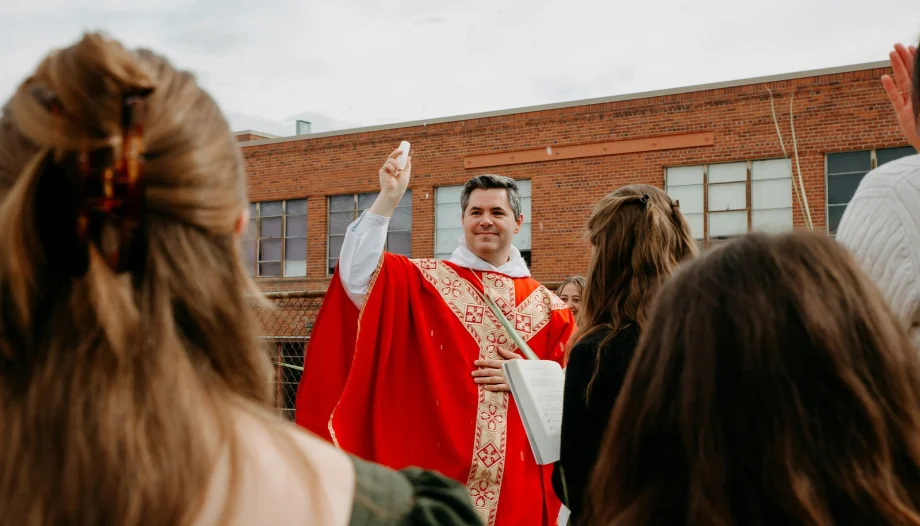
A phenomenon I've encountered on several occasions, both in parishes across Western Europe and among parishioners in various places, is the tendency to reduce the priest's importance to a transient figure in our communities. This is clearly seen in a phrase that, surprisingly, is heard more often than we realize: «The priest will leave, but we'll stay here.».
The phrase is whispered in the corridors of far too many parishes. Those who utter it are usually seeking a sense of belonging, a way to assert the stability of the community in the face of diocesan relocations. Despite this seemingly harmless reason, a symptom of having extrapolated to the Church the logic of the provisional that dominates our world lies hidden. It is this same mentality with which marriage is viewed today through the lens of «well, you never know, maybe one day you'll get divorced.» Applied to the parish, we parishioners assume the role of permanent owners of the house and relegate the priest to the status of a temporary administrator, a functional element who is here today and we'll see about tomorrow.
It is true that, often, behind that «we're staying here» lies a wound. Many communities have suffered hasty relocations, pastoral styles that contradict each other every few years, or priests who arrive eager to demolish what came before without listening to the living memory of the place. This historical weariness creates a defensive trench. But understanding the community's fatigue is one thing, and justifying a permanent attitude of impermanence is quite another.
No one would think a husband truly loves his wife if he treats her like a mere domestic helper while his own life unfolds on the sidelines. Something similar happens in various parish communities, and this perspective has a direct impact on the vocations crisis. Because while vocations are recognized thanks to the faithful witness of priests, the utilitarian attitude of parishioners can ultimately generate rejection or confusion.
Today, as demographic analyses from agencies such as Rome Reports, A single priest often serves several churches simultaneously and is overwhelmed by the logistics. Much to his dismay, he cannot be as present as he would like in the daily interactions. And this is where a disconnect occurs: a shy young man, or one with a subtle yearning in his heart, observes a priest overwhelmed, rushing from one task to another. Unable to get to know him personally due to this lack of closeness, this young man ends up mythologizing him. He perceives him as a distant, almost mythical figure, or as an inaccessible administrator. And this caricature is completely at odds with the genuine calling that the Holy Spirit has kindled within him.
This is where what we might call a ‘vocational dysphoria’ takes hold: everyone thrown off balance. On one hand, lay people who confuse co-responsibility with occupying clerical spaces or reducing the parish to a social space; on the other, the mystery of the priesthood hidden behind a wall of paperwork and haste.
To shatter this distorted mirror, we parishioners have a precious mission that goes far beyond mere administration: to rediscover and safeguard the dignity of the priest. When we, the laity, maturely assume our own responsibilities in the world and in the day-to-day running of the community, we restore our priests to their rightful place. By stripping them of that mythological prism or the cold distance of the bureaucrat, we allow the young man who may have been pondering a personal calling for some time to discover the man of flesh and blood behind it: an approachable man, focused on the sacred, with his limitations, but radically consecrated to God. And it is precisely in this genuine encounter, free from institutional caricatures, that the young man can finally see himself reflected and understand that this vocation is not an unattainable ideal, but a possible commitment.
Because when you scratch the surface of any parish organizational chart, the essential question remains: Who is going to hear confessions?
We can entrust accounting to the best economist in the neighborhood and catechesis to brilliant theologians, but no layperson can consecrate the Eucharist or pronounce in the dim light of the confessional those words that sustain the world: «I absolve you from your sins.» The priest is not among us because of an operational division of tasks, but because of ontology: he is the living icon of the Bridegroom, the man taken from among men to be a bridge to eternity.
When it comes down to it, what truly defines a priest is not his managerial skills, but what he contributes day after day. He is the shepherd who sits and listens to a young person's doubts in a church pew, the one who holds the hand of the sick in their darkest hour, or the one who reconciles us with God in the confessional. His presence is irreplaceable. Respecting his identity, protecting his time for what is essential, and allowing him to be a father and guide is the best way to care for our own community and to open the door for those who will one day take his place at the altar.
Journalist.





 Español
 English
 Italiano
 Français
 Deutsch
 Polski