


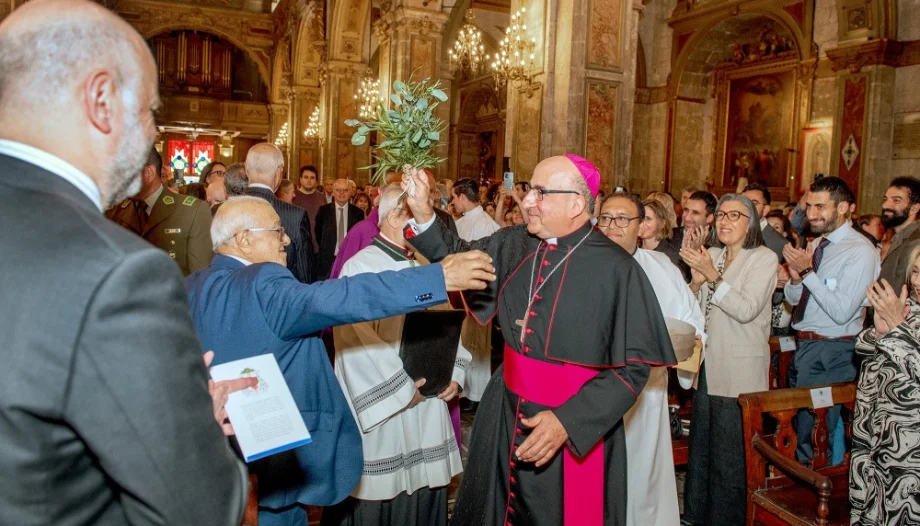
 Cardinal Chomali: "Jesus Christ lets himself be seen where no one wants to go".
The Archbishop of Santiago de Chile, Cardinal Fernando Chomalí, This year he has written letters to families, teachers, young people and businesspeople, and recently he has addressed Chilean politicians.
He begins by pointing out that in the individualistic culture in which we are immersed, he values the fact that there are people who have decided to enter the sphere of politics, because «it implies approaching the reality of the country not as mere spectators, but as relevant actors, willing to dialogue and exchange points of view with people who think differently and who, in many cases, come from very different realities, but who share the noble purpose of improving the living conditions of the community.».
But he clearly makes it clear to them that «it hurts to see signs of corruption in those who should be role models for the public. It also hurts to see the climate of polarization in which some of you find yourselves, as well as the widespread insecurity in parts of the country. It is equally unjust and outrageous to resort to bot networks to spread falsehoods and distort public opinion.»
He also tells them that he observes «with concern that trust in institutions and in those who hold public office has weakened considerably. This is very serious, given that trust is one of the most valuable assets of a democracy. It is built day by day and, to be effective, requires mutual respect and sincere dialogue. When it weakens, not only does the image of institutions deteriorate, but it also becomes more difficult to cooperate, accept decisions, reach agreements, and recognize the dignity of others.".
Promoting mutual trust is fundamental and requires a constant commitment from everyone, to ensure that agreements are honored, that promises are valued and respected, and that corrections – when necessary – are made privately, so as not to inflame tempers or create tension.»
To avoid misinterpretations, he clarifies that «the Church is not motivated by partisan interests, for, as Pope Benedict XVI taught, “the Church is not and does not wish to be a political agent.” Pope Leo XIV recently reminded us of this, echoing the reflections of the Second Vatican Council: “The mission of the Church is also accomplished by contributing to the building up of the earthly city. However, her methods and her aim are not primarily political in nature, but consist in the witness of faith and charity, together with a commitment to justice, peace, and fraternity.””.
He reminds them that whoever assumes public office enters into a fiduciary relationship with the community: they are entrusted with something that does not belong to them—the common good, everyone's resources, the destiny of a people—and therefore must be accountable for their administration. «It is the logic of the faithful administrator who is not asked for success, but for fidelity to what has been entrusted to them. Trust, then, is not a reward for efficiency, but the natural response to a public life lived with loyalty. This loyalty becomes visible in five concrete points:
a) Life consistency
b) The fulfillment of promises.
c) Respect for agreements.
d) Transparency
e) The willingness to engage in dialogue.»
It concludes with the «Beatitudes of the politician» proposed by the Vietnamese cardinal Nguyễn Văn Thuận:
«Blessed is the politician who has a high regard and a deep awareness of his role.".
Blessed is the politician whose person reflects credibility.
Blessed is the politician who works for the common good and not for his own self-interest.
Blessed is the politician who remains faithfully consistent.
Blessed is the politician who brings about unity.
Blessed is the politician who is committed to bringing about radical change.
Blessed is the politician who knows how to listen.
Blessed is the politician who is not afraid.»





 Español
 English
 Italiano
 Français
 Deutsch
 Polski