


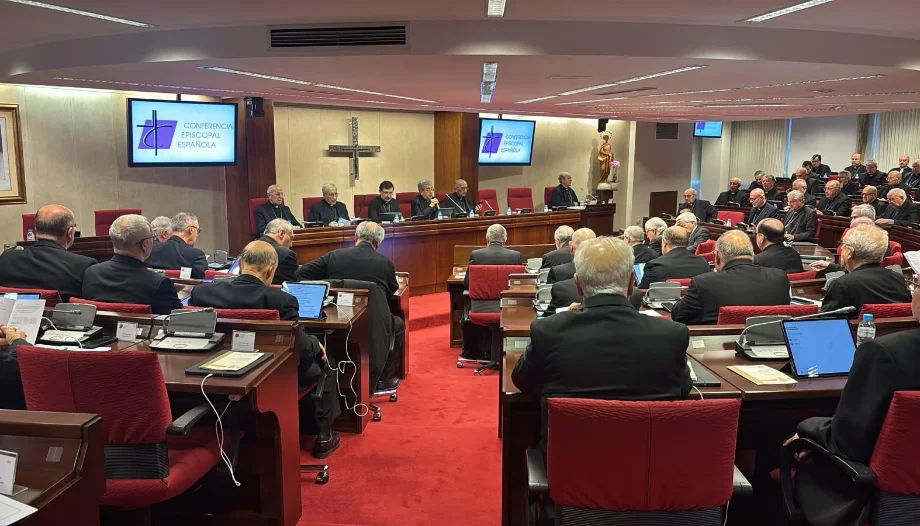
The Archbishop of Valladolid and President of the Spanish Episcopal Conference, Monsignor Luis Argüello, was in charge of opening the 130th plenary meeting of the Spanish bishops.
The first part of the opening address of this plenary session focused on Pope Leo XIV's recent trip to Spain. At this point, Argüello recalled three key themes of the Pontiff's message in Spain: Jesus Christ, human dignity, and synodal listening—the Church on a journey—which the Pope reiterated in different ways during his five-day visit.
Furthermore, the president of the Spanish bishops emphasized that “the poor have been the reference point for the historical, cultural, economic and political judgment that the Pope has made in a genuine exercise of the social doctrine of the Church.”.
“This journey has allowed us to contemplate the beauty of Catholicism: the beauty of a heart that moves through all the intimate, relational, and institutional dimensions of the person; the beauty of the universal and particular Church; the beauty of a public presence that embodies charity in dialogue with society,” stated Arguello, who brought up, in a special way, the message that the Holy Father addressed to the Spanish bishops. Leo XIV warned the bishops about three temptations: “to remain anchored in what we have left behind, to carry unnecessary baggage, and to lose roots and ties.” Along with this, the Pope asked them for “missionary creativity, to build new realities, to use new languages, and to draw inspiration from the great historical models of evangelization,” based on the Eucharist and the Word.
To form in vocation and lay vocation
One of the requests that the Pope made to the Spanish bishops, and which has been recalled as key in this opening of the Plenary Assembly, was to focus seminary formation on “the person with a vocation rather than on structures, to ensure solid formation, and to work together among dioceses. He also asked us to value the laity as a vocation and not just as a function, fostering their ecclesial belonging and a shared mission.”.
He also had words for those who have been hurt, especially due to the problem of abuse in ecclesial settings, for whom the Pope called for “special attention to the victims of abuse: listening, justice, reparation and prevention.”.
A society without identity
Having concluded his remarks on the Pope's visit to Spain, the president of the Spanish bishops addressed the current social situation in Spain. He began by alluding to what he termed, in the words of Oliver Roy, a global deculturation, devoid of identity, in which “the fragmentation of social bonds and the rise of hysterical aggression, full of disenchantment, rage, and indignation, appear as side effects of our greatest discovery: the dignity of each person, the freedom of the individual.”.
The Church is a beacon today
If the liberal model of political representation is in crisis, Argüello asked, a few days before general elections in Spain, “on what can a strong political stance be based, that is, one that affirms the legitimacy and the desirable character of that which sustains the social bond?”.
In a society where everything seems to be falling apart, “the Church is now a beacon. The reception of the pontificates of Francis and Leo XIV demonstrates this, as does the re-reading to which we are invited by Benedict XVI, previous Popes, and the Council. This doesn't mean that people will necessarily convert or reconvert; nor that the beacon is without its blemishes. But a light is needed to illuminate and guide in a world dominated by high technology.”.
But this position of reference for the Church requires a real commitment and avoiding a “double life: affirming and claiming certain ends and means in the temple and in sermons, and living in family, social and public life, both in ends and means, according to the dominant codes and norms.”.
Marriage and family, the unavoidable challenge of the Church
The final major part of this speech revolved around the challenges facing the Church in accompanying and caring for marriage and the family. In this regard, the president of the Spanish bishops echoed the recent meeting on the tenth anniversary of Amoris Laetitia, in which “the various interventions highlighted the pressure of a global cultural trend that affects, with varying degrees of intensity, almost everyone—the deinstitutionalization of married life, the dramatic decline in birth rates, and breakups. This calls for a Catholic response that is comprehensive and universal, but one that is incarnated in each specific Church and society.”.
“One of the ideas that resonated most at the meeting was that marriage is a vocation and must be proclaimed, discerned, prepared for, and accompanied before and after the sacrament; or, family ministry is not a secondary task, but an essential dimension of a Church called to be home, companionship, and hope,” continued Argüello, who emphasized the need to act “neither from indifference nor from condemnation, but by offering the Christian ideal gradually, accompanying people toward the fullest and most meaningful celebration of the sacrament possible.”.
“The Church usually arrives late to each couple’s story.”
Bishop Argüello's speech touched on one of the Church's greatest challenges today, a challenge that, in many places, continues to lack realism, energy, and concrete proposals. Bishop Argüello emphasized the need to “walk with people in their concrete stories, because accompanying families is accompanying life. It is not a matter of choosing between doctrine and mercy, nor between ideal and reality, but of proclaiming that faithful, fruitful, and merciful love is still possible.”.
Therefore, he pointed out the “shifts” requested from Rome for the entire Church in the pastoral care of marriage and the family: moving from a pastoral approach focused on events to one focused on processes; moving from a pastoral approach for families to one with and from families; moving from the “classification of situations” to personalized discernment; and moving from a language that risks exclusion to the language of witness. The Church often arrives late to people's lives, Arguello himself noted, and this needs to change.
It is a long and complex path in which, as the Archbishop of Valladolid has emphasized, “questions remain open: how to accompany the diversity of situations without diluting the truth of marriage, how to unify criteria for discernment, how to train companions for long processes, how to respond to digital culture and precarity, how to rebuild the transmission of faith and how to truly involve the laity in the mission of the Church.”.
The EEC will review its Economic Regulations and create a new Vice-Secretariat for Legal Affairs
The Spanish Episcopal Conference celebrates its 60th anniversary this year. To mark this occasion, Argüello emphasized that this plenary session will evaluate the Conference's operational experience to identify areas for improvement in its daily functioning and meetings, as well as to ensure that “decision-making on pastoral matters is more synodal and collaborative.”.
He also announced that “in this Plenary we will review the Conference's economic regulations and take the first steps towards the creation of a new Vice-Secretariat for Legal Affairs.”.
For his part, the Apostolic Nuncio to Spain, Archbishop Piera Pioppo, began his address with a heartfelt remembrance of the victims of the Urda train accident, and emphasized that “the Assembly that is beginning makes visible the effort to carry out a revitalized and enthusiastically oriented pastoral ministry,” encouraging the bishops to continue their mission, which he acknowledged on this 60th anniversary.





 Español
 English
 Italiano
 Français
 Deutsch
 Polski