


 When the missionary Prevost spent the entire night in prayer, on the eve of taking possession as bishop“Injustice is not overcome with brutality, but with prayer and patience,” the Pope says.
Pope Leo XIV denounced the devastation wrought by indiscriminate deforestation and water pollution in the Peruvian Amazon, caused by illegal mining and oil spills. These events, he stated in Pucallpa, “are not random accidents, but rather the bitter fruits of the arbitrary exploitation of natural resources that undermines the very existence of the population.”.
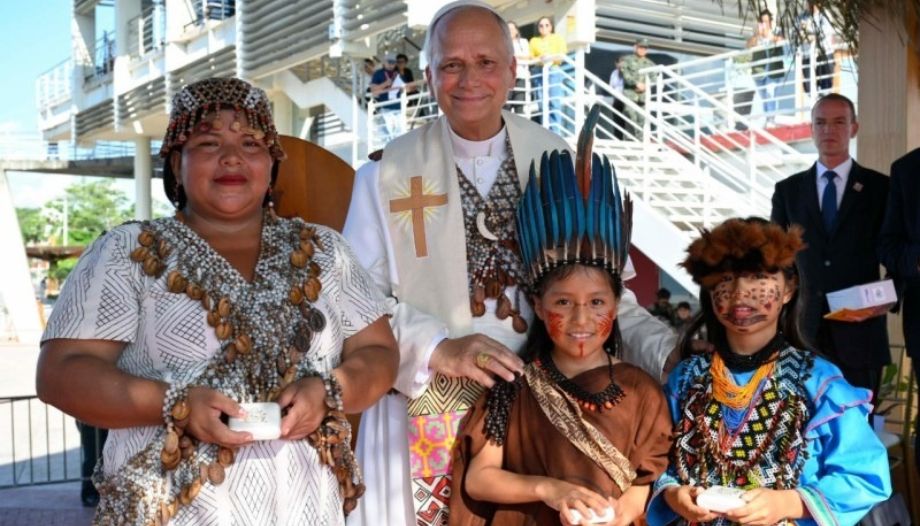
His closeness to the people and missionaries of the Peruvian Amazon has been evident. “Christ never abandons us! Christ is with you! The Church is with you and you are its members! We are the body of Christ!” he exclaimed at a meeting with missionaries, representatives of indigenous communities, and other pastoral agents in the heart of the Peruvian Amazon.
Not a simple “reserve of resources to exploit”
In its speech, The Pope proposed developing a model of integral ecology to counter the view of the Amazon as merely a “resource reserve to be exploited.” He explained that this is an alternative vision, “rooted in the Gospel and respectful of the wisdom of the peoples,” that would allow us to overcome economic exploitation and protect both nature and those who inhabit these territories.
Leo XIV arrived in Pucallpa, a city he described as a “red earth,” following in the footsteps of Francis and his visit to Puerto Maldonado. “I have come as a shepherd to listen to your stories and to walk alongside you,” he stated. The purpose of his presence has been confirm to the communities “in faith and hope,” and to support them “in the search for justice and peace, which these lands so desperately need.”.
Proximity to the Church
The Church's closeness to these communities has been a central theme of the speech. Leo XIV recalled that his years as a missionary and bishop in Peru taught him “what it means for the Church to walk alongside humanity to faithfully serve the Lord.” He considers this a necessary condition for becoming like Jesus Christ and following him in the specific circumstances of each place and time.
The Pope wanted to expressly recall Francis‘ dream for this land, contained in the apostolic exhortation 'Dear Amazonia’: “I dream of an Amazon that fights for the rights of the poorest, of the native peoples, of the least, where their voice is heard and their dignity is promoted” (n. 7).
“Exploitative logics”
However, the Pope warned that the reality of these peoples reveals wounds that have not only failed to heal, but have worsened. “The cry of the earth and the cry of the poor rise together, unmasking market logics and exploitation that threaten the very balance of creation,» he stated.
In this regard, he stressed that the protection of the Amazon rainforest cannot be separated from concern for its inhabitants. “Integral ecology, social justice, and spiritual life go hand in hand,” he noted, quoting the encyclical. Laudato si' of Pope Francis.
A Church with an Amazonian face
Leo XIV also highlighted the efforts of the Ecclesial Conference of the Amazon (CEAMA) and the Pan-Amazonian Ecclesial Network (REPAM), aimed at “increasingly shaping a Church with an Amazonian face”.
In this regard, he recalled that the Vicariate, The parish, “as large as entire countries,” has only twenty-five priests. For this reason, he expressed his gratitude to those who “with heroic fidelity safeguard the faith in the most remote places.”.
Indigenous leaders assassinated
The Pope's address also included testimonies heard during the meeting, which reflected the vulnerable situation of the communities. The first, from a woman, recalled that even defending one's own territory can cost one's life. In recent years, numerous Indigenous leaders have been murdered for protecting their lands and communities, and she cited the figure of 37.
The Pope referred to these murders with particularly forceful words: “The blood of these brothers cries out to God and demands justice from men.”.
Without access to health and education
The second testimony came from a lawyer. He highlighted the difficulties in accessing fundamental rights. The Pope considered it “unacceptable” that numerous communities are denied access to healthcare and education due to physical distances and the neglect of institutions.
She also expressed concern about the vulnerability of women, girls, and adolescents, as well as the situations of violence and sexual abuse they suffer. These are deep wounds, she noted, that are often aggravated “by the silence of complicity and impunity.”.
In the face of corruption and arbitrariness, the Gospel must break forth “as an even stronger call to personal and communal conversion,” offering hope of healing, comfort, and reparation.
An alternative to resource exploitation
The proposal for integral ecology, mentioned above, occupied a central place in the speech. Leo XIV denounced the tendency to consider this immense region as a reserve of natural resources at the service of economic exploitation and defended the need to develop a different paradigm.
“We must counter this model —with tenacity and open-mindedness— with integral ecology, an expression of the civilization of love,” he stated.
The Pope presented this ecology as an alternative vision, inspired by Jesus Christ and his Gospel, which recognizes the close connection between the different realities of creation and respects the knowledge and wisdom of the Amazonian peoples.
Social Doctrine of the Church
Faced with these challenges, the Pope emphasized the importance of the Church's social doctrine, which allows us to “read the signs of the times under the guidance of the Holy Spirit.“ He explained that ”the ancestral knowledge you possess can be combined with the Church's heritage of wisdom in order to contribute to the protection of your rights, acquired over generations.".




 Español
 English
 Italiano
 Français
 Deutsch
 Polski