


- Francisco Otamendi
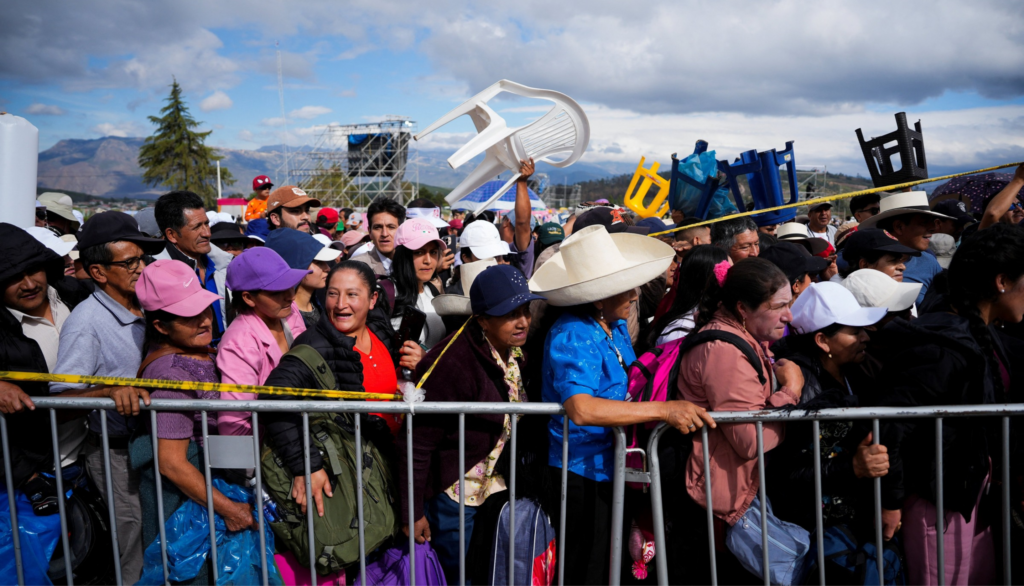
Nearly one hundred thousand people, mostly of Andean origin, attended the Pope's Mass in Santa Cruz de Succhabamba, located in the western mountain range of the Peruvian Andes, in the province of Santa Cruz de Cajamarca.
The Vicar of Christ arrived in the town by helicopter from Chiclayo. During the Eucharist, he began his homily explaining: “We are located among steep hills, ravines and fertile valleys, in a land of Andean roots, where the Inca Empire flourished, and the cradle of a deep Christian faith.”.
A pilgrimage of faith
Then he acknowledged the effort of those who traveled there: “The path you have traveled, besides being a journey along difficult routes, is a pilgrimage of faith. Each step and each effort, in effect, expresses a single desire: to find Jesus, venerated here in the image of the Lord of the Side, to hear his Word, to receive his Body and Blood and, nourished by that food, to be strengthened in hope.”.
Evangelization by the first missionaries
The Pope recalled the missionaries who arrived in the region five centuries ago “without provisions or recommendations” to proclaim Jesus and love for the Lord of Miracles of Andabamba and his Immaculate Mother. Toribio de Mogrovejo Even the Martyrs of Chimbote, he pointed out, the seed of the Gospel has borne fruit “in a discreet way, far from applause and great recognition.”.
The result, according to Leo XIV, is a “simple and genuine” faith, sustained by traditions and festivals that unite peoples and generations. He quoted Saint Paul VI to describe Andean joy as a reflection of “a thirst for God that only the poor and simple know.” And also Pope Francis, who saw in popular piety a powerful force for evangelization. This religiosity, he added, values the land, honest work, and family, and offers an antidote to superficiality and consumerism.
“If Jesus decides to come to Santa Cruz, he will find faith. Thank you for your testimony, thank you for your faithfulness to the Church.”.
The Parable of the Widow
The core of the homily was the parable of the widow before the unjust judge, as recounted in the Gospel of Luke. Leo XIV summarized it thus: “In the Gospel we have heard Jesus speak of a widow, a symbol of social vulnerability and dependence within the cultural context of the time. Defenseless and oppressed, the poor woman persistently pleaded for justice from a judge who, without fear of God or respect for humankind, remained indifferent to her pleas. Only through her perseverance did she finally obtain justice.”.
Pray without getting discouraged
“According to the words of Jesus, the parable reminds us, above all, how important it is to pray without ever becoming discouraged,” the Pope pointed out.
The story is also an invitation to open our eyes to the suffering of others, because “the widow’s plea continues to resonate today, unheard, in many people.” The Holy Father linked it to problems in the region: forced migration to the large coastal cities, the lack of generational replacement due to low birth rates, which is emptying villages, and the challenge of equitably distributing the benefits of the land’s resources.
Faced with these difficulties, he acknowledged that there is a temptation towards discouragement, resentment or violence, but warned that this “will never be the path to progress and peace.”.
Injustice is overcome with prayer and patience
The Pope then delivered one of the day's central messages. “The widow in the parable shows us that selfishness, injustice, and evil are not overcome by brutality, but by prayer, patience, and perseverance in denouncing what is wrong, by fervently asking and diligently working to bring about the necessary changes, without ever losing faith in God. Then, as happens on the summit of Cerro Cotorumi, through the cross one sees heaven.”.
Faith, prayer, and action
“There is a close link between faith, prayer, and action,” Leo XIV stated. “Where there is faith, there is prayer, and where there is prayer, there is a capacity for commitment to others. You, inhabitants of these lands, know this well. Despite many difficulties, you have never lost faith in God, nor, with His help, in yourselves.”.
The Pope praised those who, with ingenuity and entrepreneurial spirit, strive to provide dignified work, specifically farmers, merchants and small business owners, and presented them as promoters of authentic integral human development, with a reference to his encyclical ‘Magnifica humanitas’.
A message of hope
In the final part of his address, the Pope assured those present that the Lord knows their ways, their weariness, and their worries; that He understands the hopes of the young, inspires the wisdom of the elderly, and does not abandon them. He summarized it in three phrases: “When the soul wanders aimlessly, He is the way. When strength is lacking, He is the nourishment. When discouragement arises, He is the one who rekindles hope.”.
Just before giving the blessing, the Pope said, referring to Sunday's Gospel: “If Jesus decides to come to Santa Cruz, he will find faith. Thank you for your witness, thank you for your fidelity to the Church.”.
Coronation of the Immaculate Conception in Chiclayo
Earlier in the morning, before departing from Chiclayo, Leo XIV presided over the [event/conference/etc.] in the Cathedral of Santa María de Chiclayo. coronation rite of the image of the Immaculate Virgin. And in a very personal prayer, Leo XIV addressed the Virgin with filial affection: “Beside you I learned to be a shepherd of Chiclayo.” He also entrusted to her “my life and my ministry as Successor of Peter,” and asked her to protect the People of God who journey in those lands.
The Pope recalled that this temple witnessed the first steps of his episcopal ministry in service to the Diocese of Chiclayo, and expressed his gratitude. The crown he placed upon the image, he explained, symbolizes the homage of gratitude and filial love that the Pope, along with the faithful and the entire Church, pays her, recognizing her as the solicitous Mother and Protector of Chiclayo.
Addressing the people of Chiclayo, the Pope said that devotion to the Immaculate Conception is part of the Christian roots that shape their identity and strengthen their faith, and he invited them to continue walking together as one family of God, yearning for a world marked by love and compassion, forgiveness and the pursuit of justice.
Before concluding, Leo XIV ended with a prayer to the Heavenly Mother.




 Español
 English
 Italiano
 Français
 Deutsch
 Polski