


 When the missionary Prevost spent the entire night in prayer, on the eve of taking possession as bishop“Injustice is not overcome with brutality, but with prayer and patience,” the Pope says.
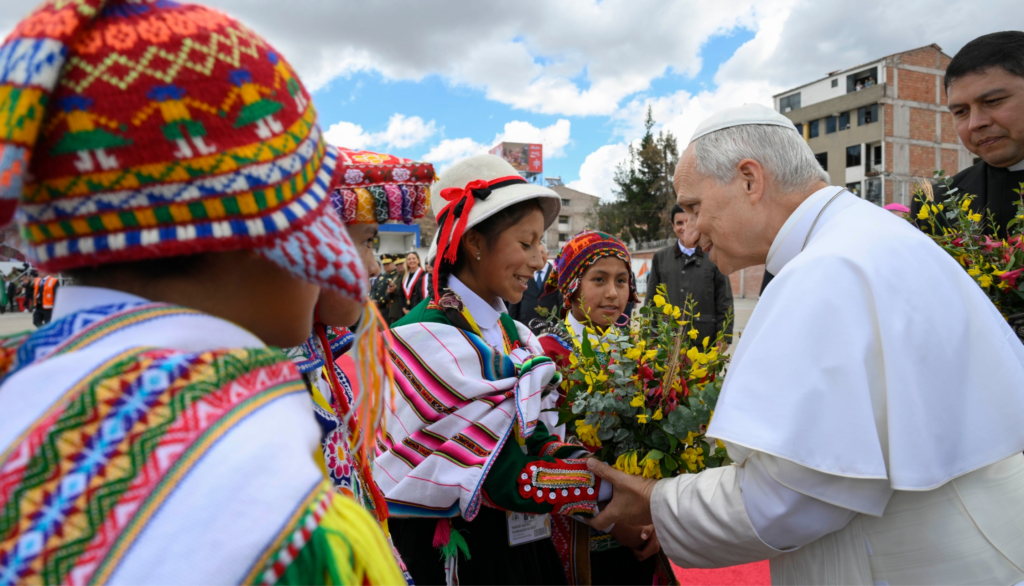
Forty-one years after the visit of Saint John Paul II to Cuzco, the ancient capital of the Inca Empire, where Andean communities have kept Catholic processions alive for centuries, Pope Leo XIV met on Sunday morning with the faithful and representatives of popular piety and religiosity, in the Saqsaywaman National Archaeological Park (“Satisfied Falcon”), located about two kilometers from Cuzco.
The ancient Inca city is located at an altitude of about 3,400 meters, and is the main tourist destination in Peru, with around three million visitors a year.
Among those accompanying the Pope was the new archbishop, Monsignor Lizardo Estrada Herrera, who posed the question: How to evangelize popular piety?
On the platform stood the Virgin Queen of Bethlehem, Mother and Protector of Cuzco, to whom the Holy Father presented the Golden Rose at the conclusion of his homily.
The Annunciation was in a everyday environment
At the homily Among other things, the Pope's message included two main ideas. First, a reflection on the Gospel, which recalled Mary's joy in saying “yes” to the angel, to become the Mother of God and give Jesus to the world.
“The Lord came to speak to her at her home in Nazareth, in an everyday setting and surrounded by her loved ones, in an environment full of symbols she knew well, in her own language, through the signs of her culture,” the Holy Father noted. “This is how God acts. He seeks the most appropriate ways and moments to draw near to us, so that we may all encounter him, understand his words, be converted, and be saved.”.
Faith does not separate
Next, Leo XIV It has focused “on the community context in which the mystery of the Annunciation is inserted.”.
“Mary matured in faith by living in a community and, after the Annunciation, continued to share daily life with the brothers and sisters around her.” “The encounter with God did not isolate her, it did not distance her; on the contrary, it made her the guardian of a gift that grew within her for the good of all: of her fellow citizens and of all humanity,” the Holy Father said.
“Faith does not separate, but unites God and others. (…). This is important,“ the Pope continued, ”especially in a time like ours, marked by divisions, wounds, mistrust, and situations that make it difficult for men and women to recognize each other as members of the same family, sons and daughters of the same Father,” he said.
Schools of fraternity and charity
In this context, religious traditions can be of great help, as places to gather in the light of faith and love, the Vicar of Christ pointed out. “A procession can bring together those who think differently. A pilgrimage can unite entire families. A celebration can gather a community. A patron saint's feast day can become an opportunity to reconcile, ask for forgiveness, and begin anew.”.
“That is why I invite you to make these holidays a school of fraternity and charity, where you work, pray, have fun together and also take care of those in need, so that the joy belongs to everyone and everyone can live it together, before God.”.
Popular traditions, an invaluable treasure
“Popular traditions, with their symbols and dynamics, imbued with values of communion and Christian solidarity, are an invaluable treasure of good teachings, especially for new generations,” the Pope insisted.
Maria, a special place
On this journey, “Mary occupies a special place,” the Pope continued. “Popular devotion in Peru is also profoundly Marian, and this is evidenced in the Vatican Gardens, where last year I blessed the mosaic that represents the different titles by which Mary accompanies this people, knows their joys and sorrows, and teaches them to have hope.”.
At the Angelus
After meeting with representatives of popular piety, the Pope went to the square in front of the Cathedral of the Assumption of the Blessed Virgin Mary in Cusco to pray. the Angelus.
In his remarks before reciting the Marian prayer, the Vicar of Christ remembered Archbishop Richard Alarcón of Cuzco, who passed away a few days ago, on October 30. This remembrance prompted a brief catechesis from the Pope on the Christian perspective of illness.
“In the eyes of a world conditioned by a throwaway culture and material productivity, illness is seen as a misfortune that diminishes a person’s value. What a great lie! In the light of the Gospel, illness, lived with faith and united to the mystery of Christ’s Passion, is a path to grow in his love and share it,” Pope Leo declared.
“You are at the beating heart of the Church: your suffering, offered with love for the salvation of souls, for vocations and for peace, becomes spiritual strength; your weakness is transformed into divine strength that multiplies the talents of love and redemption. You have been witnesses to the self-offering made by His Excellency Bishop Richard to give life, united to the cross of the Lord,” Leo XIV emphasized.
A shroud for the image of Jesus, “a caress from the Pope”
Finally, the Holy Father wished to make “a special act of devotion: with filial love, I offer this Shroud to be placed upon this image of the Lord Jesus. It is meant to be the Pope’s caress for a people who know how to suffer with dignity and Christian hope. Seeing the Lord of the Earthquakes clothed in this Shroud, remember that the universal Church is with you.”.
After giving the blessing, the Pope walked around the square greeting numerous sick and disabled people and those who care for them.




 Español
 English
 Italiano
 Français
 Deutsch
 Polski