


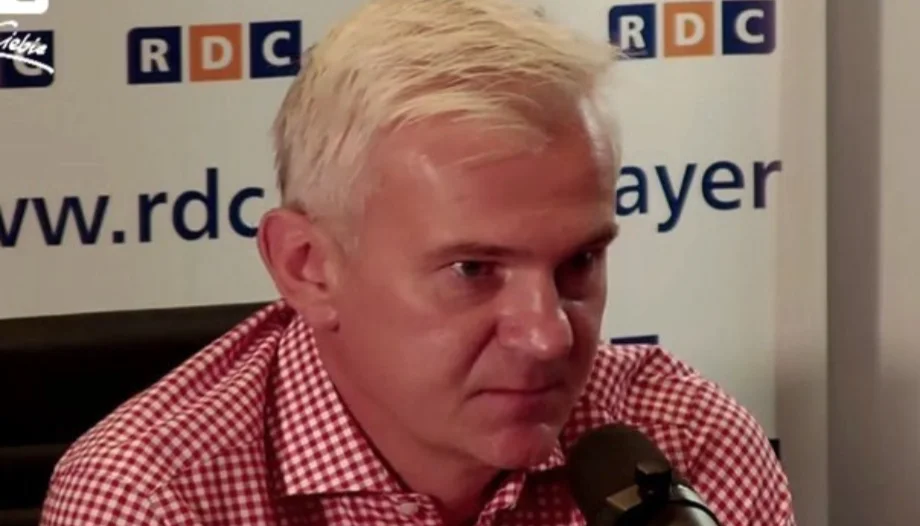
On April 10, Jacek Magiera, the assistant coach of the Polish national soccer team, passed away unexpectedly at the age of 49. His name will not ring a bell for the fans of the big soccer teams, but he has been a reference in recent years at the national level. Magiera not only had results on the field, but also helped many soccer players to grow as people. The coach did not hide the fact that, if he has done something good, it was because he responded to what God has given him.
It is rare for an adjective to appear in Przegląd Sportowy, the leading Polish sports daily. saint. Of course, due to the irruption of the Internet as a source of breaking news -such as match results-, the newspaper evolved, leaving more space for interviews and opinion articles that explain, in greater depth, the reasons behind what happens on the soccer fields or other sports arenas.
A saint?
So themes such as constant work, the struggle against adversity or not losing heart after defeat return. But holiness? Significantly, in his commentary on the passing of Jacek Magiera, his colleague from the Polish youth national team days, Kamil Kosowski, describes him as follows: “I did not want to describe Jacek only as a coach or a footballer because, regardless of the profession he played, he would be for me the same companion: full of human warmth, helpful, intelligent and empathetic to the other. A man of faith, deeply religious, assiduous reader, hungry for knowledge and able to understand that soccer development is not everything. A man without addictions, crystalline; one can say that he was a saint”.
It is interesting that his colleague, instead of talking about his successes as a footballer and coach, highlights his human side and underlines his deep faith. His relationship with God, normal and simple, affected everything he did. The fact that even people who did not share his faith realized that there was something more there, is very significant.
Who was Jacek Magiera?
Born in Częstochowa, next to the Jasna Góra shrine, Magiera started his career at the local club Raków, but soon moved to Legia Warsaw, the team of the capital, which leads the ranking of Polish clubs with 15 titles. At Legia he played 10 seasons and won the national championship twice. Already during his playing career he thought about becoming a coach. At the age of 32 he finished his soccer career and started coaching. Among his achievements, he won the 2017 Polish championship with Legia Warsaw. Seven years later he achieved the runner-up spot with Śląsk Wrocław. He also collaborated in various ways with the Polish national team, of which he was an assistant coach recently.
But more than titles, what really counts is the work he did with the players. The years that marked him the most were 2014 and 2015, when he was in charge of the second team of Legia Warsaw. There he had under his tutelage young players aged 17, 18 and 19 with a lot of talent and the whole future ahead of them, who had to face the entry into adulthood and were at risk of spoiling. That's where Magiera came in, with its high standards and comprehensive support.
Many of those who coached with him repeat the same thing: «He helped me become a better person». In one of his interviews he explained that his way of understanding coaching was to see something in a young player that others had not seen, in order to build him up and give him the opportunity to gain experience.
What your players say
And these are not just his words; the players confirm it. It is very illustrative what Jakub Rzeźniczak, who was starting his professional career at Legia when Magiera was finishing his and then had him as a coach, says: “He was one of my mentors, he always supported young players. He helped me pass my high school exam and lent me money when I was lacking.”.
Rzeźniczak tells how, when Magiera was already working at another club, he called him in difficult times, even in matters of his private life: “He helped me many times: when I was going through a bad soccer moment, when my son passed away or when bad things happened in my life; I could always count on him. After calling coach Magiera, you just revived somehow; he knew how to instill a very positive spirit in difficult situations.”.
To these young players, and not only to them, he transmitted the need to act conscientiously. At one point he came across the book by Álex Rovira and Fernando Trías de Bes, Good luck. The book, in the form of a fable, explains that profound success - be it in business, soccer or life - is not a matter of chance, but of well-made decisions and integrity. Magiera was so fascinated by the book that he bought the remaining 700 copies of the Polish edition to give to his players and explain it to them in training talks. He made the young players think so that they would take care of themselves and not waste the effort of training with harmful entertainment.
As for the way he managed the team, it was also clear that he went deep. For example, with regard to discipline in the dressing room, he explained in an interview that he did not try to impose it by shouting so that the players would do what he wanted, but that he believed that discipline should come from within the players. Good players want to do what the coach says because they have already internalized it.
Soccer, in place
In interviews he did not hide the fact that soccer was not the most important thing for him. First, of course, was his family. He married late to Małgorzata, who shared his passion for soccer, and they had two children. Significantly, he attached great importance to not changing teams too often. He knew that his children needed their father and required stability to create lasting bonds, something he admitted his wife always warned him about.
And first and foremost was his dealings with God. In an interview he said: “For me, faith is the foundation on which I build everything. I build the family, the team and each player individually (...) I know that without God I would not exist, everything I do would not exist. I completely trust that the divine path is my path”.
Circumstances of death
His death was unexpected: he collapsed during an individual training session while running through a park in Wrocław (Wrocław) due to cardiac arrest. A few weeks earlier he had undergone a thorough medical examination that detected no abnormalities.
His death was widely reported in the media. His funeral was attended by the president of the republic, Karol Nawrocki. The Polish Football Association decreed a minute's silence before all Ekstraklasa matches in the week of his death. Legia fans prepared a tifo with his portrait in large size to accompany the club in the league match. In the next match of Śląsk, his last club after his death, the game was stopped at 19 minutes and 47 seconds, in reference to the club's founding year (1947).
A year and a half earlier, she had visited the shrine of Gietrzwałd, in northern Poland, the site of Our Lady's apparitions in the second half of the 19th century. From that visit on, the Magiera family prayed the rosary daily. Jan, her twelve-year-old son, spontaneously, on the day of her death and seeing the sad atmosphere, said: “Hey, why don't we pray the rosary? That's what Dad would do.
Polish priest.





 Español
  English
  Italiano