


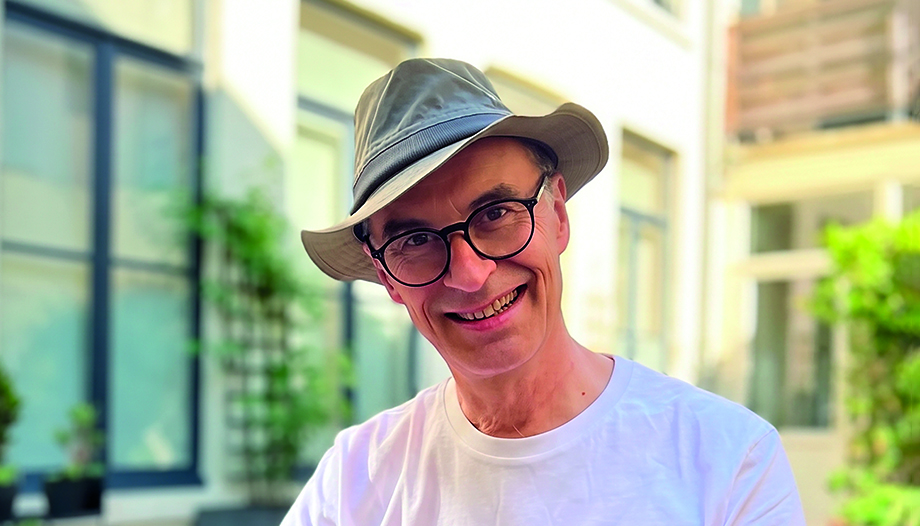
Christophe Flippo was a Freemason for 21 years. Suddenly, in a matter of seconds and at his wife’s request, he left the lodge and returned to Catholicism. His time in deist Freemasonry was not superficial; in fact, he even became a master of a lodge. Today, at age 66 and about to retire, he shares his testimony to debunk some misconceptions about this organization and explain why it is impossible to reconcile the Catholic faith with Freemasonry.
What initially motivated you to join Freemasonry?
– I was a Freemason for 21 years. I went through all the ranks and levels. I feel qualified to speak about it because I have extensive experience. I worked on Masonic rituals in Paris and served several times as what we call the “Venerable,” which is the master of a lodge.
As for why I joined: like most people, I was searching for meaning in life. Many people come from a Christian background but aren’t practicing. God may feel very distant to them, and that was the case for me.
In the past, my wife and I were religious and raised our children in the Christian faith, but we gradually drifted away from it because of Freemasonry itself. Personally, I’ve always had Leibniz’s question in mind: “Why is there something rather than nothing?”. That is, why do we have a world, people in it, and an awareness of who we are in the midst of a universe full of violence and nuclear explosions? It seemed incredible to me, and I sought answers in esoteric books before joining. In the end, I joined because someone close to me suggested it.
How would you describe the organization?
– Freemasonry cannot be understood as a single organization; there are two types. One is atheist or secular, and the other is deist, believing in a generic god or an “architect” who created the world, but nothing more.
The atheist movement is very significant in France. Its goal is to build a new and better world, which brings with it modernism and social issues such as abortion. The entire evolution of society has been driven primarily by this atheist movement. There was a time, during the Third French Republic in 1870, when 80 % of the deputies were Freemasons, so their influence was enormous right up until World War II.
Atheist Freemasons are very involved in politics because they want to promote their vision of society. That’s why, when you see someone talking about Freemasonry on TV or in the newspapers, it’s almost always from this side—because when they’re involved in politics, they have to talk about it. The entire network of business and politics is on that side, because to be a politician, you need money and connections.
The other branch, the Deist one, is rooted in the tradition of the United Kingdom, and its constitution was established in the 18th century, around 1715. It was founded by two Protestant pastors with the aim of fostering peace during a time of conflict between Catholics and Protestants. They wanted to bring people together to discuss philosophy with tolerance, without the Church getting in the way. As the British Empire expanded, they recruited local people in India or China to support and manipulate them. To make this work across different religions, they removed any mention of the Christian faith. Thus, a Muslim, Buddhist, or Hindu can be a Freemason because the only common ground is the “Great Architect of the Universe.”
What is the problem that arises from that combination?
– The problem is that they construct rituals and a narrative based on a blend of many cultures: alchemy, Greek and Egyptian rites, Templar traditions, and the Bible. In the Emulation Rite, which is the best known, the name of the “Great Architect” changes at each level. It starts as “Architect,” then “Geometer,” and at one level comes to be called “Divinities,” in the plural, which is already a problem for a monotheistic faith. In the end, the name is a combination of three gods: Jehovah, Baal (the Syrian god), and On or Ra (the Egyptian sun god). You move away from the one true God and end up in a fully pagan place.
Such syncretism ultimately raises questions. What light can be found in these pagan traditions?
In the Christian faith, you are saved through the redemption of Jesus Christ. In Freemasonry and alchemy, you try to save yourself in order to become the “perfect Adam” of before the Fall. It is a path to total self-destruction.
Deist Freemasonry is completely incompatible with the Christian faith, because it relativizes everything. Everything is treated as equal: from the myth of Isis and Osiris to the resurrection of Christ. In short, I quote to Freemasons Christ’s first words in the Gospel of John: “What are you looking for?”.
Is that why you decided to leave?
– I left within a few seconds, even though I loved Freemasonry. I left because my wife asked me to. We were rediscovering the Christian faith on a pilgrimage in France and were going through a crisis. My wife said the crisis was because I was a Freemason, and as her husband, she is my priority.
The day I left, I received a sign: I read a passage by St. Athanasius of Alexandria in a magazine that said: “Your brother is God”. It was a message telling me to stop looking for “brothers” in my former community; now my brother is Christ.
How does being a Freemason affect a marriage?
– It’s a problem for couples because you develop your spirituality on your own. Your wife can’t understand the rituals, which are strange and progressive. A rift develops. A woman once told me that her husband, who was a Freemason, asked her for a divorce over dinner, simply saying: “We have nothing else to share”. He was building something on his own, and she was left alone.
Is Freemasonry a cult?
– It’s not a cult. It’s hard to join, but easy to leave. They don’t drink blood or spit on Christ. It’s a philosophical aberration. A gradual drift away from Christ toward pagan traditions.
However, this “brotherhood” is false. The day you leave, you disappear from their lives. I was crying at my last meeting because I was sad to be leaving my brothers, but the next day, no one called me. The relationship is with the group, not between individuals.
How has your departure from Freemasonry affected your personal, professional, or spiritual life?
– What changed my life was becoming a Christian again. You stop judging others. Before, if I saw someone begging on the street, I would judge them, thinking it was their own fault for drinking or not working; now I simply help them because they need help. Being a Christian gives you hope and joy.





 Español
  English
  Italiano