



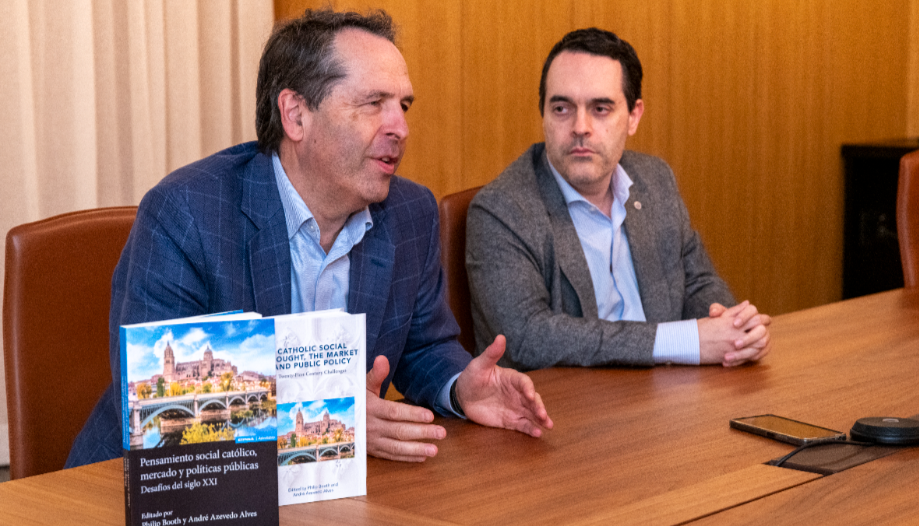
With the title “Catholic social thought, market and public policies. Challenges of the 21st centurypolitical economists Philip Booth and André Azevedo Alves have authored the first work in a publishing initiative that aims to recover and update the richness of Catholic social thought in dialogue with the major issues of economics, politics and contemporary public life
In this conversation, Booth and Azevedo reflect on some of the challenges facing Catholic social thought today in a world marked by economic uncertainty and significant cultural changes.
Do the Church and the hierarchy understand how the economy works?
PHILIP: In a sense, it is not the role of the hierarchy to understand how the economy works at a technical level. The role of the hierarchy is to provide moral and theological guidance, including on economic and social issues. The documents of the hierarchy make judgements that are contingent. Judgements on economic and political issues can change over time for all sorts of reasons.
And I think that if we were to succumb to the temptation to believe that the hierarchy should make judgements about technical aspects of economic life, it would be a form of clericalism. Just because someone is a cleric does not mean that they know everything, while there are other people who have knowledge and authority in those areas. Catholics in public life have to make prudent judgements informed by moral and theological considerations on economic and political issues.
ANDRÉ: I think I would add that not only should people in the hierarchy not necessarily be expected to be experts in economics, but I also think the main concern should be that they do not overreach in their pronouncements on economics.
So I think it is more important than having experts in the hierarchy to have people, especially in positions of power within the Church, who understand the role and limits of what Catholic Social Teaching (CST) is or should be, and who do not overreach in terms of wanting to have very strict positions on issues that may be, and often are, issues on which Catholics can disagree and still be good Catholics. For example, for prudential reasons, one can have different opinions on the application of economic theory to specific policy issues and it is okay to disagree.
Could you give a concrete example?
PHILIP: Gambling taxes are being discussed in the UK at the moment. The idea is to increase them to provide more money for poor families. The Church hierarchy could talk about the moral implications of gambling (the fact that it can be an occasion of sin or be addictive, etc.). But I would not expect them to have special expertise in this area, so they should not pronounce on exactly what taxes to impose.
There are many variables at play. It is very likely that increasing taxes would have worse effects on poor families than on rich families: because poor families would spend proportionally more money on gambling; it would further worsen the position of poor addicts; it could create a black market, with devastating effects when things go wrong, etc.
There is nothing in the training of clergy that helps them understand whether increasing gambling taxes would help improve human welfare, even if they can understand the morality of gambling perfectly well.
In a context of high public debt and fiscal tensions, how should solidarity between generations and between countries be interpreted in the light of the CST?
PHILIP: This is a very serious problem throughout the Western world. It has been exacerbated by financial crises and COVID, as they have increased public debt.
For 30 or 40 years, populations have been declining, birth rates are low, and our social security systems have promised that we will all receive pensions and healthcare financed by future generations. This is also a form of debt. We have made promises to the older generation that will have to be financed by future generations of young people.
For decades, many people have denounced the unsustainability of the system and, at the very least, we can now say that there is a significant transfer from the younger generation, which now has to bear higher tax burdens and retire later.
It is an injustice. Francis has also spoken about distributive justice between generations; there is a section in Laudato Si that addresses this. Laudato Si that addresses it.
Are there any countries or politicians who are good models of Catholic Social Teaching?
(Laughter from interviewees...) ANDRÉ: That's an interesting and difficult question. I think I would divide the answer into two parts, one referring to political economy aspects and the other to bioethical issues. It is more in line with Catholic social doctrine if you manage public finances prudently; if you do not excessively increase a country's debt and compromise future generations with it; if you have efficient public services in reality. In short, a prudent, modest, rigorous government, etc.
In this sense, I would say that Milei is more in line with Catholic social doctrine than previous governments in Argentina. Nor does the current Spanish government have satisfactory policies from this perspective, as it does not comply with the general principles of good governance and promote the common good more easily.
And what about issues such as abortion or gender issues?
ANDRÉ: On these issues, I think we are living in interesting times because over the last few decades, governments, both on the left and then on the right, have become very socially progressive. However, it now seems that some ‘untouchable’ positions are being challenged by politicians such as Orbán and Meloni. And this is regardless of whether they are doing so for instrumental reasons or out of a genuine commitment to reversing the progressive agenda.
There are many open questions, but I believe we are now at a moment of possible change. What happens will depend on all of us, but I believe there has been a change that seemed impossible just 5 or 10 years ago.
PHILIP: I work for the Catholic Bishops' Conference of England and Wales, and life issues fall within the Department of Social Justice because they are considered the pinnacle of social justice issues: without the right to life, other rights are obviously not enforceable. And I know for all sorts of reasons that the debate on gender has definitely changed direction in many countries, something that has been made possible by a kind of alliance between Christians and scientists and feminists who know the difference between a boy and a girl!
I think the same thing could happen one day with abortion. I don't know when, but it could happen one day that people realise that this is a life and not part of the mother's body. In the United Kingdom, this is not on the horizon, but it may happen. When it comes to how politicians behave, I am concerned by populists in countries such as the US. I believe that politicians should, in the best sense of the term “liberal”, debate in a liberal manner, assuming the best of their opponents, rather than trying to traduce their opponents and stop them in ways that are not appropriate.
What is the Church's approach to economic inequalities and the moral obligations of the rich?
PHILIP: There are inequalities that arise from clearly unjust sources: corruption, bribery, etc. And no Pontiff has spoken out against that more strongly than Pope Francis did. I think that's very important. More difficult is the question of people who are immensely wealthy through legitimate and legal work, for example, developing businesses, being successful in sports or music.
In ‘Rerum Novarum,’ Pope Leo XIII made very clear the moral obligations of wealthy people, and I think we have to be careful not to think that our obligations to the poor end with just paying our taxes.
We must also bear in mind that, although globalisation has enabled some people to become very rich — some unfairly, but I believe most fairly — inequality in the world as a whole has decreased dramatically, in a way that no one could have imagined in 1970. And in a way that has never happened before in the economic history of the world.
Catholic social thought, market and public policy: Challenges of the 21st century.





 Español
  English
  Italiano