


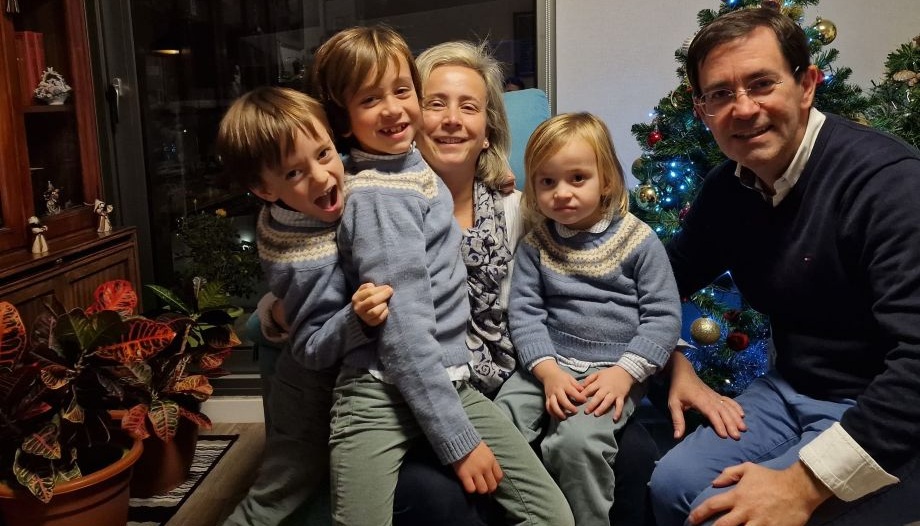
Juan Chimeno is from Madrid and lives in Zaragoza. He has a law degree and is the father of three children. He began his career at Europa Press, then moved on to Mediapro. He worked as a temporary civil servant in courts of first instance and preliminary investigation for several years. He then worked for a year at AXA before returning to the courts. He enjoys music, plays the guitar, has been a singer in three bands, and is a songwriter. During college, he started out as a DJ and has spun records at weddings and parties.
In 2008, he was diagnosed with multiple sclerosis, although it had been suspected for years, since his first flare-up occurred in 2001, but symptoms didn’t begin to appear until 2007. It was a heavy blow for his entire family and friends, but even then it became clear that “Juanchi” (as his friends call him) wasn’t going to let discouragement get the better of him.
His convictions led him to reshape his life. This brought his family great peace during times of discouragement, as well as great joy. This limitation became a blessing—even though it may seem like a contradiction—because it brought out the best in him.
He showed them that, as he says, Marian Rojas: Happiness doesn't lie in what happens to us, but in how we interpret what happens to us. She was able to be happy and bring happiness to her loved ones.
So much so that his “girlfriend” from Zaragoza, Carla—whom he had met in 2007—remained deeply in love with him, and they got married in 2011. They’ve been living in Zaragoza since 2010. They currently have three children—two boys and a girl: Álvaro, 8; Jacobo, 6; and their youngest, Marianita, 3. Juanchi has been retired since 2017 because he is totally unable to work, and he devotes his time to his family and letting them take care of him.
How did you two meet? How did you start dating?
– Juanchi: We met through mutual friends who had been volunteering in Nairobi that summer with Mother Teresa’s Sisters. We started dating because she sent me a text message, and I thought, “Hey, this girl seems interesting,” so we started talking and talking—which is the best way to get to know each other—and in the end, thanks to a friend, I took the plunge and formally asked her out.
We were in a long-distance relationship for four years. It was hard—really hard—because it wasn’t easy to see the person I loved: we had to take a train just to see each other for a day and a half, which didn’t feel like enough, and there were weekends when we couldn’t see each other at all. But even so, it was worth it because you come to appreciate things so much more.
Juanchi, what's your educational background? What do you do for a living? What are your dreams?
– I studied law at Complutense University and, years later, earned an MBA from ICADE. Both helped me a great deal in shaping my thinking and broadening my horizons, especially because of the effort they require and the subjects they cover.
I’m currently focusing on my physical rehabilitation and my family. In 2016, I was working as a Litigation Manager at the Plaza Castilla Dean’s Office, and thank God, I was accepted into a clinical trial at Hospital Clínic in Barcelona. That made me rethink my life, and I decided to apply for disability benefits; thanks to God and the intercession of Mr. Isidoro Zorzano, I was granted full disability benefits.
To be honest, my dreams are really limited to my immediate circle: my wife, my children, my recovery, my friends, bringing the people I know closer to God, and music—although lately, except for my singing lessons, I’ve been neglecting that.
And you, Carla, what did you study? What do you do for a living? What projects are you working on?
– I went to school in Sansueña, a Fomento school, and that’s why I’ve chosen for our children to attend school there as well.
After that, I studied pharmacy at the University of Navarra, in Pamplona, a place where I'd like my children to study because it's a very important part of my life.
I work at a pharmacy with two of my brothers; we have some great times and some not-so-great times, but I love working with them.
My professional endeavors are in the pharmacy business—since it's the family business—and we work hard every day to make sure it does very well.
Carla, when did you receive Juanchi's diagnosis? What were those first moments like?
– One thing I’ll never forget is when we told my mother we were getting married, and on that very same day we received the definitive diagnosis of her illness. My mom said to me… ”Are you sure you want to marry him? It’s a very serious illness. You’ll have to take care of everything for him and work really hard to make sure he has a good quality of life.” To be honest, I said, “So what?”.
But my mother knew what she was saying; still, at that moment I thought, “Well, I’ll just help him out.” I don’t know if it was something I did unconsciously or not, but to this day, he takes care of his own stuff and I do everything else—except for the cooking, which he does for the whole family. And when I have to take care of my own stuff plus everything else, I still find myself saying… “My mom was so right,” hahaha.
But you have to live life one day at a time! And above all, you have to put your trust in God’s plans, which just happen the way they do—period.
Juanchi, what's your daily routine like? How do you get through your rough patches?
– I go to rehab, physical therapy, and occupational therapy several days a week. I make lunch and dinner for my family (as Carla mentioned). I also do the grocery shopping and take care of household chores.
There are days when I don't leave the house, and to be honest, the day drags on, but oh well—I always tell myself that there will be a tomorrow when I can go out.
There’s a lot to say about these slumps. Before I had this disease, I was a very restless guy. My friends in Madrid know me and know that I was always making plans. I spent most of the day out of the house, and then suddenly this disease hit me. The loss of mobility didn’t happen all at once—it happened gradually. At first, I had trouble walking; then I walked slowly; and later, I’d trip over any obstacle on the ground. Years later, I started using a cane, and eventually I decided it was better to use a wheelchair when I was out on the street.
I’m not the kind of person who gets really down or paralyzed when I receive bad news like this, or when I take a hard blow. I try to figure out how to move forward and not get stuck in the face of misfortune or the challenges I’m facing. I often use the example of a lemon. In this life, you have to “make lemonade out of lemons.” Don’t dwell on the bitterness of the things that happen to you in life; turn them around and make lemonade out of what’s causing you pain. The suffering doesn’t go away, but your attitude can change. It doesn’t happen right away—it takes effort—but the result is fresh, delicious lemonade that brightens your life.
I place my difficult moments in the Lord’s hands—He is my strength, my refuge. Without Him, I am nothing, so what I do is keep my mind occupied with other things. But then again, sometimes I have even deeper slumps, and everything bad seems to get bigger and bigger, as if I were in a deep hole from which it were impossible to escape.
Even when I'm feeling down, I know that, thank God, I'm not alone. In those moments, I find time to talk to a priest, and after speaking with him, I go to confession. And thanks to that, I find the strength to get back up and resume life's struggle. For me (and I imagine for many others as well), life is about falling down and getting back up.
I feel loved by God, but I’ve realized that God cannot take away our freedom. He wants us to love Him freely, without anything or anyone forcing us to do so. God, who can do anything (He is all-powerful), cannot interfere with our freedom (no one would want to be loved against their will), and it’s very important to make this known so that everyone understands how much God loves us, the infinite respect He has for our free will, and the mercy He shows us, even though we commit terrible acts.
Juanchi, it’s understandable that this experience has led you to see firsthand our fragility, our vulnerability, and our personal limitations. How do you connect this reality with God? How do you reconcile humanity and transcendence?
– I am a humble servant who tries to tell everyone about God because He has shown me that, despite my weakness and my shortcomings, He loves me infinitely, and that He will not force me to love Him—He wants me to love Him of my own free will.
I have also seen that God relies on the weak and the sick so that His love for us, His omnipotence, and His mercy may be made evident. It was St. Lawrence whom the Roman authorities demanded hand over the Church’s assets following the death of Pope Sixtus II. He appeared before the Roman prefect alongside the poor, the sick, the blind, the crippled, the widows, and the needy whom he cared for, asserting that they were the true treasure of the Church. To make the Lord’s hand even more evident, I was born on August 10, the feast day of Saint Lawrence, and on that very same day, my father passed away at the age of 67.
In my case, humanity and transcendence are intertwined in everyday life, in the day-to-day.
The cross I bear is a daily one, and this has helped me rise above it and realize that it comes from God and that I have to thank Him for it—even though thinking this is crazy. Many will think, “How can you say, ‘I thank God for this cross’? You should be thinking the exact opposite: ‘Why has God punished me with this misfortune?’”.
Not long ago, a woman I know, María Mora Figueroa, who passed away in April, told me, “God gives each of us what we can best bear.” It took me a while to realize that the cross the Lord had given me has made me a better person. Before, my daily life didn’t help me be as spiritual as I could be. I thought I was a good Christian, but I was rushing around everywhere without paying attention, without realizing what really matters.
Now that I can barely walk, I notice countless things I didn’t see before. I’m grateful to God for the cross He has given me, even though I have to endure it every day and it’s a pain. I’ve also learned that you learn to love through suffering, though that’s a topic for another interview.
All of this does not prevent me from acknowledging that I am a sinner and that I continue to struggle day by day, because I have many sins and because, even if you have a cross to bear, you have to keep fighting just like everyone else.
Carla, people will ask you, “How were you brave enough to get married?” And you’ll say that love is above all else. But love is built day by day. What would you say to those who are going through something similar?
– Honestly, I’m a bit old-fashioned. I’m not very affectionate, so all I can say is that I was taught to respect others and to commit to a relationship with courtesy and respect. Juanchi is the complete opposite, and that’s why we complement each other. As you so rightly said, love is forged day by day; a relationship is built day by day, and it’s not all as wonderful as it seems. At least in my case.
As we all know very well, at first everything is fantastic and wonderful, and then things cool off—that’s why you have to take care of them, and really take care of them! Life is very hard, and even more so if something like this has happened to you. Either you learn to stay positive and make the best of it, or you fall apart. I’m a pharmacist, and I know there are millions of things that can help you feel better. But that’s not the solution. You have to lean heavily on God and stay positive. Nobody gives you anything—we all have to fight for it ourselves.
Carla, how long did it take for your first child to arrive? How did you come to the very generous decision to have three children?
– Both Juanchi and I come from large families. And we both liked the idea of having children. We didn’t know if that would be possible, or if it were, how many we’d have. We love children, and having them is no small matter. It’s a huge responsibility, and you have to work at it every day to raise them to be well-mannered and good people. It’s a constant struggle.
It took us 7 years to have our first child, and we received help from the Spanish Association of Naprotechnology. We now have three children. The support from my parents and siblings, who live in Zaragoza, has been very important, and we are very grateful to them. Juanchi's family lives in Madrid, and they have also helped us a lot.
What projects are you working on?
– Carla: I think the most important thing is to teach our children good values and to enjoy every moment of life.
We both love to travel, and it’s still possible to do so with him. Every summer we take a family trip, and the last one was to Rome during the Jubilee Year—we had a great time. We went with a very large group, and while traveling with Juanchi and other people is tough, it’s possible.
What messages do you want to convey to society?
– Two: “Make lemonade out of lemons” and go to confession more often. God rewards the humility of acknowledging your sins before a priest with a true peace that cannot be found anywhere else in this world.





 Español
  English
  Italiano