


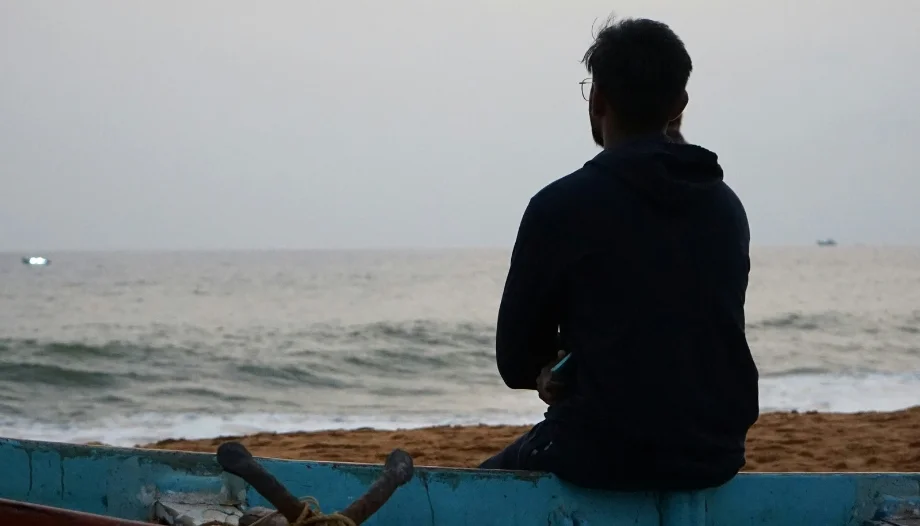
Amid Pride celebrations, and surrounded by a social discourse that often presents freedom as ‘always doing whatever one wants,’ Leandro’s testimony offers a different perspective. He does not seek to impose his views on anyone, but rather to share the path he has chosen to follow as a Catholic who experiences same-sex attraction (SSA) and has decided to live in accordance with the Church’s teaching.
His story is not that of someone who claims the path is easy. Nor is it that of someone who claims to have answered all the questions. Rather, it is the story of a reconciliation built on knowledge, faith, and the conviction that a person’s identity runs much deeper than their inclinations.
Understanding as a Path to Reconciliation
For Leandro, the starting point was realizing that reconciling his faith with his same-sex attraction could only begin with understanding. «You can’t have faith in what you don’t know,» he explains.
For years, he was unaware of what the Church actually taught about this issue. It was around the age of 25 or 26 that he learned about the apostolate Courage and attended one of their meetings for the first time. There he found an explanation that would change the way he understood himself: “God loves the sinner infinitely, but never the sin.”.
From that perspective, Leandro explains that his reconciliation was made possible by the realization that “feeling AMS is not a sin, but by acting in accordance with AMS, we distance ourselves from God and His divine plan.” “In recent years, Church teachings such as St. John Paul II’s Theology of the Body have given meaning and motivation to this reconciliation,” he adds.
The Strength of a Spiritual Life
When asked where he finds the strength to persevere, Leandro singles out three sources of support in particular: “devotion to certain saints, the presence of his guardian angel, and the Eucharist.”.
For him, faith is not merely about accepting moral standards, but about maintaining a living relationship with God that sustains him on his daily journey.
His experience within parish communities has not always been the same. He acknowledges that there are places where he has felt welcome and others where he has not felt quite as welcome. However, he avoids letting that experience become a source of resentment.
«The Church is imperfect,» he says, “and I believe that the most important thing is to learn along the way that it is up to us to welcome and value others with the love we receive from God Himself.”.
When faced with rejection, choose empathy
Leandro doesn't deny that there are comments or attitudes of rejection, but, as he says, “they don't keep me up at night.” «There are more comments and attitudes of support than of rejection,» he explains.
He even believes that some negative reactions can become an opportunity to develop greater empathy, since many stem from ignorance or fear—feelings that, he acknowledges, we all experience at some point when faced with something we don’t understand.
For those who are going through the same struggle
Leandro believes that fewer and fewer young people are experiencing an internal conflict between their sexual orientation and their faith. “Today’s world and society have worked to eliminate that conflict through moral relativism,” he says. “But if I were to meet someone in that situation, I would tell them that the teaching of the Catholic Church is the only one that truly gives meaning to both faith and sexual orientation.”.
In his view, the Church’s teaching does not seek to deny or repress human sexuality, but rather to lead it toward its fullness: “It is generally thought that the Church advocates castration or a ban on sexual orientation, but nothing could be further from the truth. It is the Church’s teaching that brings human sexuality—including sexual orientation—to its fullness.”.
In his conversation, he refers to the documentary The Third Way (La tercera vía), produced by Blackstone Films, which serves as a good introduction to understanding this vision.
He never felt rejected by God
One of the most striking aspects of his testimony is that, even during the times when he had drifted away from the practice of his faith, he never thought that God had rejected him. Quite the contrary: «I knew that I was the one who was unfaithful and who was rejecting God.»
Leandro shares a great truth: God's mercy endures, even when the human response is imperfect.
A Shared Calling
Leandro also makes a point he considers important regarding language. He prefers to speak of a «person with same-sex attraction» rather than a «homosexual person,» because he understands—in accordance with the teachings of the Catechism and the Courage apostolate—that such attractions do not define a person’s deepest identity.
As for a possible specific mission within the Church, he acknowledges that he has not yet discovered it—“if there even is one,” he remarks. In the meantime, he embraces the common vocation of all Christians: “to strive and aspire to live in holiness, whatever my circumstances and reality may be.”.
Along the way, he finds special guidance in the five goals proposals within the Courage ministry, which is understood as a journey of spiritual growth and fidelity to the Gospel: living chastity according to the Church’s teaching, strengthening one’s relationship with Christ through prayer and the sacraments, cultivating genuine fellowship with those who are walking the same path, relying on chaste friendships that help one grow in faith, and offering, through one’s own life, a consistent witness to the Gospel.
Freedom?
Leandro’s story is not intended to settle a debate that continues to rage both within and outside the Church. His intention is much simpler: to share how he experiences that reality through his faith.
In a cultural context where freedom is often equated with the absence of limits, his experience raises a different question: Can freedom also consist of choosing a demanding path out of fidelity to what one considers to be true?
His answer is yes. Not because that path is easy, but because he is convinced that following Christ gives meaning even to those aspects of life that require self-sacrifice, perseverance, and trust.
That, in short, is the heart of his testimony: a faith that does not ignore personal reality, but seeks to shed light on it through the Gospel.his testimony: a faith that does not ignore personal reality, but seeks to shed light on it through the Gospel.





 Español
  English
  Italiano