


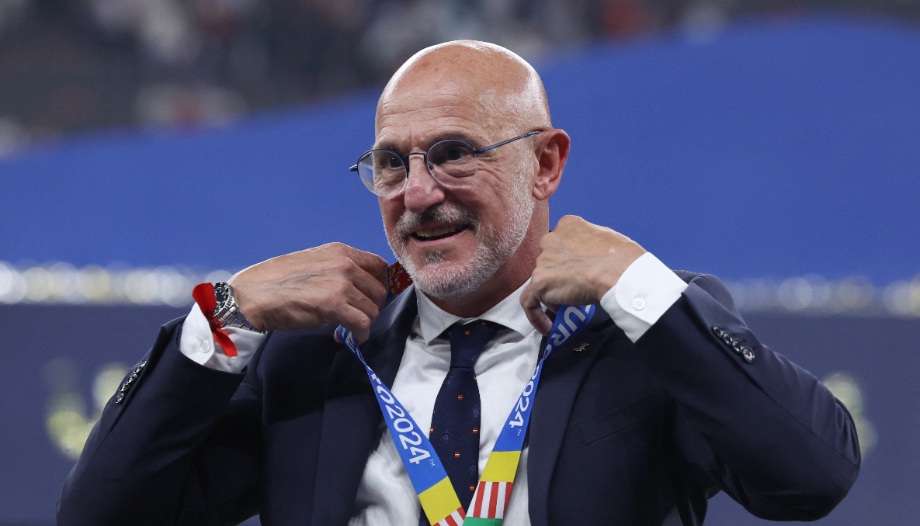
There’s always a risk when a public figure speaks about their faith: that of turning them, almost unwittingly, into an icon to be canonized—an idealized role model whom we applaud more for their fame than for their actual example. It’s wise to be cautious about that. But in the case of Luis de la Fuente, one can tip one’s hat to him with confidence, because what underpins the applause is not just media hype, but a rare combination: a well-understood doctrine, solid human virtues, and hard-earned professional prestige.
This week, at a press conference, he made it clear that his prayer life does not depend on the sports calendar: «I pray every day, but not because I’m at the World Cup,» he explained, making it clear that he doesn’t expect that to guarantee any particular result either.
«I give thanks every day, every day I wake up,» he said, simply for the fact that he is well and has, in his own words, one more day to enjoy life. It is an unpretentious theology—that of someone who gives thanks before asking, and who understands faith as gratitude rather than a transaction.
When asked what he asks of God before a decisive game, he replied that «it would be unfair to ask God to help me and not my opponent.» In a sport that normalizes pleading for one’s own victory as if heaven were colored by team jerseys, that statement is, quite simply, sound doctrine: God is no one’s twelfth player. The only thing De la Fuente asks for himself is more modest—«I ask for good health, above all, and that He give me the chance to keep fighting»—because everyone else understands that victory is earned on the field.
That is where De la Fuente’s argument unwittingly diverges from the suspicion with which Marx and Nietzsche viewed believers. For Marx, religion was above all a self-serving consolation, a painkiller that the weak administered to themselves to endure earthly injustice without changing it; for Nietzsche, the common man’s faith concealed a way of seeking compensation for his own weakness.
In both cases, belief was reduced to a disguised form of utility: people pray because it’s convenient, because it brings relief, or because it offers a form of retribution. De la Fuente does exactly the opposite when he explains that it would be unjust to seek an advantage over one’s rival and that his prayer seeks no result in return. His faith does not function as a tool that yields a benefit for him, but rather as gratitude that requires no return, which debunks—at least in his case—the utilitarian caricature that both thinkers projected onto the average believer.
You don’t have to canonize anyone to recognize the obvious: here is a consistent, hardworking, and down-to-earth Catholic who isn’t afraid to bear witness to what he believes. A Catholic we can be proud of. And whether Spain wins or loses the final, that alone is an example worth highlighting.






 Español
  English
  Italiano
  Français
  Deutsch
  Polski