



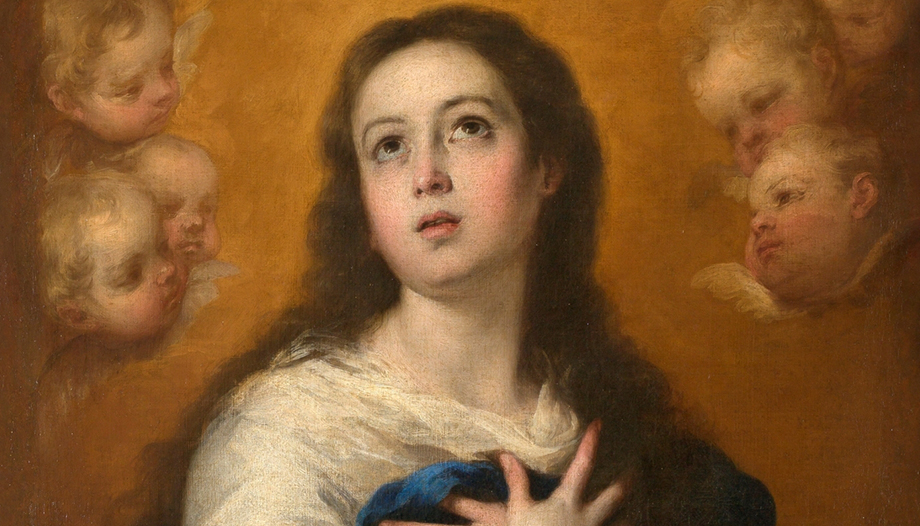
The solemnity of the Immaculate Conception occupies a privileged place within the Catholic faith, not only because of the doctrinal content it conveys, but also because of the spiritual and pastoral richness it has generated over the centuries. It brings together the devotion of the Christian people, the defining solemnity of the magisterium, and theological reflection.
Mary, preserved by grace from the stain of sin at the first moment of her existence, appears as the point of union between celebrated faith, believed faith, and lived faith. In this sense, the Church discovers in the angel Gabriel's affirmation in Luke 1:28—“Læaetare, gratia plena” (κεχαριτωμένη)—the privileged biblical foundation of her original holiness. The Greek Fathers, such as St. Ephrem and St. John Damascene, saw in this fullness of grace a radical exclusion of sin: “You, and you alone, are totally beautiful, without any stain” (Ephrem, Carmina Nisibena 27,8).
Now, the classic immaculate premise —He could, he should, therefore he did.—, simply summarizes the logic of the Marian mystery, which can be summed up as «God could preserve Mary from original sin; it was advisable to the dignity of the Mother of the Incarnate Word that it should be so; therefore, in his loving providence, did it»It should be remembered that this formula is present in the Franciscan tradition and was gradually adopted by the Church, and with it not only does it express an argument theological, but rather a dynamism spiritual y Pastoral that permeates ecclesial life.
Duns Scotus masterfully formulated this logic, which was included in the papal bull. Ineffabilis Deus;However, St. Irenaeus already anticipated the spirit of this premise when he contrasted Eve and Mary: “the knot of Eve's disobedience was untied by Mary's obedience” (Adv. Haer. III,22,4). If it was fitting that the new Eve should introduce life where the old Eve introduced death (cf. Rom 5:12-21), it was also fitting that she should be completely renewed from the beginning.
The dogma of the Immaculate Conception is not an isolated privilege, but rather constitutes the luminous manifestation of God's gratuitousness and the full availability of human freedom to his work. This dogma, defined by Pope Pius IX in Ineffabilis Deus (1854), it has been celebrated for centuries both in the liturgy and in the piety of the Christian people. Even long before its magisterial recognition, the heart of the believer already intuited and venerated Mary's original purity, understanding that God prepared her in a unique way to be the Mother of his Son.
Pius IX echoes this “instinct of faith” of the faithful when he affirms that the Church has always regarded the Immaculate Conception as a doctrine received from the Fathers, and even more, has sought to refine the teaching so that it may receive clarity, light, and precision (cf. Ineffabilis Deus, prologue). Benedict XVI emphasizes this continuity by acknowledging that the expression in Luke 1:28 captures the most beautiful title given by God to Mary, proposing her as star of hope y dawn that heralds the day of salvation, without neglecting the Christological and ecclesial reading of Mary, in whom her unique vocation, her anticipated election, and her role in the Church stand out, valuing dogma as an authentic integration of the divine plan (Angelus, December 8, 2005-2007).
The voices of those who, through a multitude of devotional works, express with poetic and theological beauty the ecclesial conviction that Mary is “all pure” cannot be silenced., beautiful total. The devotion of the people, the teaching of the Church, and theological reflection are oriented toward an integrated vision of the Marian mystery that illuminates both the history of salvation and the vocation of human beings. The liturgy applies to Mary the texts of the Song of Songs: “You are all beautiful, my friend, there is no blemish in you” (Song 4:7), which St. Ambrose interpreted in a Marian key (Expos. in Luke. II,7).
The «potuit»: theological possibility in Ineffabilis Deus.
We must remember that the popular belief in the so-called “convenience”The mystery found its doctrinal affirmation in Ineffabilis Deus (December 8, 1854). In this bull, Pope Pius IX articulates the dogma of the Immaculate Conception based on full divine omnipotence: «If God could preserve Mary from original sin in anticipation of the merits of Christ, then such an act legitimately belongs to his sovereign freedom.»,Therefore, it is not just a simple assertion of operational power, but rather the expression of a possibility inscribed in the plan of salvation.
Although the papal text explicitly cites St. Ephrem, St. Augustine, and St. Andrew of Crete as ancient witnesses to this original holiness, curiously, in the texts of St. Augustine, who is prudent in his formulation, when he addresses the question of sin, he states: “When it comes to the Virgin Mary, I do not want sin to be mentioned,” summarizing this in the Latin expression «except, therefore, the holy virgin», that is, excepting the Blessed Virgin Mary (De natura et gratia, 36).
By offering biblical and patristic foundations, the bull shows that this could It does not arise from voluntarism, but from the internal coherence of the divine plan. The new Eve had to be fully associated with the mission of the new Adam; the fullness of grace proclaimed by the angel must have a beginning proportional to its destiny. The could This thus becomes the foundation of the dogma: if God is the almighty Father and Savior, He could certainly accomplish this unique work in Mary.
The Incarnation required free human cooperation; and if God prepares the way for the coming of his Son, nothing prevents that preparation from reaching the very root of Mary's being. What the Church proclaims is that God acted in advance; that his redemptive action is not limited by time; and that Christ's grace can even break into the origin of a human existence to preserve it from evil.
The «decuit»: the appropriateness of the Immaculate Conception in the devotional intuition of the people. If the Church has recognized in Mary an original purity, it is largely because the Christian people perceived her in this way long before the dogmatic definition.
I must say that the novena Candor of eternal light (written in Guatemala around 1720 by the Franciscan Friar Rodrigo de Jesús Sacramentado) can be considered an authentic and remarkable testimony to this sensitivity; it is a work that, using poetic and symbolic language, expresses the profound “convenience” —the decuit— that the Mother of the Savior was from her origin a space without shadow for the light of God.
Far from being a popular sentiment, this conviction arises from continuous contact with the Mystery. Identifying Mary as candor of eternal light, presents an important theological insight: If the Son is the Light, it was fitting that his Mother should be pure transparency, an aurora without sunset, a creature open without fissures to the action of grace..
The decuit devotional nature is evident in the biblical images that the novena displays: Mary as mirror without blemishas enclosed garden or as morning star. These figures show that the Christian people have “recognized” in Mary that which was appropriate to her maternal mission. What centuries later would be formulated dogmatically already lived in the prayer and contemplation of the faithful. As so often in history, liturgy and piety precede theological definition, expressing the profound wisdom of the sensus fidelium.
The «fecit»: historical realization and its contemporary reception in Benedict XVI If theology affirmed the possibility (could) and the faithful sensed the appropriateness (decuit), the therefore he did points out the certainty that God has done it. In Mary Most Holy, the preservation from original sin is not merely a theological concept, but rather a historical event that reveals something essential about God's action in the world: his desire to radically save, to rebuild humanity from the ground up.
I would like to refer to the thoughts of Pope Benedict XVI, who has enlightened us with a timely interpretation. The German Pope seems to read the therefore he did as a pedagogy of freedom. God did not annul Mary's nature, but brought it to its fullness. Preserving grace did not distance her from others, but made her an icon of what humanity is called to be when it unreservedly welcomes divine love. In a world experiencing inner fracture, the Immaculate appears as a sign of the definitive victory of grace: God did it to show what she will do fully in regenerated humanity. Mary is “transparency of God's love, a sign of what God wanted for man from the beginning” (Homily, December 8, 2005).
For Pope Benedict XVI, the Immaculate Conception is humanity's pure and original “YES” to God. In her, the fecit divine in a profoundly Christological way: what God accomplishes in Mary anticipates, illuminates, and confirms the work of Jesus Christ in all people. Mary is not an isolated exception—it would be a grave error to think so—but rather the most valuable fruit of redemption. Let us remember that the definition of the dogma points from Mary to Jesus Christ: “The Blessed Virgin Mary was preserved immune from all stain of original sin from the first moment of her conception, by a singular grace and privilege of almighty God, in view of the merits of Jesus Christ.”. Mary is the icon of man's totally free response to God, because human freedom, preserved and elevated, becomes the place where Grace unfolds.
Unity of mystery in the dynamism of could–did–made
The Immaculate Conception, viewed from the classical immaculate premise, as I mentioned at the beginning, «He could, he should, therefore he did.», reveals the profound coherence of divine action: God can do whatever He wants, He wants what is best for His love, and He does what most fully manifests His glory and mercy..
The Christian people intuitively grasped this convenience in devotional works such as Candor of eternal light, a novena composed in the context of Baroque spirituality and widely disseminated in the Hispanic tradition, a privileged testimony to this devotion; the Magisterium of the Church confirmed the possibility and reality of the mystery in Ineffabilis Deus; and Benedict XVI's thinking presents it from a Christological interpretation as a profoundly relevant truth for humanity, also called to allow itself to be transformed by grace.
Mary, the Lady who is the candor of eternal light, is the presence of what God can do, of what befits his love, and of what he has effectively accomplished in history. To contemplate her is to learn to trust in divine action which, even today, continues to recreate the world and guide it toward its fullness. Despite the wounds and the evident loss of the sense of sin, Mary continues to be a sign of hope, a reminder of the beauty of a pure heart, a model of inner authenticity, and a guarantee of the definitive triumph of grace. There is no doubt that in Mary we see God's promise fulfilled in the sense that grace is stronger than sin. Thus, the «could–did–made» It is not a line of reasoning, but a spirituality: it describes how grace acts, how it transforms, and how it completes its work in those who open themselves fully to it.




 Español
  English
  Italiano