



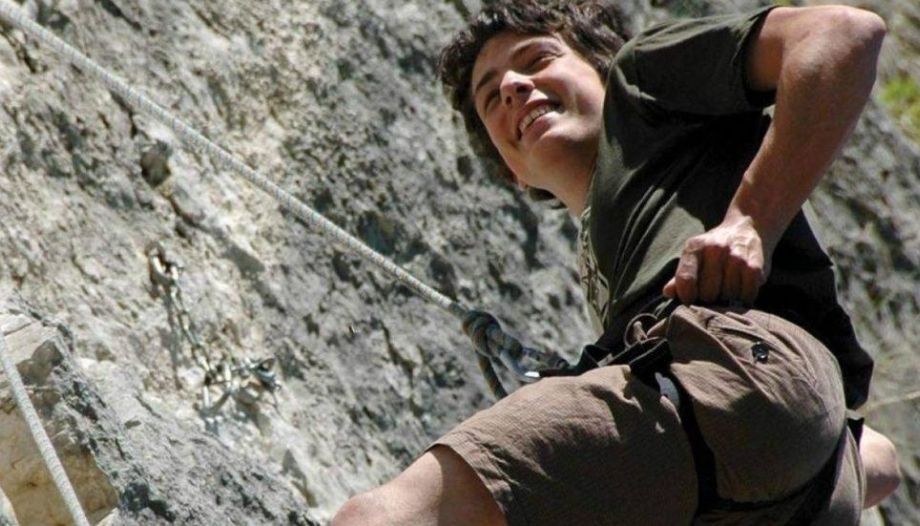
It was a typical autumn day in 2011, like any other, when Marco Gallo, a 17-year-old from northern Italy, was riding his ‘scooter’ to school.
The last month had been a difficult period, marked by a heightened awareness of the fragility of human mortality. The tragic deaths of Italian professional motorcycle racer Marco Simoncelli, who was killed in an accident during the 2011 Malaysian Grand Prix, as well as the death of an acquaintance, prompted existential reflection in the young teenager.
Life is short, it cannot be wasted.
“It could have happened to me.”
After a minor accident in which a classmate slipped and fell, Marco wrote to one of his friends, “Can you imagine? It could have happened to me,” and added, «Life is short, you can't waste it.».
On the evening of November 4, 2011, he decided to write on the wall of his room his final reflection on recent events.
The next day, while riding his bicycle to school, he was hit by a vehicle and died.
Marco's mother
Marco's mother, Paola Cevasco, recalled discovering the words he had engraved on the wall in large letters, right next to the San Damiano cross that hung in his room: “Why do you seek the living among the dead?.
These words, taken from the Gospel of St. Luke, were spoken by angels to the women who found the tomb empty.
A comforting reminder in the midst of pain.
For Cevasco, the words written by her son offered comfort in the midst of the pain she and her family felt, reminding her that death does not destroy everything.
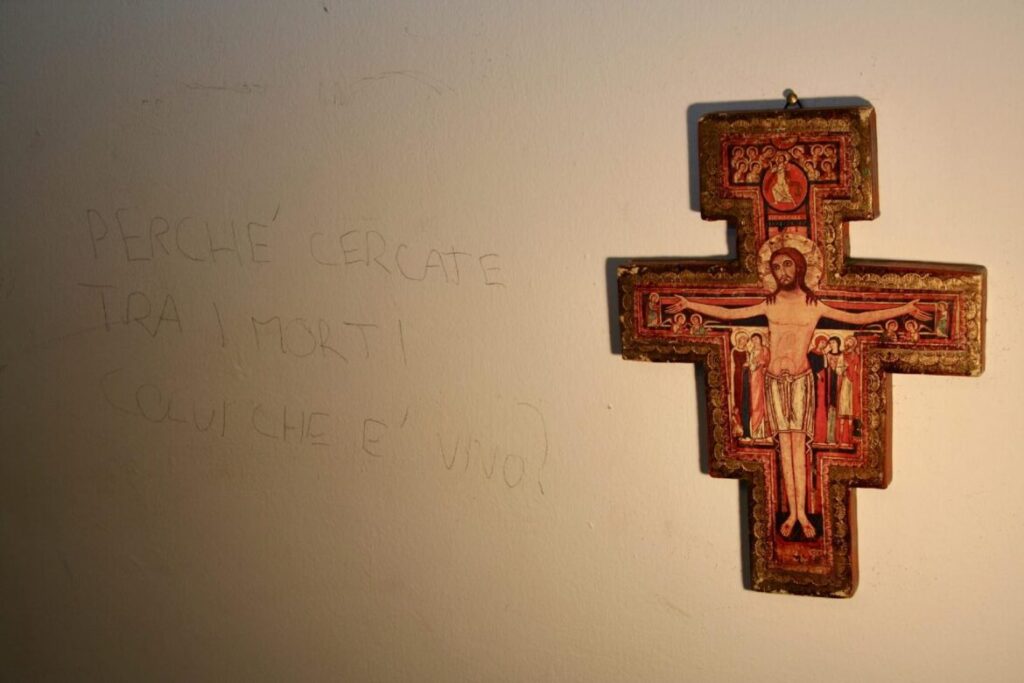
“Death does not destroy everything.”
“He had big questions about what God wants to tell us. And that's why he wrote it. He was aware that the question of what is life, what is death, was truly gigantic,” Cevasco told OSV News on March 19.
“It was the same question asked by those women who went to the tomb. The key, the central point, the focus, is that this life does not end. Death doesn't destroy everything,” he said.
His curiosity, his devotion and participation in the sacraments, and the example of his spiritual life prompted the Archdiocese of Milan to initiate the diocesan phase of his cause for canonization in March.
‘True joy in his love for Jesus’.’
The edict declaring the opening of his cause noted that Marcus “loved life, asked many questions and, above all, found the source of true joy in his love for Jesus and his neighbor.”.
“For this reason, he left a deep conviction of his holiness in all who knew him,” the edict proclaimed, adding that the teenager's reputation for sanctity had only “grown stronger with the years.”.
Born in 1994, Marco grew up in a close-knit family active in the Church. His parents were members of Communion and Liberation, a Catholic lay movement whose members seek to discover the presence of Christ in all aspects of life.
‘The fullness of our humanity’
Cevasco said she and her husband, Antonio Gallo, saw their faith as “the fullness of our humanity, something beautiful, the reward that the Lord promises in this life, which is so fascinating. And, to be honest, something that also involves suffering.”.
However, they did not try to impose their faith on Marco or his two sisters, Francesca and Veronica, because “if God created us free, how could we impose it on ourselves?”.
Like his sisters, he noted, Marco was a person who always asked questions, «but never indiscreetly.».
‘The heart of the matter’
“He wasn't one to overwhelm people; he respected them, he valued them. He could spend an afternoon playing with you and then, afterward, he would get to what he called ‘the nitty-gritty,’” he said.
Cevasco told OSV News that, from a young age, Marco had always been «a little different» and “had a very marked sensitivity.”.
“One thing that always struck me was that he didn't seem very interested in conversations. In that sense, he was, you could say, very typical of a man. He tended to be reserved,” he commented. “However, if something happened - if there was tension or if something important was being said - even from another room, he would notice and intervene. In other words, he was attentive.”.
For her, Marco's need to observe and her search for “something meaningful and true” helped her «deepen her spiritual quest.».
A favorite church hymn
Looking back, Cevasco said he really noticed her search for deep spirituality when he was 15 years old. He handed her a piece of paper with a reflection on a Church hymn, “Io non sono degno” (“I am not worthy”).
“I'm not worthy of what you do for me. You who love someone as much as I do, look, I have nothing to give you, but if you want it, take me,” the song goes.
When he gave her that thought, she told OSV News, «That's when I realized there was really something there.».
That reflection, which Cevasco said he wrote when he began studying philosophy, began with the words: «I am 15 years old and I am writing this for myself and for all young people my age».
The «fundamental questions» of life
In it he wrote “that fundamental questions often arise in life, and he discusses what can also be the desire to try things, to do things, to be distracted, what he called ‘the Saturday night idol.’ And he explains how, when it happens, it leaves you with even greater bitterness,” the mother recalled.
After his death, his family was able to find more of his writings on his “search for happiness” and compiled them in a book entitled “Anche i sassi si sarebbero messi a saltellare” (“Even the stones would have started to bounce”).
“He wanted to live his life fully for himself, he wanted to find joy and what he had discovered, he couldn't bear for others not to know,” Cevasco told OSV News.
A note in your wallet
This search for true happiness was something that accompanied him, literally, until the end of his short life. Among the objects found in his wallet after his death was an image of Our Lady of Medjugorje and a note.
“Today I promise that, with great longing and with constant fortitude, as if it were the last day of my life, in choosing to whom to give my day and my life, I will open myself to the search for the Mystery, with discernment and respect for the reality that presents itself to me, even when it is difficult. I depend only on the Mystery,” the note said.
——————–
- Junno Arocho Esteves is an international correspondent for OSV News. Follow him on X @jae_journalist.




 Español
  English
  Italiano