



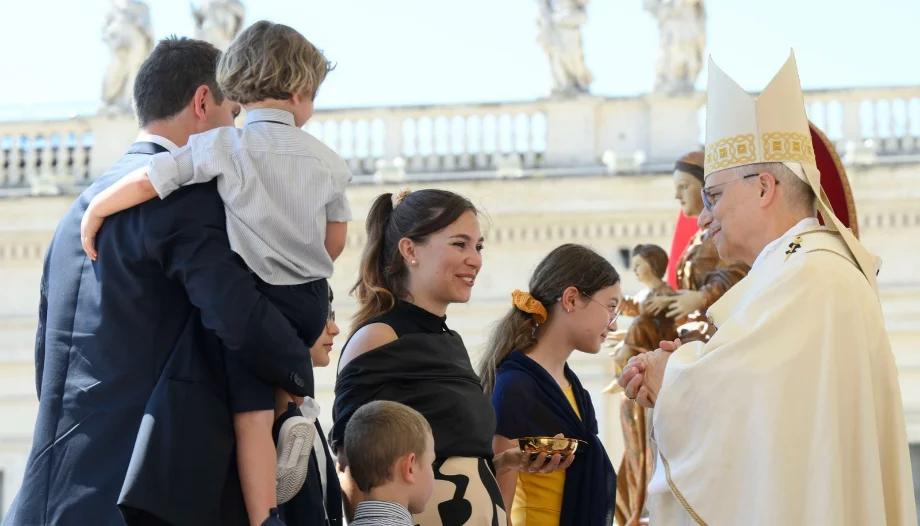
 What has changed in the family? Challenges and beauty 10 years after Amoris LaetitiaThe Church speaks out about couples who live together instead of getting married.
Cardinal Pablo Virgilio Siongco David, Bishop of Kalookan in the Philippines, has advocated for the need to accompany families in complex situations without judging them beforehand, but rather by listening to their stories and understanding the difficulties they face. He expressed this view during the meeting «Ten Years After Amoris laetitiaThe cardinal spoke at the conference »Announcing the Gospel with Families Today," held this Monday at the Vatican with Pope Leo XIV, the heads of the Eastern Catholic Churches, and the presidents of the episcopal conferences. In his address, the cardinal emphasized that the Church's mission consists of reaching out to people where they live and suffer.
Drawing on his pastoral experience in a diocese encompassing three densely populated cities in the Manila metropolitan area, the cardinal explained that many families live under the constraints of poverty, migration, violence, addiction, incarceration, injustice, and job insecurity. These circumstances, he noted, can severely limit their freedom and their ability to live the Christian ideal of family.
David recalled the case of a father who was raising his four children alone after separating from his partner and who was murdered. His relatives had to take care of the children, the youngest three years old and the oldest twelve. «In what category should we classify a family like that?» he asked, to show that family fragility doesn't depend solely on personal choices.
Listen before you judge
The cardinal has highlighted the importance of Amoris laetitia, Pope Francis' apostolic exhortation on love in the family invites us to accompany people on the journey between the Christian ideal and their concrete circumstances. As he explained, this approach allows us to discern each situation, foster gradual growth, and recognize the action of grace even in lives marked by weakness and imperfection.
In his diocese, this perspective took on particular importance during the violent campaign against illegal drugs, which left numerous victims in the poorest communities. The Church accompanied the families who lost fathers, sons, husbands, and brothers, some of whom were even afraid to mourn their loved ones publicly for fear of being judged.
«Our first reaction during the years of the war on drugs wasn’t really a program. It was presence,» the cardinal stated. The missionaries visited grieving families, listened to them without judgment, and prayed with them. The shared suffering allowed widows and parents who had lost children to establish bonds of mutual support, which gradually gave rise to a community.
The Missionary Stations, communities of accompaniment
This experience contributed to the creation of the Missionary Stations, small ecclesial communities established in poor urban neighborhoods that the usual parish structures could barely reach. Priests, religious, and lay missionaries began by walking the streets, visiting homes, and listening to the residents. Over time, the residents themselves—including widows, young people, former drug addicts, and families—became pastoral companions and guides.
The cardinal explained that many poor Catholics identified as members of the Church and kept religious images or rosaries in their homes, but did not feel they truly belonged to the ecclesial community. Some considered the parish a place reserved for people with financial resources, education, or a certain social standing.
Faced with this reality, the diocese changed the question: instead of asking why these people were not coming to the Church, it began to consider whether it was the Church that should go to meet them.
«Presence became the starting point of the mission,» David noted, adding that these communities have taught his diocese to listen before speaking and to recognize Christ already present among the poor. «We often discover that God has already arrived there before us,» he added.
Families should not face their difficulties alone.
For the cardinal, a vulnerable family needs more than pastoral advice: it needs a community to help it bear what it can no longer manage on its own. Therefore, he has raised the need to see if those who feel alone find companionship and if those who are afraid regain their courage thanks to the support of others.
Accompaniment, he explained, does not consist solely of what a priest or pastoral agent does for a family, but of what the entire Christian community learns to be around them.
The Holy Family also offers a key to understanding this reality. David recalled how political violence forced Joseph to flee to Egypt with Mary and the infant Jesus, while other families were not so fortunate and suffered the death of their children in Bethlehem. Thus, the Gospel of the family does not present an abstract ideal detached from human suffering, but rather Emmanuel, God with us, who enters into the fragility of life.
Furthermore, those who receive support can later become supporters for others. Widows help other widows, those recovering from addiction support others going through the same process, and families who received help begin to offer it to others. In this way, people who previously felt they had no place in society discover leadership and service abilities.
«They cease to be mere recipients of pastoral care. They become protagonists of the mission,» the cardinal stated.
Along these lines, he concluded that the invitation to Amoris laetitia It requires asking not only to what extent families are approaching the Christian ideal, but also to what extent the Church is willing to reach out to them in their real difficulties. «The Church cannot always wait for people to come to her,» she emphasized. Sometimes, she added, she must go where people live, struggle, suffer, and hope, to discover that Christ is already there.






 Español
 English
 Italiano
 Français
 Deutsch
 Polski