



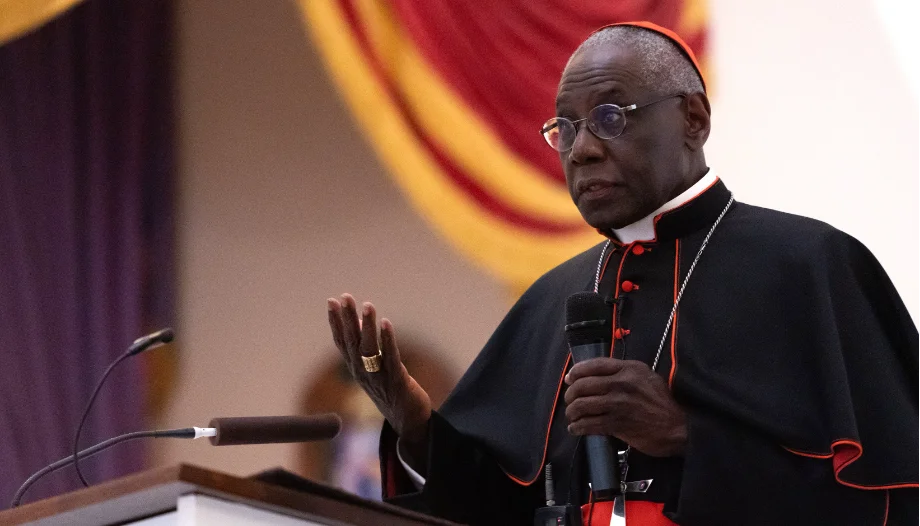
Cardinal Robert Sarah, Prefect Emeritus of the Congregation for Divine Worship, delivered a «Lectio magistralis» on July 15 in the SPAAK Room of the European Parliament on relations between Europe and Africa, at the invitation of the ECR Group (European Conservatives and Reformists), together with Sos Chrétiens d’Orient and Pro Vita e Famiglia.
In a speech with strong theological and political undertones, the Guinean cardinal posed a question that, he said, is «crucial to the future of our two continents»: «Can we still understand one another?».
A Crisis of Language and Reason
The central theme of the speech was a critique of the progressive hollowing out of the vocabulary shared by Europe and Africa. Sarah wondered whether words such as «human rights,» «dignity,» «development,» «freedom,» «health,» «gender,» or «family» «still mean the same thing to those who use them in Brussels, Strasbourg, Kampala, or Conakry.».
The cardinal cited a statement made by Pope Leo XIV in January before the Diplomatic Corps accredited to the Holy See: «We need words to once again unequivocally express true realities. Only in this way can an authentic dialogue, free from misunderstandings, be resumed.» Drawing on this quote, Sarah argued that the current crisis—geopolitical, regarding rights, and concerning multilateralism—is «at its root, beyond language: a crisis of logos, of reason.».
According to the cardinal, the dossier prepared for the meeting shows «with documented clarity» how, in the relationship between the European Union and Africa, «words are used today not to reveal reality, but to conceal it or even to invert it.» He gave several examples: when people speak of «sexual and reproductive health,» he said, what is meant is «access to abortion»; when they speak of «gender equality,» what is meant is «the deconstruction of the sexual difference between men and women inscribed in the human body»; people speak of «human rights» for African countries, and what is meant is «the imposition of legal categories alien to our history, our faith, our culture, and our anthropological vision.».
For Sarah, this is not «a matter of academic semantics,» but rather «a political issue, a matter of truth and honesty in human relationships.» Ambiguous language in treaties and resolutions, she asserted, becomes «instruments of perversion and silent power, of cultural and economic neocolonialism,» since «whoever controls the meaning of words controls, in fact, the outcome of the negotiation, without the other party realizing it.» The cardinal announced that he would attempt to «shed light» on this phenomenon «in the light of the Gospel and reason.».
Benedict XVI's Teachings on the Logos
Sarah recalled three speeches by Benedict XVI—in Regensburg (2006), at the Collège des Bernardins in Paris (2008), and before the German Bundestag (2011)—as an early assessment of this crisis. In Regensburg, Benedict XVI emphasized that God acts «with logos»—that is, with both reason and word—and warned that a reason «deaf» to the divine «becomes incapable of engaging in dialogue among cultures.» In Paris, he proposed the path of to seek God and warned that «a purely positivist culture […] would amount to the capitulation of reason.» In the Bundestag, he asked, «How can reason rediscover its greatness without slipping into the irrational?».
Ideological colonization, abortion, gender, and the self-determination of peoples
In the remainder of his remarks, the cardinal elaborated on these ideas in several specific areas:
- «Ideological colonization.». Quoting Pope Francis—who coined the phrase in Manila in 2015 («Let us be on guard against new forms of ideological colonization […] that enter a people with an idea that has nothing to do with that people»)—Sarah argued that categories such as SOGI (Sexual Orientation and Gender Identity) or CSRHE (comprehensive sexual and reproductive health education), are systematically repeated in European treaties and action plans to the point of constituting «a system in its own right.».
- Abortion and Reproductive Rights. The cardinal criticized the European Parliament’s 2022 resolutions calling for «prioritizing universal access to safe and legal abortion,» and cited the constitutions of Kenya and Uganda—which protect life from conception—as examples of «self-determination of peoples.».
- Gender and Education. He denounced the Samoa Agreement and the EU’s «Gender Action Plan III» for imposing, as he put it, «comprehensive sexual and reproductive education» and a «gender-transformative» approach without «genuine consultation with the affected communities.».
- The European cross-compliance system. Sarah described a «three-tiered» mechanism—normative, legal-conventional, and financial-commercial—which, in her view, circumvents the principle of self-determination, citing as an example the pressure exerted on Uganda in 2023 in the wake of its criminal legislation.
- African Voices. He cited statements by African officials who speak of a «fait accompli» in the negotiations («If you don’t sign, there will be consequences») and recalled the words of Ugandan President Museveni at the Entebbe conference (May 2025): «We’ll have to withdraw from that absurdity and tell the European Union that we cannot be part of that injustice.».
- Summary and Final Appeal. The cardinal insisted that his intention is not to reject cooperation with Africa, but to call for «the culture of power» to be transformed into «a civilization of love.» He also recalled his now-famous analogy, made at the 2015 Synod, likening gender ideology and Islamic fundamentalism to two «apocalyptic beasts.» He concluded by calling on the European Parliament to perform «an act of reason»: to verify whether the words it utters «truly honor the human person, the family, and the freedom of peoples,» warning that, if it fails to do so, «no treaty, however well-written it may be, will be able to bridge the gap that ‘betrayed words’ will have created» between Europe and Africa.






 Español
  English
  Italiano
  Français
  Deutsch
  Polski