



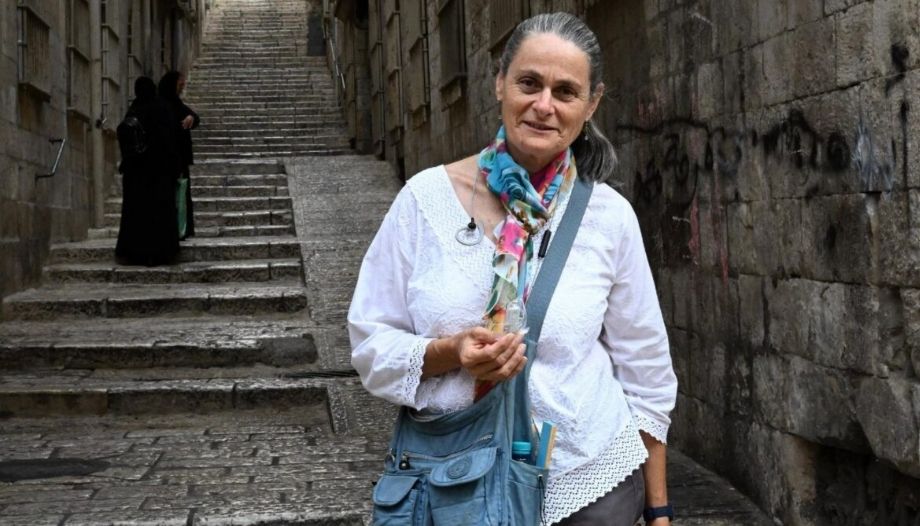
– Judith Sudilovsky, Jerusalem, OSV News
The founder of the Religious Freedom Data Center, Yisca Harani, has stated that more than 88 incidents have already been documented this year—63 of them in the second quarter alone—putting 2026 on track to exceed last year’s total of 181 cases.
“We’ve exceeded all our projections, and it’s not even the end of June yet,” he said.
Most of the incidents—which include spitting and verbal insults, vandalism, and the desecration of graves, tombstones, statues, and crosses, as well as damage to signs and graffiti—have taken place in the Old City of Jerusalem, on Mount Zion and near the Armenian Patriarchate, located on one of the routes leading to the Jewish Quarter, according to Harani, a Jewish-Israeli Christian scholar.
He added that there have also been reports of harassment, vandalism, and arson at Christian holy sites in northern Israel.
Two versions: “isolated” incidents or “an everyday occurrence”?
Although Israeli authorities maintain that these are “isolated incidents” and “pranks” carried out by a small minority of young people, most of whom are minors, Christian clergy report that it is “an everyday occurrence,” Harani said, criticizing what she called the authorities’ reluctance to treat the problem as a systemic issue.
A report is required to report incidents
Ori Narov, director of the legal department at the Israel Religious Action Center (IRAC), has pointed out that the police typically open only a small number of investigations. Of the 25 complaints filed by the IRAC between 2012 and 2021, 19 were closed on the grounds that “the suspect was not found,” that “no crime was committed,” or that the case “was not suitable for investigation,” he explained.
However, he emphasized to Christian leaders, including the Catholic clergy and the men and women religious present at the conference, on the importance of continuing to file complaints, documenting incidents, and demanding full accountability under the law.
“I have no doubt that the road ahead is long… but as we’ve already said, we’re not afraid of a long road, and we will achieve a better future,” he said.
Vandalism and Harassment Against the Sisters of St. Elizabeth
Father Stanislaw Kolakowski, speaking on behalf of the Sisters of St. Elizabeth at the New Polish House pilgrim hostel—located in an ultra-Orthodox Jewish community on the outskirts of the Old City—stated that the incidents occur in waves. Sometimes, neighbors offer friendly greetings, but the Catholic sisters have also been victims of vandalism on their property, mainly by young people, who have knocked down a stone cross, smashed a car’s windshield, trespassed, and thrown eggs, trash, and rocks onto the grounds.
As he explained, the hotline for the Data Center on Religious Freedom They have found it to be “extremely valuable” as a resource in crisis situations, as it provides guidance on “what to do, how to react, who to report a specific incident to, and how to do so.”.
Limited cooperation from state authorities
Harani described the work of the Center’s hotline, which has just celebrated its third anniversary: systematically documenting incidents, determining their scope, and presenting evidence to the authorities to reduce and, ultimately, eliminate the phenomenon. Throughout its three years of operation, he said, the initiative has experienced both progress and setbacks.
The lack of cooperation from state authorities and their tendency to downplay the severity of the problem pose a significant challenge, Harani said, as does the lack of reports of incidents within Christian communities themselves. Harani noted that many victims choose not to report incidents or contact the center’s hotline, which limits the organization’s ability to obtain a complete and accurate picture of what is happening.
Although representatives from the Ministry of Foreign Affairs, the Ministry of Justice, and the Israeli police were present at the conference, they were not authorized to make public comments.
Increased involvement of the Israeli academic community and civil society
Among the positive developments, Harani highlighted the growing involvement of the Israeli academic community.
Universities such as the Hebrew University, the Open University, and the University of Haifa have supported the research and organized conferences despite initial resistance, Harani said.
She also highlighted the role of civil society, noting that hundreds of volunteers have joined the initiative, forming what she described as the largest volunteer initiative of its kind in Israel. These volunteers provide support through a protective presence, documentation, accompanying victims, and preparing reports on the ground, she explained.
“Hundreds of Israelis, concerned and hurt by the harassment, chose not to remain alone in their despair and anger. They turned their concern into action and their pain into volunteer work,” Harani emphasized. “Every month, new people join the group of volunteers. We are ready to respond to calls to accompany, document, provide assistance, and be present on the ground whenever necessary.”.
The attack on a French nun highlights the problem
Pope violent attack The attack on April 28 against a French nun who works as a researcher at the French Biblical and Archaeological School, near the Cenacle and King David's Tomb in Jerusalem, made international headlines, as the assault was captured on security cameras.
The suspect in the attack has remained in custody ever since and is expected to stand trial for assault motivated by hostility toward a religious group.
Priest of the Latin Patriarchate
A few days before the report was scheduled to be presented on June 4, a priest from the Latin Patriarchate reported that he had been spat on and verbally abused by three young Jewish men, who also made obscene gestures at him as he was leaving a restaurant near the Damascus Gate. According to a statement he issued, the priest had been having lunch with Israeli friends, including peace activists.
According to his account, the harassment lasted several minutes, and his companions left the restaurant and confronted the young men. The priest’s friends filed a complaint with the police, despite the long delays in the process and repeated attempts to dissuade them from doing so, he added.
While acknowledging that publishing documentation on the persecution of Christians carries risks—including the possibility that it could be misused for anti-Semitic propaganda abroad—Harani insisted that transparency and the publication of data remain essential.
“We know that what we post—especially the videos—turns into virulent anti-Semitic propaganda, with consequences,” he said. “That won’t stop me from publishing the statistics, but it will stop me from doing anything sensationalist.”.
———————-
– Judith Sudilovsky writes for OSV News from Jerusalem.







 Español
  English
  Italiano