



 The creation of man. The Garden of Earthly Delights, by Bosch.Adam and Eve on trial before God. Bassano Brothers "The counterclaim to Adam"."The temptation of the first parents. Albrecht Dürer: "Adam and Eve"."
ARTISTIC COMMENTARY
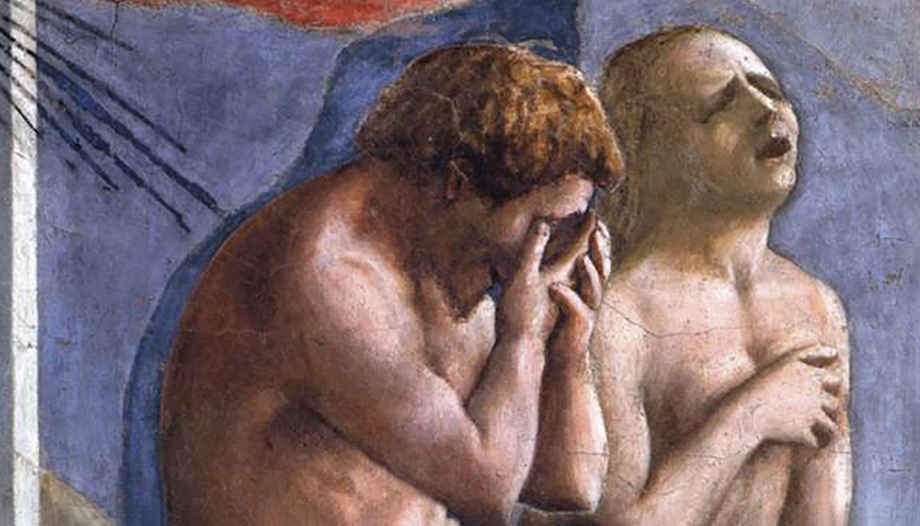
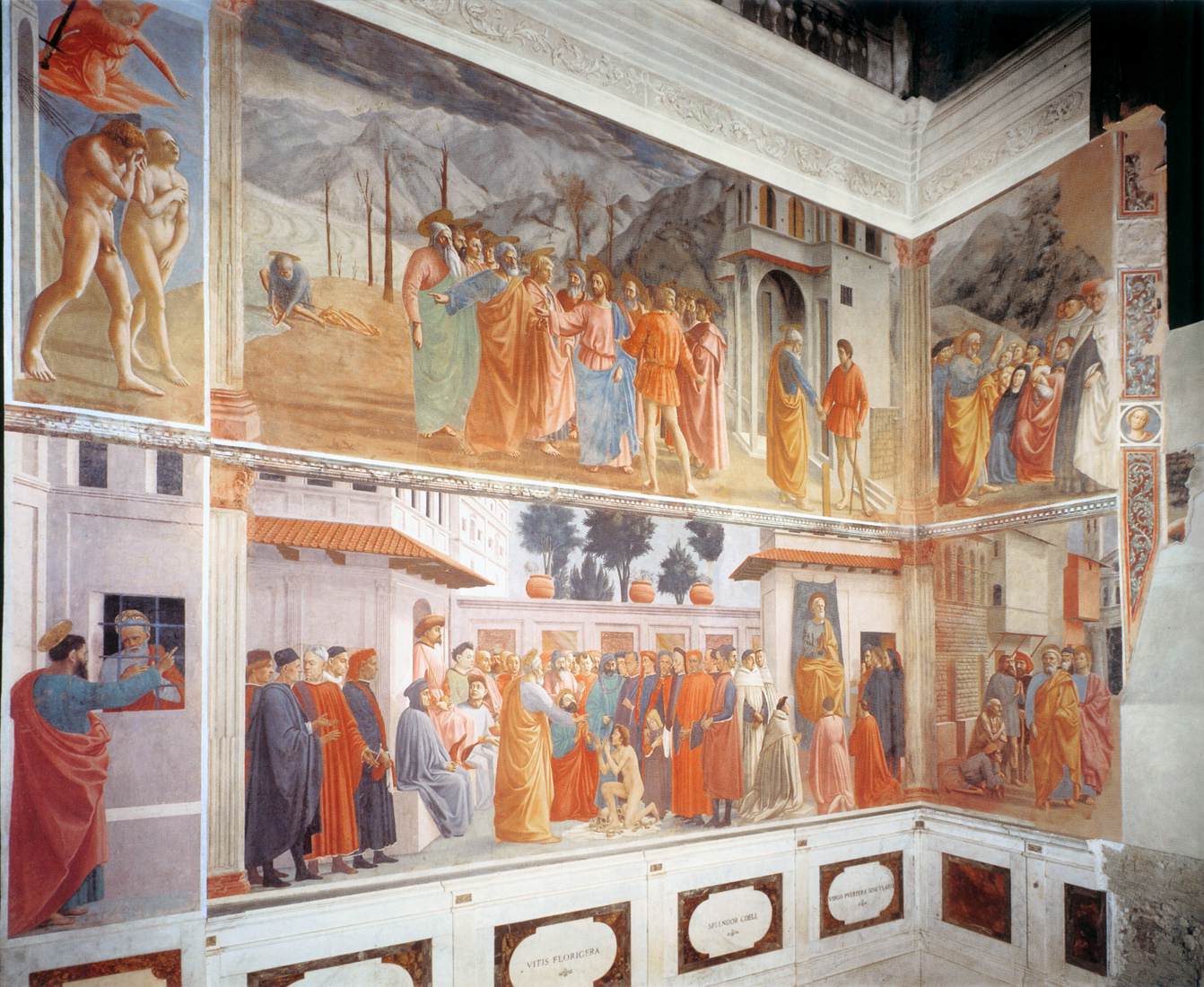
This scene is the first fresco in the series dedicated to the life of St. Peter, which, at first glance, may seem out of context. However, it has a deep theological meaning: it represents the consequences of the fall of Adam and Eve and the need for salvation offered through the Church founded by St. Peter. Placed high on the left wall of the Brancacci Chapel, the expulsion of Adam and Eve begins the narrative, setting the spiritual background for the stories that follow. Next to it, another emblematic work by Masaccio stands out, The Currency Tribute, which narrates later events.
Masaccio and the naturalistic turn
This representation of Adam and Eve is deeply emotional and charged with drama. The life-size figures are designed to be viewed from below, which enhances their visual impact. According to the biblical account, after God reprimands Adam for his disobedience (as illustrated in a work by the Bassano brothers discussed previously), he expels him and Eve from the Garden of Eden. Masaccio depicts this moment by including a foreshortened angel who, wielding a sword, expels them from Paradise. On the left, there is an illusory door, a characteristic element of international Gothic, which pays homage to the tradition of spatial realism initiated by artists such as Giotto. However, the spatial arrangement between the angel and the door seems somewhat forced. The shadows cast by the figures on the ground anchor them to the scene, providing greater dimensionality.
Adam and Eve are on the move, moving away from Eden under the watchful eye of the angel. The burden of sin is reflected in the stooped posture of Adam, who covers his face with his hands, dejected by shame. His nakedness, exposed to the viewer, symbolizes his vulnerability. Masaccio uses chiaroscuro (contrast between light and shadow) to endow Adam's body with an extraordinary naturalism; the tonalities of his torso demonstrate a technical skill uncommon in his time.
In contrast, Eva tries to cover her body with her hands, reflecting modesty and guilt. Her gaze towards the sky and her half-open mouth show us the tearing produced by guilt.
His posture evokes the classic type of the Venus Púdica, reinterpreted here to express human suffering instead of idealized beauty. In front of them stretches what looks like a desolate landscape, symbol of the consequences of their disobedience.
Restoration and technique of frescoes
Between 1988 and 1990, the frescoes in the Brancacci Chapel underwent a major restoration to remove centuries of dirt, candle smoke and repainting that had obscured their original coloring. This process allowed for a better understanding of how the artists used the technique of the buon fresh, or real fresh. In the case of The Expulsion from the Garden of Eden it is possible to observe how the figures are delimited by separate areas. The visible patches are a consequence of this technique and of the use of the giornatas, daily sections of fresh plaster applied for painting. Fresco painters had to carefully plan which areas they would paint each day, as they had to complete them before the plaster dried. Masaccio seems to have dedicated giornatas The darker shades of blue behind Adam reveal differences in the plaster layers, the result of chemical changes in pigments over time. The darker shades of blue behind Adam reveal differences in the layers of plaster, the result of chemical changes in the pigments over time. These marks, imperceptible in the 15th century, have become visible as the fresco has aged.
The Expulsion from the Garden of Eden contrasts with the rest of the scenes in the series, which are more restrained in style. Compared to the idealized and serene depictions of Adam and Eve by Dürer or Bassano, Masaccio chooses here to emphasize raw emotion. The characters show their despair; their body language expresses shame and pain. There is nothing beautiful in this scene, only the agony of realizing that they have disobeyed God and there is no turning back. Yet even in this moment of despair, hope for redemption arises. God, in His infinite mercy, sent His Son, Jesus Christ, to redeem humanity. Through Mary, the new Eve, this redemption became possible. The immaculate conception of Mary and her fiat allowed the restoration of grace by Jesus, the new Adam, who reconciles humanity with God.
CATECHETICAL COMMENTARY
The image of pain and loss that dominates the fresco painted by Masaccio for the Brancacci Chapel expresses crudely that after the original sin the whole of humanity lives in a state of exile. Indeed, the sin committed by the first human couple means that the whole of their descendants must live banished from Paradise, the garden that God created for their enjoyment when he thought of them. The mock gate to which Adam and Eve turn their backs evokes the immense goods they have lost by passing through it, and recalls, with its cold gray tone and its barren surroundings, the immense misery of the exile faced by all human life, subjected from then on to evil and death.
Indeed, sin, the true death of the soul, shows its consequences in the faces and gestures of Adam and Eve, whose crude drama reminds us of their need for redemption and justification. Not only for them, but for all their descendants, since humanity, banished from paradise, walks through history dragging its fallen nature from generation to generation, since original sin, by transmission, reaches all life that comes into this world.
All united in Adam's guilt
The unity of the human race explains this universal transmission of original sin. Indeed, the whole of humanity forms one body in solidarity, and just as the whole of humanity receives life from its first parents, so the whole of humanity is affected by the consequences of its sin. Hence, even if the sin of Adam and Eve was personal, the one body of the whole of humanity must bear its stigma. Any human being, therefore, can recognize himself in the figures of the painting, for however distant he may be from them in time, he has received by transmission the sin narrated in it.
We can say, therefore, that every human life comes into the world with the burden of original sin, although, since it is not a sin committed, but received by transmission, it can only be called, by analogy, "original sin". sin. In fact, original sin is a state, contracted by the fact of existing in a human nature, it is not a sin committed by an act of one's own will. It is not a sin in the absolute sense of personal fault that causes a greater or lesser deprivation of God's grace, but in the analogous sense of absolute deprivation of original holiness and justice.
It is this absolute deprivation that makes every human person an outcast, for the home intended by God for his creature is intimacy in his holiness and righteousness, as he came to live in the garden of Eden. Thus, the human being, bent over himself, naked, trying to cover his shame, as Masaccio paints him, is wounded and expelled from grace, but he is not completely corrupted. He is wounded, not dead; banished, but not executed; fallen, but not buried.
It is important to value this wound in its proper measure, so that it is neither ignored nor magnified. In the 5th century, St. Augustine had to refute the thesis of the heretic Pelagius, who affirmed that Adam's sin was only a bad example, a scratch on the conscience that every human being could heal with the mere strength of an austere and virtuous life. In the 16th century the heretic Luther, on the contrary, maintained the absolute corruption of human nature, whose original wound could no longer be healed but only covered. Faced with this, the Council of Trent had to recall that humanity, although wounded and subject to ignorance, sin and death, can be healed by the redemption of Christ, the new Adam who restores the human being with a universal scope. As all sinned in Adam, so all have been redeemed by Christ, and all need to embrace this redemption through the reception of Baptism.
All redeemed by the new Adam
Human nature can be restored by Baptism, which unites us to the redemptive work of the new Adam and thus converts the exile into a pilgrim who, after being baptized, initiates his return to paradise. The baptized person is justified and sanctified by the bath of the new birth, so that before him the door that Adam and Eve left behind is reopened. The hope of returning home is open to him, although this path must be traveled with effort. Baptism erases original sin and forgives his guilt, but it does not completely erase the wound of the soul, the inclination to evil that beats in concupiscence.
Hence, the baptized person's personal and communal struggle is necessary, and above all, the help of God's grace, received in baptism and guiding us along the way. This help reminds us that God neither abandoned humanity in its fall nor abandons the baptized in their daily struggle against concupiscence. Sacred Scripture, just as it reveals sin to us (Genesis 3:7-13), it also announces the permanent providence of the God who not only does not abandon, but promises future redemption (Genesis 3, 14-15).
What was promised in this Protoevangelium for all the descendants of Adam and Eve, who introduced original sin by their disobedience, has been fulfilled in Christ and Mary, in the Redeemer and his Mother, who by their obedience made reparation for the first sin. The Redemption worked by Christ, in fact, was shown first and foremost in Mary, in whose immaculate conception the original sin with which every human life is conceived was absent.
Christ is for all humanity not only the door that leads back to paradise, but the giver of a state superior to that of original justice, for, as St. Thomas reminds us, he is not only the door that leads back to paradise, but the giver of a state superior to that of original justice, “the human being was destined for a higher purpose after sin.”. The evil that we see in this image, therefore, is a reminder that, in the end, God brings out of evil a greater good, and that, as St. John of the Cross wrote, "God brings out of evil a greater good, “God wisely and beautifully knows how to bring good out of evil, and from what was our evil, to make the cause of greater good.”.
Work
Art historian and Doctor of Theology




 Español
  English
  Italiano