


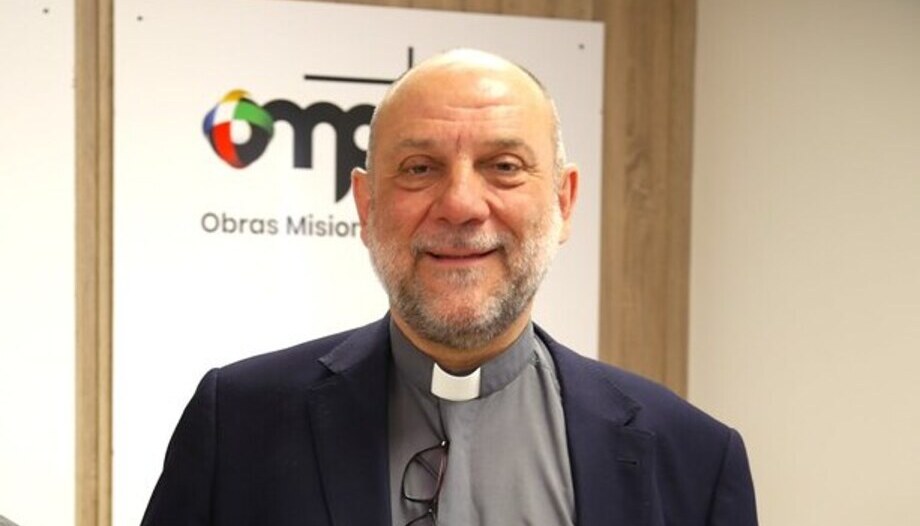
Father José María Calderón has been in charge of the Pontifical Mission Societies in Spain. A few years in which he has personally experienced the 200th anniversary of the founding of the Society for the Propagation of the Faith, the beatification of Pauline Jaricot, and the 150th anniversary of the birth of Blessed Paolo Manna.
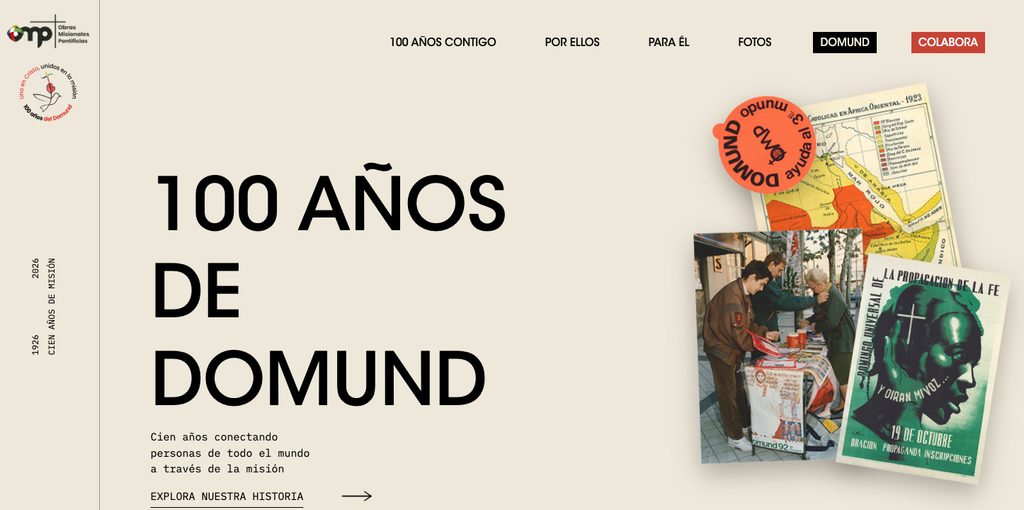
This year, 2026, the Pontifical Mission Societies celebrate another significant anniversary: the centenary of the establishment of the penultimate Sunday of October as World Mission Sunday in support of the Pontifical Society for the Propagation of the Faith. This day, observed in Spain since its inception, is one of the key dates on the Spanish Catholic calendar, thanks to the acronym DOMUND, coined in 1943 by Father Ángel Sagarmínaga, then director of the Pontifical Mission Societies.
In this interview with Omnes, José María Calderón recalls how the missionary vocation is inherent to the fact of Baptism and the permanent relevance of the mission ad gentes since "the mission, moreover, is not talking about Jesus Christ, it is bringing people closer to Jesus Christ, it is taking a person by the hand and placing them before the Lord.".
How do you summarize 100 years of history?
–One hundred years of Domund is one hundred years in which the Church wants to make aware that the mission is the responsibility of all the baptized.
Has that awareness been achieved?
–We still have a long way to go, because it never ends, but much has been achieved. Now there is a great awareness among the baptized that we are all missionaries.
In Spain, there is a palpable sense of admiration for the missions and for missionaries, because the witness of a man or woman who has dedicated their life to the Lord to speak of Him, who has abandoned their own security to show the way to heaven, is deeply compelling. It is a path that is being forged; we must continue sowing seeds, because there are still many Christians who are unaware of it, or even if they are aware, they do not live it.
There's a lot of talk about digital missionaries now. How does the mission coexist? ad gentes with these “missionaries”? What do they have in common and what makes them different?
–I believe they are distinct yet complementary concepts. We cannot renounce the digital mission, given that this sphere exists. Therefore, abandoning it would mean leaving a significant area of human life unevangelized. Clearly, we must preach Jesus Christ through all means. But this does not replace the previous mission. ad gentes.
Among other things, because the digital mission is for those of us who live here. The digital missionary, working in Madrid or Barcelona, is primarily speaking to those within their own sphere of influence—that is, those of their culture and language. It's a mission in "non-mission" territories. We cannot disregard the other side.
I was recently in St. Louis, in the United States, for the beatification of Fulton Sheen, He reached 30 million weekly listeners on his radio show. He was a true influencer, a guy who was evangelizing… In fact, the conversions that occurred thanks to his show in the United States are very well known: people from the film industry, the arts… So, it's true that digital evangelization is necessary today. We can't ignore that aspect, but we can't reduce it to just that.
The mission, moreover, is not to talk about Jesus Christ, but to bring people closer to Jesus Christ, to take a person by the hand and place them before the Lord, as Philip did with his companion Nathanael. This must be done physically; it is a personal encounter with the Lord.
World Mission Sunday is the best-known missionary day in Spain, but is it also the best-known worldwide?
–World Mission Day, what we know in Spain as DOMUND, It is the most powerful day, not only in Spain, but throughout the world. It is the day that Pope Pius XI instituted and that he wanted all nations of the world to experience.
Therefore, it is the main source that the Church has to talk about the mission, to spread the missionary spirit, to promote missionary vocations and to raise money for mission territories.
There are other, smaller campaigns, much more limited in terms of advertising and public awareness. We rely heavily on World Mission Sunday and Mission Month.
It is true that, for example, in Latin America the Missionary Childhood It's very powerful, and it hasn't been achieved here in Spain. In Latin America there are many groups; in fact, there are Missionary Childhood catechesis programs that create an environment for young people to be missionaries from a young age, but it's a very particular case.
Alongside this, Spanish society faces a problem: the missionary spirit ad gentes has been lost. This may be influenced by what we've discussed regarding the digital mission.
The social work of missionaries is a consequence of that love; they want to bring Jesus Christ to men.
José María Calderón. Director of OMP Spain
In this sense, has missionary awareness declined? ad gentes?
–There are three factors that make us give less importance to the mission ad gentesThe first is the idea that "everyone is saved." 'If everyone is saved, why would I go to Africa or Burkina Faso to preach Jesus Christ, Our Lord? Let them be saved.'.
The next idea is to confuse the work of the Church with social work based on building wells, bridges, and orphanages. If that's the case, I won't go with the Church; I'll go with an NGO, which has much more money, provides social security, and offers all kinds of support.
The final idea that erodes the missionary spirit is: “Everything is mission territory.” So, I'm not leaving here, my city, because 'we need missionaries.' These three ideas have greatly damaged the missionary mindset.
I don't know if everyone is saved. I don't know, because I haven't been to heaven yet. When I go to heaven, I'll see. But if they are saved, they are saved by Jesus Christ. They are not saved by their own merits. They are saved by the merits of Jesus Christ. What would horrify me most in heaven is running into a neighbor of mine, a guy I've crossed paths with 50,000 times here in Madrid, who might throw it in my face: 'I was saved, even though I wasn't a Christian, but you never spoke to me about God, and you never told me there was a God who loved me and a God who forgave my sins. Jesus Christ saved me, but it's also true that I, on earth, lived without the joy of faith, without the joy of feeling forgiven and loved by God, and thanks to you, I never came to know Him.'.
Of course, Spain is mission territory, and mission work must be done in Spain, but for that, we have millions of Christians in Spain. How many churches are full every Sunday? What are those Christians doing? Where are the baptized who stay here for their entire lives?
If Spain has 47 million inhabitants, let's say 30 million are Catholic. Where are those 30 million who aren't evangelizing, who aren't stirring things up, who aren't making things change? If we aren't doing it, it's because we aren't taking our Christian vocation seriously.
What we need to do is wake up so that priests, religious people and lay people take our vocation seriously and become missionaries here.
Obviously, missionaries do social work and build bridges, but they go to preach Jesus Christ, to bring the hope and love of God to men, and that is not to be confused with social work.
The social work of missionaries stems from their desire to bring Jesus Christ to humanity. When they see people in need, they try to help, but NGOs clearly have more resources and better-trained personnel—people better equipped to do the work and to do it more effectively.
So, how do we rekindle that missionary vocation ad gentes?
"It's true that the number of missionaries being sent is decreasing. We're still the leading nation in this, but the average age of our missionaries is 75, which means that in 20 years, if this trend continues, half of them will be gone. Therefore, we need to encourage missionary vocations and raise awareness.".
Do you know one of the things I love most about my job? It's given me a sense of what it means. Catholic. We are Catholics, that is to say, universal. It's a way of breaking with that impoverished, narrow-minded mentality that sees no further than my house, my group, my movement, my parish…
The Church is much bigger than all that; the Church is universal.
I cannot remain indifferent to the situation of Christians in India, the attack on a church in Nigeria, or the fact that men and women are dying right now in Burkina Faso without the possibility of confessing their sins and receiving the Lord because there are no priests. It is terrible.
We need to foster a missionary vocation in Christians. They need to discover that it's a vocation they must consider because it's important, because the Church was born to evangelize: "Go into all the world and preach the Gospel." And that "Go into all the world" wasn't just for priests and nuns... Jesus Christ said it to everyone. The entire Church needs to be aware that we must be missionaries.
The layperson has a role in the world and in the Church. They are not a substitute for anything or anyone. They do not fill the void left by absence.
José María Calderón. Director of OMP Spain
We are seeing more and more lay missionaries. Is this a growing trend?
–The number of lay people is clearly growing. Currently, 12% of our Spanish missionaries are lay men and women. Some are single lay people who go with a missionary institution, and others go with their families and bring their children, etc.
A few years ago, when I wasn't yet the director of the Pontifical Mission Societies in Spain, a priest criticized me for allowing families to go on missions because, in his opinion, it was "terrible what was done to the children, condemning them to a bad education or exposing them to diseases." I thought about how terrible it was for a priest to say that to me when I had a brother who was assigned to Brazil by his company, and everyone congratulated him for taking his children to learn a new language, a new culture... Although he was going to live very well, I wondered what was more important then, money or faith.
What a joy it is that there are men who are even willing to sacrifice the security this world offers to bring Jesus Christ to others. This is far more important than building a life free from physical or financial hardship.
If we Christians ourselves, not to mention priests, don't value that, then what are we doing?
Obviously, I can't force any married couple to choose that path. It's something they have to discover in their prayer life, in their relationship with Christ. To see that the Lord is calling them to it—which is a commitment that entails a great deal. And it's true that lay people have more problems than priests or religious men and women, because a family that goes to Africa or Asia has to sell a house, or close it for a few years; give up their professional work… But, thank God, the Church is also there, collaborating and helping, and trying to meet the needs of the missionaries.
Furthermore, regarding this, we must dispel a completely false notion: that the lay missionary is a substitute for the priest. In other words, missionary vocations among the laity are not encouraged because there are no priests. No. The layperson has their role in the world and in the Church. They are not a substitute for anything or anyone. They do not fill the void left by priests. They will fulfill their lay vocation wherever they are and will be witnesses of Christ wherever they live.
The layperson has the missionary vocation as a gift from God and carries the faith from his vocation as a man, as a woman, single or married with children, showing the world the light of Christ without replacing anyone, feeling, perfectly, the architect of the mission.
That “Go into all the world” wasn’t just for priests and nuns… Jesus Christ said it to everyone. The entire Church must be aware that we have to be missionaries.
José María Calderón. Director of OMP Spain
Looking back on a centenary is wonderful, but we also have to think about the future. How do you see the future of the PMOs?
–I could say that just surviving is enough, but no. The first director of the Spanish Pontifical Mission Societies, Father Ángel Sargarmínaga, who coined the acronym DOMUND, spread missionary awareness throughout Spain in a spectacular way. He traveled all over the country, went to every seminary, giving retreats to all the priests, meetings, talks, and conferences.
Spain has a missionary mindset thanks to what he sowed and others continued. I hope to follow in his footsteps in that regard, and that those who come after me will continue to do so.
We cannot cease to be that "conscience" in Spanish society, lest we forget that the Church is greater than my diocese, my parish, or my group. We must remind all the baptized that the mission is not something foreign to them or something in the hands of others who are very good and admirable. No, no, no.
You are also part of that mission, and if you don't live it, you are neglecting the commitment that God has placed in your hands.
You will experience it in one way or another: through prayer as cloistered convents do; through sacrifice and offering your illnesses, as missionary sick people do; through missionary outreach; through your financial contribution or through your means of communication.
We want this to never end. We want to continue fulfilling our obligation as pontifical missionary works to be a reminder of the life of Christians, beginning with the bishops and ending with the last of the baptized.
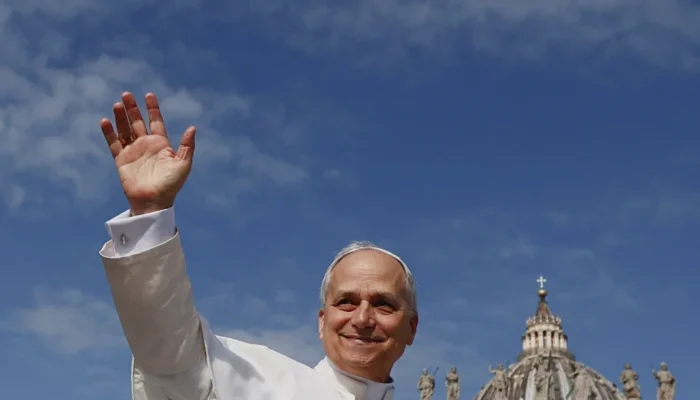
You are celebrating your 100th anniversary with a missionary Pope at the helm. Did Leo XIV have a special sensitivity towards mission?
One thing before anything else: All Popes are missionaries by virtue of being Popes, since mission territories fall under their responsibility even if they have never set foot in them in their lives, and their function is to evangelize the whole world, therefore, they are missionaries.
It is true that Leo XIV has an 'extra' advantage: he has lived the mission. He has a very clear sensibility and, in fact,the first time he received us, the directors of the PMOs Shortly after his election as Pope, he told us that his predecessors had spoken of the mission and the Pontifical Mission Societies based on their knowledge, but he spoke from his own experience and gave thanks to God because the PMS were the Church's instrument for carrying out its mission. I believe that Leo XIV had a great love for the evangelizing work of the Church and its missionaries. .
Furthermore, the mission is not to talk about Jesus Christ, but to bring people closer to Jesus Christ, to take a person by the hand and place them before the Lord.
José María Calderón. Director of OMP Spain





 Español
 English
 Italiano
 Français
 Deutsch
 Polski