


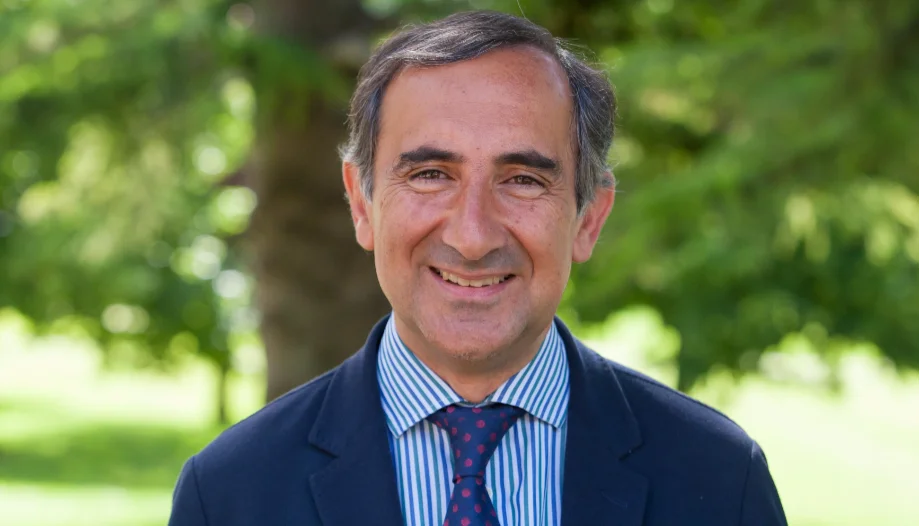
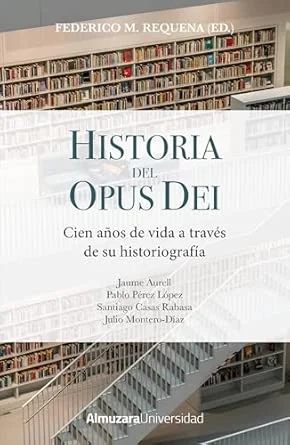
As it approaches its centennial, Opus Dei continues to be viewed in a distorted light by the public. What are the reasons for this perception? Is it the result of a “black legend” fueled from outside? Marking this centennial milestone, historian Jaume Aurell co-authors History of Opus Dei. One hundred years of life through its historiography., an analysis that seeks to shed light on various issues from a historical perspective.
We spoke with Aurell to trace the historical origins of these prejudices and understand why, a century later, the institution continues to face the challenge of explaining its identity and history to society.
Almost everyone in Opus Dei has been asked at some point why the public image of the organization is so different from the reality one experiences when getting to know someone from the Work. Why is this the case?
–Because Opus Dei’s public image has not been shaped by looking at what the institution truly is, but rather by projecting onto it the fears and obsessions of each era. I have studied this using the theory of metanarratives: these are narratives that act as a mirror, in which each generation sees reflected what obsesses it, projecting it onto the organization.
What exactly do you mean when you say those narratives are «presentist»?
–Because we judge the past using the standards of the present, rather than understanding it within its own context. It’s a phenomenon we see in many other areas: today, authors like Shakespeare, Mark Twain, and Agatha Christie are censored because their works contain expressions or stereotypes that we now consider offensive, but which were within the bounds of social convention in their time. Something similar has happened with Opus Dei, but over the course of a hundred years and through three different—and even contradictory—narratives.
Let's talk about those stories. Which one was the first?
–Opus Dei was viewed as a religious heresy between 1940 and 1957. And here’s the curious part: this view did not originate among anticlericals, but within the Church itself. Some Jesuit priests, such as Ángel Carrillo de Albornoz and Manuel María Vergés—who were linked to the Marian Congregations—began to characterize the institution’s doctrine as a dangerous heresy that had to be eradicated before it took root.
Why did such a hierarchical Church see a threat in something as simple as living out one's faith in daily work?
–Because in the pre-conciliar Church, the laity were second-class members of the faithful. The idea that ordinary young people, dressed in suits and ties, without any religious habit or distinctive mark, could claim to attain holiness through their ordinary work seemed strange and even suspicious. They were called «Enlighteners» and accused of stealing religious vocations.
And almost at the same time, political suspicion arose, with the Falange involved.
–That’s right. The Falange, which wanted to maintain its position as the sole political party, saw Opus Dei as a threat. In 1941, a formal complaint was even filed with the Special Court for the Suppression of Freemasonry and Communism, accusing Escrivá and his followers of plotting something «Judeo-Masonic.».
Were there any other accusations against the Work before Escrivá moved to Rome?
–Yes, they were also accused of «taking over university professorships.» Between 1940 and 1945, 179 university professorship positions were filled in Spain. Of those, only 23 went to members of Opus Dei: 6%. This is far from the massive takeover suggested by the legend.
The story took a dramatic turn in 1957. What happened?
–Yes, a dramatic turnaround. Franco, forced to abandon the Falangist economic autarky, brought in experts such as Mariano Navarro Rubio and Alberto Ullastres—both members of Opus Dei—who designed the 1959 Stabilization Plan and the subsequent Spanish «economic miracle.» The Falangist factions, resentful of their loss of power, then coined the label «Opus Dei technocrats» and accused them of seizing power
From heretics to powerful allies of the dictatorship.
–Exactly, and that image spread worldwide through magazines such as The Economist o Time, and was reinforced by books written by anti-Franco authors such as Daniel Artigues and Jesús Ynfante, who coined the term «Santa Mafia.» Once again, politics and religion became intertwined. At the same time, within the Church, the Second Vatican Council politicized the debates between «progressives» and «conservatives,» and the institution was branded as «fundamentalist,» even though it had originally been considered too “innovative.”.
Was there also pressure from the Vatican itself?
–Yes, between 1967 and 1973, figures such as Giovanni Benelli and Jean Villot pressured Escrivá to have Opus Dei act as a political bloc aligned with European Christian Democracy. He refused, defending the individual political freedom of each layperson, and that cost him six years of estrangement and mistrust on the part of the Curia.
We've reached the third wave—the one involving the cult and the financial scandals.
–Starting in 1980, as societies became more secularized and individualistic, values such as lay celibacy and mortification began to be interpreted through the lens of a growing media phobia against Catholicism. In this context, Opus Dei was seen as a reactionary and conservative force.
Its establishment as a Personal Prelature in 1982 and the beatification of its founder in 1992 sparked a new wave of criticism, with testimonies from critical former members.
And that's where the word «sect» comes up, too.
–Exactly, the international press, with The Times At its helm, it abandoned the framework of political power and adopted the paradigm of sectarianism. In Germany and Italy, theories about «brainwashing» promoted by anti-cult organizations circulated to such an extent that they prompted an attempt by the Italian Parliament to launch an investigation in 1986, which ultimately did not take place because it was dismissed as baseless slander.
What about the financial scandals attributed to him?
–These are three distinct cases that public opinion loosely linked together: the Matesa case in 1969, the Calvi and Banco Ambrosiano case in 1982, and the Ruiz-Mateos case in 1983. These are very different episodes, but popular narrative linked them together as if they formed a single plot related to Opus Dei. When one studies these cases with even a modicum of seriousness, one realizes that they stem from completely different economic contexts and involve entirely different political actors.
So why did they work?
–Because of something that happens very frequently with Opus Dei: people confuse the professional conduct of its members as if each one were following orders from the organization. Obviously, this is not the case for most members, who have ordinary jobs with no particular public relevance. However, if someone holds a high-level position in politics, banking, law, or the arts, then their actions come under the microscope of suspicion. Although it may be hard to admit, there is still an underlying clerical bias in many of these interpretations.
And it all culminates with Dan Brown.
-With The Da Vinci Code, in 2003, and its film adaptation in 2006. There, all the myths that had accumulated over decades are fused into a pop-culture caricature—the albino killer monk—which achieved enormous commercial success at the expense of reinforcing the dark legend.
The most striking aspect of your analysis is that Opus Dei has been accused of things that are completely contradictory depending on the era.
–This is proof that these narratives are artificial constructs. In the 1940s, he was accused of heretical innovation for defending the sanctity of laypeople without religious habits or vows; from the 1960s to the present, he has been accused of the opposite—of being ultra-conservative and reactionary.
During World War II, some denounced Escrivá as pro-German to the Allies, while others denounced him as pro-British to the Germans and Italians at the same time.
In Spain, he was accused of being the ideological pillar of Francoism, when in reality he was persecuted by the Falange itself, and some of his children were forced into exile to join the opposition.
And from a sociological perspective, it has been described both as a modernizing form of «Catholic Calvinism» and, today, as an obscurantist stronghold opposed to individual autonomy.
Your analysis of the text stops in 2010. Why don't you analyze the last fifteen years, including all the recent controversy?
–Because I am a historian, not a journalist or a current affairs analyst. The historian’s craft requires temporal distance and perspective: archives must be opened, testimonies must be cross-checked, and the passions of the present must cool before we can judge rigorously.
To write about what has happened in recent years without that perspective would be to repeat the very mistake I denounce in the book: getting carried away by the dominant narrative of the moment—however well contextualized—rather than analyzing the facts with the time needed to separate myth from reality. In twenty or thirty years, another historian may be able to do for this most recent period what I have attempted to do for the previous century.
In closing, what do you hope readers will take away from this journey through a hundred years of stories?
–Let them learn to be wary of easy labels. When an institution does not fit into the dominant ideological categories of its time, society tends to distort it in order to classify it. Understanding these mechanisms is useful not only for evaluating Opus Dei, but also for reading any historical narrative presented to us as definitive with a more critical eye and contextualizing it appropriately. In the text, I illustrate this with the absurdity of dividing the Spanish Civil War into fascists and communists, as many attempt to do today: this is not manipulating the past—by simplifying it—in order to to use it in today's political contests and create an unwisely unnecessary polarization.
History of Opus Dei. One hundred years of life through its historiography.






 Español
  English
  Italiano