


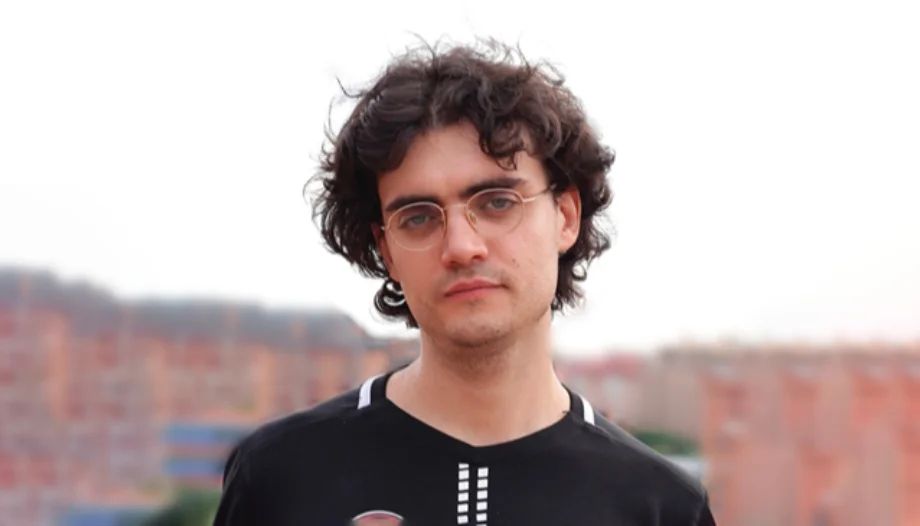
Ernesto Castro Córdoba (Madrid, 1990) has established himself as one of the most distinctive and prolific philosophers, essayists, and popular science writers on the contemporary intellectual scene in the Spanish-speaking world.
Born into an environment of intense intellectual debate as the son of the renowned art critic and philosopher Fernando Castro Flórez, he earned his bachelor’s and doctoral degrees in philosophy from the Complutense University of Madrid. Throughout his career, he has taught at the University of Zaragoza, at the Complutense University itself, and, more recently, as a professor of Aesthetics at the Autonomous University of Madrid.
He stands out as a prime example among his generation millennial thanks to his extraordinary ability to blend high academic culture with mass phenomena of the digital age, demonstrating a conceptual rigor that neither undermines the former nor condescends to the latter. Ernesto Castro first came to prominence 13 years ago when, at the age of 25, he began a channel In his *Philosophy* journal, he published his university lectures and his analyses of the great works of philosophy.
The videos had no technical flourishes, no background music, and no flashy editing. Just a young man sitting at his desk at home, recording reflections that often lasted more than an hour and a half. More than 300 videos containing 1,000 hours of thinking out loud.
What set this channel apart from conventional media coverage was Ernesto’s approach—his effort to understand the authors rather than simply criticize them. In an intellectual environment where hasty criticism is often mistaken for intelligence, this is a rare virtue. And he did so from an unequivocally leftist stance—an enthusiastic heir to the 15M movement in which he participated—without letting that prevent him from delving rigorously and respectfully into the great Christian thinkers: Augustine, Thomas, Bonaventure, and also lesser-known figures such as Nicholas of Cusa, the authors of the School of Salamanca, Peter Abelard, and Hugh of Saint Victor.
That channel had amassed 170,000 followers. Then one day, it disappeared—out of the blue. Ernesto shut it down just as decisively as he had built it up.
A thinker with radical convictions
Ernesto Castro was always a man of firm and radical convictions. This held true whether he was criticizing the left—of which he was an enthusiastic supporter—or denouncing the mediocrity that had taken root in Spanish universities, where critical thinking is often buried beneath layers of jargon and corporatism.
His philosophy was rooted in both reflection and real-life experimentation. It wasn't uncommon to see him with his hair dyed extravagant colors, or to see him show up to class with a huge tonsure that made him look like a medieval monk transported to the 21st century. Ernesto wasn't a regular guy, and that was precisely what made it extraordinary.
When he was assigned to the University of Zaragoza—his first post outside of the Complutense University of Madrid—he complained about having to teach the same courses year after year. And not because he disliked the subjects—he loved them, and it showed—but because he hated having to explain the same thing twice. His argument was as simple as it was devastating: «My classes from last year are already on YouTube; anyone can watch them.» Ernesto liked to learn and explain things he didn’t yet know. He stood at the opposite end of the spectrum from the mundane comfort zone that characterizes far too many professors.
In addition to that immense intellectual capacity and integrity, he possessed a breadth of culture that extended beyond philosophy into literature and poetry as naturally as a river overflows when it rains too much.
Conversion
A few months ago, Ernesto Castro was baptized and received his First Communion. He converted to Christianity.
It's not easy to know exactly what happened inside, although he has shared some details about his conversion in a podcast and an interview in El Confidencial at the beginning of the month.
It may have been primarily an intellectual conversion—the culmination of a very long journey of reading and of being honest with himself about what those readings raised for him. There may also have been a mystical rapture, a personal encounter with Jesus Christ that defied all rational explanation, or an existential void that no philosophy could fully fill. Probably all of these at once, blended in proportions known only to him.
According to what he has said publicly, the final catalyst for his conversion had to do with a severe bout of depression he was going through and a pilgrimage to the Virgin of Montserrat that his wife suggested he take.
Be that as it may, it is significant that someone who for years has been commenting on the great classics of the history of philosophy has taken the leap to reading the encyclicals published since the 19th century with the same seriousness and rigor he devoted to Aristotle or Marx. It is a gesture that reveals the journey of someone who follows ideas wherever they lead, even if the destination wasn’t on the map.
I also don’t know if the famous debate that Diego Garrocho and Miguel Ángel Quintana Paz sparked a few years ago in Spain—regarding the lack of credible Catholic intellectuals in the public sphere—had any influence. Perhaps he read the numerous publications and attended the many conferences that were organized. But what is truly a cause for great joy is that one of Spain’s most promising young intellectuals has taken that step and speaks clearly about it in interviews and podcasts, without euphemisms or apologies. Although he has much to learn, much to experience, and much to enjoy in Christianity, Ernesto’s conversion could be that of a young St. Augustine or Chesterton. Time will tell, but he certainly doesn’t lack intellectual potential or youth.
Although he has read more than most people his age, what is most moving about his new Christian life is the humility with which he speaks of his faith. He considers himself the least of the neophytes. That humility in the face of what he cannot control, coming from someone with his background and temperament, is in itself a testimony.
The Papal Chronicle: In Theos
Ernesto Castro published on Spanish —a newspaper to which he regularly contributes— a very long and personal account of Pope Leo XIV’s trip to Spain. The text is an exercise in enthusiasm in the etymological sense of the word: in Theos, to be filled with God. But also to retain a critical spirit, a recognizable sense of irony, and the ability to view with detachment the very things that matter deeply to him.
The chronicle begins with an image that only someone from Ernesto Castro’s background could describe—one that, in just a few words, encapsulates the entire journey he has taken: «I don't know about God, but if Nietzsche weren't dead, that postmodern performance would have finished him off.».
Nietzsche is left behind from the very first paragraph. What follows is a description of a physical presence that has something of a confession about it, almost like a stocktaking on one’s knees: «On my knees, on a balcony under construction at the Sagrada Familia. On my knees, in the crowd and in the press area. On my knees, going to confession and receiving Communion before one of the hundreds and hundreds of concelebrants of His Holiness.»
And regarding the encyclical Magnifica humanitas In the letter with which Leo XIV traveled to Spain, the tone becomes even more strident: «Magnifica humanitas—the first encyclical with which Leo XIV has journeyed to Spain, like a baker delivering freshly baked baguettes of salvation door-to-door—is a masterpiece in that delicate art of papal conciseness. I read its first two chapters on my knees, weeping with joy.»
But where the account becomes most surprising is in its portrayal of the volunteers of the Papal Committee, in whom Castro discovers, against all ideological expectations, something unexpected: «I will soon discover that these coordinates are—one of the great discoveries of this journey—the most coherent forms of feminism and acracy I have ever encountered. Radical, matrix-based feminism and acracy driven by faith, you might say. If there is anyone in this world who puts charity before the law, if there is anyone who puts into practice equality rooted in the human matrix, it is these utterly charming ladies of the Committee.»
And he immediately adds, with the honesty that always characterized him, the question he never got to ask—and the practical reason why he couldn't ask it: «I would have liked to ask them about the protests calling for female priests in the Catholic Church as well. But they’ve been so busy saving my ass, making sure the police didn’t arrest and handcuff me for being more Catholic than the Pope, ensuring I was allowed access to the events, the press pools, the photo zones, the armored buses… All in all, they’ve been so busy playing boss—good bosses, caring and empathetic bosses—that I haven’t been able to ask them my little protest questions.»
There are two short sentences that are worth reading together, because their apparent contradiction encapsulates the entire journey of conversion: «I don't know at what point, caught up in the Roman frenzy, I forgot about the classic »Fuck tha Police!« and »ACAB.'" "I don't know at what point I joined in the cheers the crowd was directing at the police.".
And Ernesto himself answers his own question with a scene that has something of a Roman Pentecost about it, with a Madrid accent: «Well, I do know. After the Holy Mass of Corpus Christi, a million and a half of us faithful were walking through the streets around Cibeles, reeking of the risen Christ, accidentally trampling the flower beds (how beautiful, but so fragile, those white and yellow flowers!), peeing and pooping ourselves, but with the Spirit clamping down on and blocking our sphincters. We were on such a Catholic high that we would have cheered even a chair.»
Not even the euphoria makes him lose his sense of proportion. The chants, repeated ad nauseam, draw his ironic commentary—and his simultaneous defense: «Well, it’s not all going to be «Pope Leo / we love you so much!» and «You can see it, you can feel it, / the Pope is here!» and «The Year of Gaudí, / the Pope is here!» and, of course, «This is / the Pope’s youth!»» All of this chanted amid pre- or post-ironic tears. No, the only objective and real irony is that of our faith, which drives us to follow the Pope for a week, going to bed and getting up at dawn, sleeping only a few hours a day, only to end up exhausted halfway through the rosary, like another apostle at the foot of his olive tree.”
A revealing moment in his account is the section he devotes to the small anti-clerical demonstration he stumbled upon. Ernesto went to see it as if he were visiting a neighborhood from his childhood. What he found was something else entirely: time has passed very differently for some people than for others:
«Of course, there were already people fed up with this theophany before it had even begun. Two days before that clown touched down, some twenty anticlerical organizations called for people to take to the streets and squares. One street and one square, specifically, in Madrid. That’s where this sinner happened to be, hoping to refresh his memories of his post-adolescent, anti-WYD days. Back then, in 2011, several thousand of us «Indignados» protested against World Youth Day, which drew two million kids to Madrid, stealing the spotlight and the square from our meticulous, horizontal, and deaf-mute assemblies. Our marches began with us shouting absurd fiscal accusations at pilgrims who didn’t understand the local language—and even if they had, it was absurd to shout, «That backpack—I paid for it!» in reference to the symbolic gift they’d received from the government—and ended in the usual cycle of getting ourselves arrested at demonstrations calling for the release of »the women detained” at previous demonstrations.”
What he found in 2026 in that same place was this: «About thirty elderly men and women—the men bald and potbellied beneath Republican soccer jerseys, the women with gray hair dyed green, red, or purple—crossed their fingers as they waited for the microphone to be disconnected from the loudspeaker. Despite the shrill beeping in the background, they were barely noticeable in the enormous plaza in front of the Reina Sofía Museum, where people were still lining up at the entrance and lingering on the terraces as if there were no tomorrow. By the old woman’s count, each organization had mobilized 1 and 3/4 protesters, as in the best Western birth rate statistics. «This is not / the Pope’s youth,» we chanted eristically in 2011. In 2026, there’s no need to chant it. The only audience under 40 that the anticlericals briefly enjoyed were two museum ticket clerks, with nothing better to do during their smoke break.»
Irony isn't cruel: it's the realization of someone who was on that side and acknowledges, without schadenfreude, that the world has changed in ways their former certainties did not foresee.
His intellectual journey
His philosophical trajectory can be seen as a constant shift between hard theory, cultural criticism, and lived experimentation, unfolding in three distinct phases. The first, between 2011 and 2015, finds him as a thinker a staunch opponent of relativism: his work Against Postmodernism He argued for the need to restore truth and political commitment in the context of the socioeconomic crisis and the 15M movement. He was still part of the left at that time, but he already suspected that something was fundamentally wrong.
The second period, from 2016 to 2019, is that of its pop twist: the application of classical philosophical tools to the analysis of mass culture, which culminated in Trap: A Millennial Philosophy for the Crisis in Spain, a book that managed to capture the generational divides in a way that conventional scholars could not.
The third one, between 2020 and 2021, led him to the ontology and speculative realism: his Post-Continental Realism It is now a seminal work in Spanish that systematizes the contemporary «realist turn,» distancing itself from both analytical idealism and continental deconstructionism.
There is now a fourth chapter that does not yet have a title, but which is, in a way, the most radical of all: that of someone who has come to the faith after having understood it better than most believers. Castro still has a long way to go in his Christian life, and he himself knows it and says so. But it is very promising that a person of his intellectual stature is now part of the Church and is working for the Kingdom of Heaven.





 Español
  English
  Italiano