



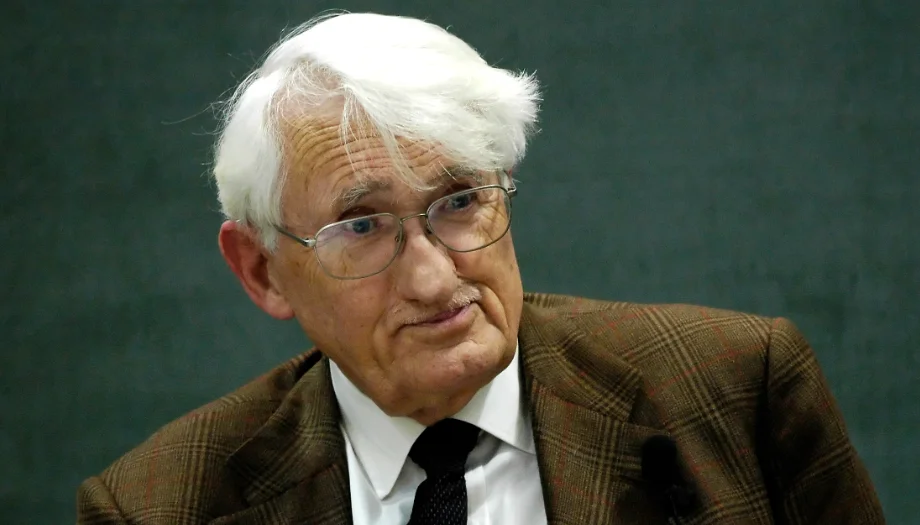
At the beginning of the millennium, the world watched in horror as religious fanaticism brought down the Twin Towers. In 2001, as images of the disaster circled the globe, a disturbing question arose: were we facing a new religious war in the 21st century? Today, with the echo of similar conflicts in places such as Gaza, Iran or Ukraine - not very religious wars - this reflection takes on a new relevance. It was in this climate of perplexity that Jürgen Habermas received the national booksellers' prize at the Paulskirche of Frankfurt. This recognition marked the beginning of an intellectual shift to what is now called the “post-secular society. Habermas observed that in the aftermath of the tragedy, churches, synagogues and mosques filled up, and not necessarily to cry out for revenge.
In this analysis, Habermas found an unexpected interlocutor in Joseph Ratzinger, then Prefect of the Congregation for the Doctrine of the Faith, who argued that Islamic fundamentalism had more similarities with Marxism than with Islam. This parallel between the neo-Marxist philosopher and the dogmatic theologian laid the groundwork for the historic meeting that was to take place two and a half years later in Munich. That meeting at the Catholic Academy of Bavaria in 2004 between the post-Marxist philosopher and the then Cardinal Ratzinger was not a simple academic talk, but an effort to find the “pre-political moral foundations” that sustain a democratic and pluralistic society.
The meeting of two worlds
The dialogue brought two seemingly opposing figures face to face: the epigone of the Frankfurt School - someone “with a poor musical ear for religion” - and one of the most influential theologians of contemporary Christianity. Both shared a common concern about the fragility of the liberal state. Habermas recognized that the ethical foundations of the modern state have a religious origin, even if today they are expressed in a rational and secularized form. Ratzinger argued that Church and State must maintain their autonomy - “render unto Caesar what is Caesar's” - rejecting any attempt to return to a confessional State.
One of the points of greatest friction was the conception of truth. For Habermas, it is the fruit of dialogue and consensus; for Ratzinger, dialogue is the fruit of a prior truth, to which we can have access through reason. Ratzinger appealed to the need for a right that is above the “law of the strongest”. Recalling the Nazi barbarism that both lived through in their youth, the theologian warned that the simple consensus of the majorities is not enough to establish human rights; a higher instance is required to protect the dignity of all.
The enlightened philosopher and the theologian of reason
Jürgen Habermas represented the culmination of the project of modernity, an enlightened man who dedicated his life to the theory of communicative action and the defense of democracy. His approach was post-metaphysical: for him, truth is a construct that flows from the symmetrical dialogue between free citizens. In his scheme of things, the liberal state must be neutral and legitimized through democratic procedures, without the need for direct religious support, although he recognized that religion contains meaning that society cannot ignore.
Joseph Ratzinger personified the synthesis between Christian faith and philosophical reason. As a participant in the Second Vatican Council and a theologian between two millennia, Ratzinger always defended Christianity as an enlightened religion that, from its very origins, opted for the logos in the face of myth. He did not take refuge in syncretism or mere symbolism, typical of Eastern religions. His thought, deeply influenced by figures such as Augustine, Bonaventure and Thomas Aquinas, maintains that human reason is capable of knowing objective truth and that natural law constitutes the necessary refuge against the arbitrariness of power. For Ratzinger, truth is based on the person of Jesus Christ, accessible through a reason open to transcendence. The divine Logos is the foundation of the logos of all things, which in turn may be understood by the logos human (cf. Jn 1.1.3.14).
Reason and religion: curing each other's pathologies
Perhaps the most luminous conclusion of that meeting was the proposal of a necessary collaboration to avoid the “pathologies” of both sides. Reason and religion must be cured of their respective pathologies. Reason as medicine must purify religion, to prevent it from falling into fanaticism or fundamentalism that kill in the name of God. Religion as a limit must prevent reason from falling into fanaticism or fundamentalism that kill in the name of God. hybris and engenders “monsters” like Auschwitz, Hiroshima or Chernobyl. “The dream of reason produces monsters”, I could quote Goya, evoking the historical errors caused by a modern reason, isolated from ethics, art, feelings, religion.
The lesson was clear: in an increasingly fragmented public sphere, it is vital to recover concepts such as conscience, justice and a broad notion of human nature. The agreement reached by Habermas and Ratzinger demonstrates that, even from divergent positions, it is possible to build a common ground where faith and reason help each other to become more humane.
This dialogue was later continued with the famous speech delivered in Regensburg in 2006, in which Ratzinger - already as Benedict XVI - made a commitment to “expanded reason”. As opposed to a purely instrumental or mathematical reason, the Bavarian pope called for an open reason. Habermas replied in the Neue Zürcher Zeitung, qualifying it as the Vorlessung as “anti-modern”. But then he partly retracted this at a subsequent meeting in Rome the following year, returning to the initial position he had set out in Munich years earlier. The game then ended in a draw. Perhaps now they can continue it.




 Español
  English
  Italiano