


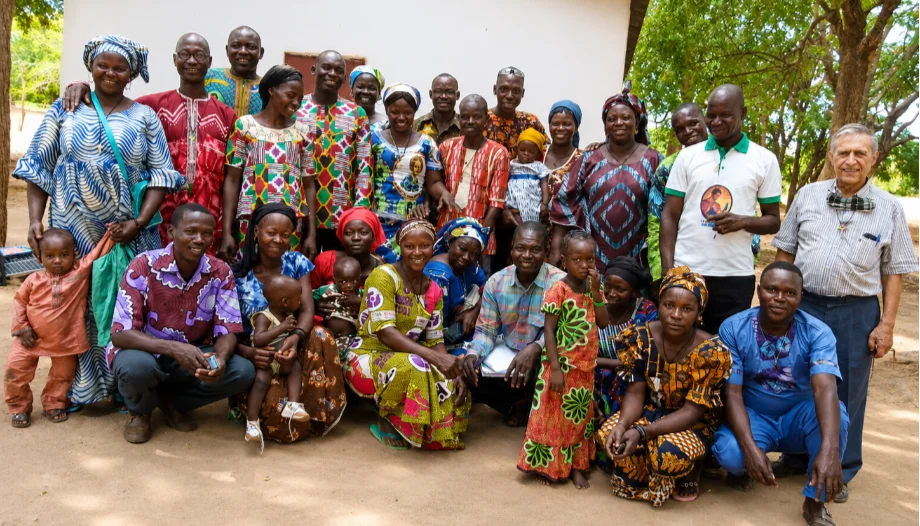
For years I have been explaining to people unfamiliar with the context of the Church in Africa why, in our dioceses, not everyone who wants to be baptized can do so immediately, nor under the same conditions. The most common reaction, at least among those coming from Europe, is one of some perplexity. Isn’t baptism a free gift? Isn’t the Church an open door? Yes, of course it is. But the fact that the gift is free does not eliminate the need to receive it under conditions that will make it fruitful; that is why the Code of Canon Law requires priests to ensure that there is a serious commitment to living out the Christian life after baptism.
What we do here is pastoral ministry applied to concrete realities, with canon law as our framework and the good of the people as our guiding principle. Depending on the nature of each case, we act in one way or another.
Infant Baptism
The first thing that strikes someone coming from outside is just how strict our regulations are regarding the baptism of young children. In a parish like mine, very few children are baptized over the course of an entire year. The reason is that a child’s baptism commits the parents to providing a genuine Christian upbringing, and if that upbringing cannot be guaranteed, the sacrament becomes a mere formality with little future.
In order for a child to be baptized, we require that both parents be baptized, that they actively participate in the life of the community—not only Sunday Mass, but also the specific tasks that sustain the parish—and that the Christian upbringing of their children already born be evident. Whenever a baby is born, the child is presented to the community and receives a solemn blessing on Sunday, in front of everyone, together with his or her parents. It is a beautiful and meaningful gesture. But it is not Baptism. Baptism will come when there is soil in which the seed can grow.
The Church acts this way because Canon 868 of the Code of Canon Law stipulates that, in order to lawfully baptize a child, there must be «well-founded hope that the child will be raised in the Catholic faith.» We simply take that seriously. And the results confirm it: children who are baptized under these conditions grow up in families where faith is a living reality, not merely a cultural tradition.
Women with polygamous husbands
The most common and most sensitive case in our context is that of a woman married to a polygamous man. Here, the Church could take a rigid stance and say: no to polygamy; no to baptism either. But that would mean abandoning people who, in many cases, have not freely chosen that family situation. Dowries, agreements between families, and social pressure shape—and in some cases determine—the course of one’s life.
When a woman enters the catechumenate and her husband is polygamous, the first factor that determines whether she can be baptized is her position within that structure: if she is his first wife, she may enter the normal catechumenate and, upon completing it, be baptized. The husband must give his explicit consent—it must be documented in writing that he accepts his wife’s faith and will not prevent her from being baptized—but the woman is not responsible for her husband’s family situation in matters beyond her control.
Why this distinction between a first and a second wife? Because the second or third wife of a polygamist has, in a sense, entered into a union that the Church cannot recognize as a marriage. Not because she is any less worthy, but because Christian marriage is a covenant between two people, and her inclusion in that structure would imply the Church’s tacit endorsement of polygamy. The Church cannot do that. But neither does it abandon that woman. She can undergo the catechumenate, participate in parish life, and receive a blessing in times of difficulty.
It falls into the category of what we call friends o supporters: people who have received a baptism of desire, who live their lives guided by their faith even though circumstances do not yet allow for the full sacrament. If life circumstances were to change in the future—for example, due to the death of her husband—the situation would be resolved without any problem, since that woman would then be able to live her faith fully and consistently.
When one of the two is already a Christian
Another common situation involves a couple in which one partner has already been baptized and the other wishes to begin the catechumenate. In this case, the couple’s prior marital status—whether they are married, the nature of their marriage, and whether the necessary cultural requirements have been met, particularly the payment of a dowry—must be clarified before baptism.
For example, if a woman wants to be baptized and is going to marry a Christian, we have to check whether the dowry has been paid—but keeping in mind that the dowry isn’t like it used to be in Europe— here the man pays it to his wife’s family as a guarantee that he considers her a truly valuable woman and is committed to treating her with dignity. The dowry is a cultural element with profound significance in these societies: it expresses recognition of the woman’s family, formalizes the bond between the two families, and guarantees a certain level of social protection for her.
A couple in which the dowry has not been paid lives, from the perspective of the local context, in an irregular situation. The Church cannot ignore this. We hold a meeting with the couple and their godparents to assess the actual state of their family life. In such cases, baptism takes place at the end of the catechumenate and only if the situation has been resolved.
When both ask to be baptized at the same time and begin the catechumenate together, that is the most beautiful and simplest scenario. We see them every Easter: couples who have decided together to take that step. That is the ideal we strive to support.
The Case of a Woman Married to a Muslim Man
Perhaps the most complex case is that of a woman whose husband is Muslim and who is seeking baptism. Here, there are several factors that must be met simultaneously, and none of them is negotiable.
First: She must be the first wife. For the reasons already explained regarding polygamy, we cannot baptize a woman who is the second or third wife in a polygamous marriage, regardless of whether her husband is Christian, Muslim, or of any other faith.
Second: The husband must give his explicit, written consent. It is not enough for him to merely tolerate it; he must commit to respecting his wife’s religious practice and not preventing her from practicing it.
Third: the upbringing of children. This is the most sensitive issue. What we ask is that, at the very least, children be given the freedom to choose, or that a Christian upbringing be possible. Typically, in these mixed families, the sons follow the father and the daughters follow the mother. If the father does not impose an exclusively Islamic upbringing, there is some leeway. But if the situation is such that the children will not be able to receive any Christian education at all, then we submit a request to the bishop, who is the one who authorizes baptism in such an exceptional case. Because a woman has the right to live out her faith even if her children, at that moment, cannot follow it.
The Church acts this way because it respects both the religious freedom of the person seeking baptism and the family environment in which that faith will be lived out. We do not impose a faith that will be crushed from the very first day. We baptize where there is solid ground.
The Polygamous Christian Husband
There is one final case that deserves special attention: that of a husband who is baptized—and is therefore a Christian—but who lives in a polygamous relationship. This occurs because, in the early years of evangelization, some men were baptized who later took a second wife, or whose first wife was baptized but they took another. The reality is more complicated than any protocol can anticipate.
When that man’s wife requests baptism, an honest assessment must be made: Can this woman receive Baptism and live out her Christian faith even though she cannot enter into a sacramental marriage because her husband—who is a Christian—does not wish to do so under these circumstances? In such cases, we ask the bishop for a formal dispensation. After reviewing the case, the bishop may authorize the baptism, on the condition that the reasons why the marriage could not take place are recorded. Everything is recorded in the parish registers. And these records are important, because situations change: if the husband dies, she can receive Baptism without that restriction if she had not yet received it, or she can regularize a situation that previously could not be regularized.
Why Does the Church Act This Way?
It might seem as though all of this is just a series of obstacles. It is not. It is genuine accompaniment of real people in real situations. The Church does not baptize to keep statistics; it baptizes to incorporate someone into the Body of Christ in a way that ensures that incorporation is lived out, sustained, and fruitful.
In a diocese like ours, with 3,500 baptisms in a single Easter season, the temptation to simplify the criteria would be great. But each of those 3,500 baptized individuals has gone through a catechumenate lasting at least three years, including individual pastoral conversations and an honest assessment of their family situation. And that is what makes these baptisms solid.
What we do here is reminiscent of the early centuries of Christianity, when the catechumenate was long, serious, and demanding—precisely because the Church understood that baptism is not a point of arrival but a point of departure. A point of departure that requires the ground to be prepared.
The Church acts this way because she loves people enough not to settle for a superficial commitment. And because she knows that the Gospel, when it truly takes root, transforms not only the individual but also the family, the community, and the entire social fabric. I see this every day in southern Chad. And believe me, it’s worth it.
Comboni missionary in Chad.






 Español
  English
  Italiano
  Français
  Deutsch
  Polski
  简体中文
简体中文