


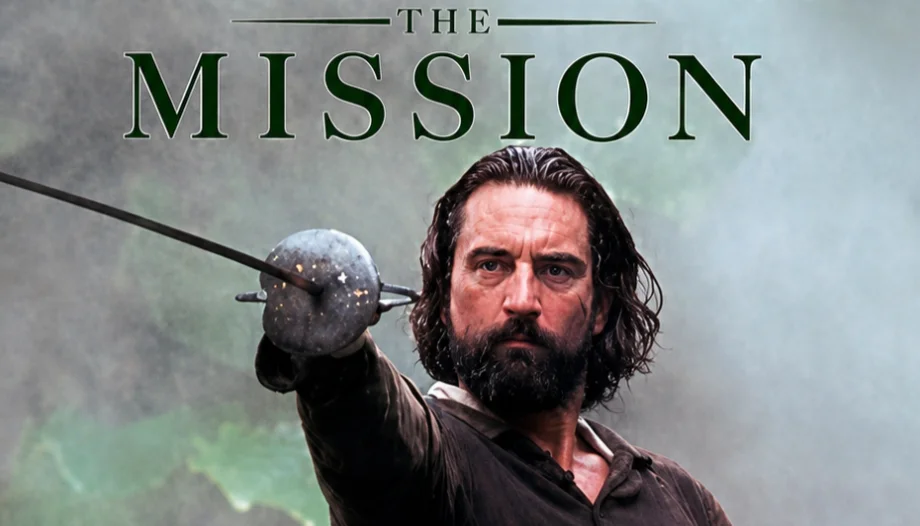
Forty years ago the film The mission, directed by Roland Joffé and produced by David Puttnam, won the Palme d'Or at Cannes. Its soundtrack has become part of popular lore and some of its scenes, such as the opening sequence of the crucified missionary falling down the Iguazú waterfall, have become iconic. In September, it will receive a tribute at the San Sebastian Film Festival. Beyond the awards and its music, the moral dilemma posed by this feature film continues to challenge consciences.
The 39th edition of the Cannes Film Festival, in May 1986, opened amid great expectation. Among the films in competition were two religious-themed films: Sacrifice, by Andrei Tarkovsky, and The mission, by Roland Joffé. The jury, chaired by Sidney Pollack, chose the latter, which they considered a good symbiosis between European cinema and commercial film.
The world premiere was in Madrid on September 30 of that same year, and shortly afterwards it reached the screens of Paris and London and from there the whole world. The film received good reviews, although it obtained rather modest results at the box office. In terms of awards, the film was discreet, although with the passing of time it has been catalogued as a classic of historical-religious cinema.
Prolegomena with four names
The story of the gestation of this film starts with the confluence of four names linked to the film industry. First, the Italian producer Fernando Ghia, who had tried to adapt for the big screen a play entitled Das Helige Experiment, written in 1943 by Austrian playwright Fritz Hochwälder and premiered on Broadway a decade later under the title The Holy Experiment (o The Strong Are Lonely, as it is known in other cases).
This theatrical drama was set in the same historical context as The mission, It took the form of a judicial drama in which, driven by political interests, the communal missionary work of the Jesuits in South America was condemned. It was not until 1973, however, that Ghia found his second source of inspiration: an extensive report on the Jesuits in the magazine Time, which included a historical section on the reductions Jesuits in the Southern Cone. Ghia then contacted Robert Bolt, a British screenwriter with whom he had previously worked and who had risen to fame thanks to the screenplay of A man for eternity (A Man for All Seasons, 1966). Bolt agreed to write the screenplay and in mid-1975 gave Ghia a first draft titled Guarani.
At the same time, Roland Joffé and David Puttnam, director and producer, respectively, of The cries of silence (The Killing Fields, 1984), they were looking for a new story for their next joint collaboration. Puttnam was a well-known producer at the time, thanks to one of his previous productions, Chariots of fire (Chariots of Fire, 1981), had won the Oscar for Best Picture in its year. Also the success of The cries of silence had been notorious.
The paths of Ghia-Bolt and Joffé-Puttnam crossed, and thanks to Puttnam's good relationship with Goldcrest Films (a then fashionable British production company responsible for such titles as Gandhi yA room with a view) and with Warner Brothers (distributor of his films at the time), the project of The mission was given the green light. Puttnam had access to Bolt's script and thought it contained a great story. It also coincided with the fact that Joffé had long been interested in developing a film project about the complex relationships between political and religious power that have always existed in Latin America.
Thus, the interests of both parties converged in the same direction. Although Ghia initially started out as the main producer, the complexity of the project and the fact that most of the team was British, ended up giving Puttnam the maximum responsibility for the production.
An eventful production, favorable reviews and uneven box-office performance
Being a period film and shot mainly on location meant moving on the scale of a large production. Consequently, the cast also had to be top-notch. Robert De Niro (Rodrigo Mendoza) and Jeremy Irons (Father Gabriel) agreed to share the lead, along with Ray McAnally (Cardinal Altamirano). One thing or another, the budget was close to $20 million.
After a complicated shoot - which included Joffé's hospitalization for a few days due to exhaustion and dehydration - the film completed its editing and soundtrack and was ready for the Cannes Film Festival. It was competing with Sacrifice, another film with religious content directed by Andrei Tarkovsky. It was a close race, but the The mission ended up winning the Palme d'Or, while Tarkovsky's film won the Grand Special Jury Prize.
From that point on, he would begin a career towards other awards. It could be said that The mission obtained a discreet award for a film of its category, with a clear disproportion between nominations and actual awards. As for the Oscars, The mission gathered a total of seven nominations, including Best Picture and Best Director, of which it only won Best Cinematography.
A similar fate would befall him at the British Academy Film Awards (BAFTA), where he managed to garner 11 nominations, of which only those for Best Supporting Actor (Ray McAnally), Best Editing (Jim Clark) and Best Soundtrack (Ennio Morricone) crystallized. Among all the soundtracks I have written,“ confessed the Italian composer, ”this is the one that I consider most representative of me. In this music I see myself portrayed both emotionally and intellectually".
As for the commercial performance, one critic had ventured: “The mission is a film that presents itself to the cause of sainthood and which, I fear, will die a martyr's death at the box office”. Indeed, in the United States it grossed $17.2 million, a respectable figure but far from initial expectations. In Europe, the result was mixed: a great success in France (about 6 million euros), quite good in Spain (3.4 million) and poor in the UK (2.2 million pounds).
A moral drama in a historical context
As is well known, the plot of The mission is built around two main characters, Rodrigo Mendoza and Father Gabriel, who are joined by a third character, Cardinal Altamirano, from whose point of view the film's story is told. It is important to note that the filmmakers did not try at any time to recreate a historical event in a rigorous manner, but rather to take advantage of a specific context to present the moral conflict that the film deals with. In fact, there is no shortage of dramatic license and historical inaccuracies (which we will not discuss here).
We are in the 18th century. The Jesuit reductions, where the Indians are instructed in religion and culture by the missionaries, were momentarily alive. However, the territorial readjustment to which Spain and Portugal committed themselves through the Treaty of Madrid (1750), obliged the Spanish sovereign to cede to the Portuguese a territory that included seven of these missions in Guarani territory. A dispute then arose over the future of the indigenous peoples: while the Spanish crown protected them, the Portuguese allowed slavery.
The Pope sends a cardinal, named Altamirano, to go to the place and make a decision. Although he was pleasantly impressed by the work that the Jesuits carried out in the reductions, the papal delegate gave in to political pressure and ordered the Jesuits to abandon the missions. Internal conflict then broke out among the missionaries, who had to choose between religious obedience and remaining with the Guarani.
The soldier and the saint
The film opens with the story of Rodrigo Mendoza, a former military man and current mercenary, a man of strong and tough character, as irascible as he is proud. He combines the ideals of his time: good physical appearance, skillful in the saddle and skillful with weapons. Cruel and unscrupulous, he puts his military skills at the service of such an ignoble ideal as the capture of Indians - half sustenance, half sport - destined for the slave trade.
Famous among women, he professes his love for a widow named Carlota, from whom he soon becomes disillusioned because of her brother, Felipe. Confused and wounded in his pride, he commits fratricide in a fit of rage and is plunged into a deep depression, no longer wanting to go on living.
Gabriel, a Jesuit whom he had previously met in the jungles of the altiplano, beyond the Iguazu Falls. Both had gone there for very different purposes: the one, to bring the Indians the freedom of the children of God; the other, to condemn them to the slavery of men.
Gabriel appears as a man of great spiritual stature, in love with God and with his missionary vocation, to which he gave himself with fervor and audacity. Thus, after learning of the martyrdom of one of his co-religionists at the hands of the Guarani, Father Gabriel climbed the enormous walls of the falls to go out to meet the savage tribes. With the help of his oboe, he penetrates among the Indians and begins the evangelization.
Gabriel, on the other hand, plays a leading role in Mendoza's conversion. By making a dent in his pride, he gets him to agree to carry out the penance he deems necessary, but not before overcoming his fear of failure. The ascent of the falls with the bundle of weapons and armor is significant in that the symbols of power from the previous life now become a heavy burden. Equally significant is the forgiveness of the Guarani, an image of the consummation of divine mercy.
Certainly the conversion that Mendoza undergoes is profound, to the point that Gabriel takes advantage of his good dispositions to awaken in him a desire for greater dedication. In this way, Rodrigo dies definitively as a mercenary and is reborn as a soldier of Christ, thus being able to repair the damage caused to the Guarani.
The judge
Despite this important change experienced by one of the characters, the central conflict in The mission begins later, at the moment in which Gabriel and Mendoza, during the audience before Altamirano, become aware of the difficult situation in which the missions find themselves after the agreement of territorial reorganization between Spain and Portugal. From then on, the attention revolves around the papal delegate, who has to carry out the committed task of settling the future of the reductions, listening to the interests of each of the conflicting parties.
Altamirano is presented as a skillful diplomat, knowledgeable of the political intricacies of his time and of the difficult role of the Church in the resolution of politico-religious issues. This papal delegate manifests an apparent honesty and fairness of judgment, insofar as he guesses hidden intentions, refutes fallacious arguments and resorts to supernatural reasoning. However, the serious consequences for the Society of Jesus and for the Church itself that could result from such a decision weigh heavily on him.
Thus, he struggles between the dilemma of supporting the work of the Jesuits, whose greatness he himself contemplates and enjoys in the extreme, or following the dictates of his pragmatic reason, which advises him to sacrifice a particular good for the benefit of a more relevant common good, such as the maintenance of good relations between the major colonial powers of the time - Spain and Portugal - and the Holy See. Ultimately, although his indecision was sincere and he promised to act in conscience, he succumbed to political pressures and disregarded his own inner voice.
Two forms of resistance
In the face of the conflict, and while the deliberation lasts, Rodrigo and Gabriel react in the same way -both rebel and express their opposition- although they express their feelings in different ways, in accordance with their respective personalities. Rodrigo must control his impulsive nature and, although at first he cannot contain his indignation and publicly disdains Cabeza, the Spanish authority, he is able to rectify his affront by virtue of his vow of obedience. Gabriel, for his part, acts at all times with great rectitude of intention.
His conversations with Altamirano move on the supernatural plane that governs his whole life and to which he subordinates any reasoning. He did not doubt Altamirano's honesty and therefore encouraged him to visit the mission of San Carlos, above Iguazú, convinced of the help of divine grace and the good heart of the papal delegate.
The moment of disillusionment occurs during the meeting with the Guarani chiefs, in which Altamirano, having already made a decision, no longer acts as himself, but as a representative of foreign interests.
The rebelliousness of the Guarani people poses a first conflict of conscience for Gabriel and Mendoza, as they must decide between obeying the express orders of the papal delegate, abandoning the mission and the Indians to their fate, or remaining with them. The scope of the dilemma is reflected in the feeling of frustration of the Guarani, who, trusting in God's will, had agreed to live in the reductions and now, because of the same mandate, are forced to leave.
“By God's will they left the jungle and built the mission; they do not understand why God has changed his mind”, Gabriel explains to Altamirano; and he adds: “they say that they were wrong to trust us; that they are going to fight...”. For the Jesuits, it was a conflict of obedience between the will of God and the mandate of men - in this case, the strict order of the papal delegate: “whoever disobeys me will be excommunicated, separated, expelled”. Thus, he who was supposed to defend the salvation of souls, decides in favor of earthly interests.
Both Gabriel and Mendoza - together with other Jesuits - chose to stay, following the dictates of their conscience. This is a first decision whose heroism derives from the fact of risking their lives. However, there is still a second conflict, equally important, that questions the protagonists' fidelity to their commitments: the legitimacy of the armed struggle. After deep reflection, Mendoza decides to use arms; Gabriel, on the other hand, chooses to resist without violence. Although he initially opposes Rodrigo's position, which he considers incompatible with his vocation as a Jesuit, he ultimately appeals to divine justice.
The denouement seems to underline the legitimacy of both positions as an example of coherence and integrity: Gabriel, faithful to his conception of God as Love, goes out to meet his executioners carrying the monstrance and dies with it in his hands; and Mendoza, whose presence in the battle ultimately makes the survival of the Guarani possible, helps a group of boys to flee; these boys appear at the end heading upriver towards the interior of the jungle, taking with them what they have learned.
A wise decision?
In a significant way, the one who comes to morally endorse both attitudes is the one who has contributed to unleash the conflict: Altamirano. The papal delegate finally admits his mistake and, therefore, his responsibility and guilt. Thus, in the face of his grief after the massacre, Hontar, the Portuguese representative, tries to console him: “You had no choice, Your Eminence. We have to work in the world, and the world is like that”; to which Altamirano responds sharply: “No, Mr. Hontar, we have done it that way; I I've done it this way.
Likewise, in his subsequent report to the Holy See, he concludes: “So, Your Holiness, now your priests are dead, and I am still alive. But in truth, it is I who have died and they are the ones who live”. In this way, in spite of his blunder, he shows a certain manhood of goodness. In this sense, his imploring glance at the viewer after the credits - a scene that very few viewers remember or have even seen - seems to underline the idea that “he is not a villain, not even a corrupt man; he is simply a weak man in a strong world”.
This is also the opinion of producer David Puttnam, who emphasizes: “For me the most important character is Altamirano, because he represents what we are and, in the end, he makes the wrong decision, as we undoubtedly would have done too”. And Joffé adds: “The cardinal is a very interesting man because he knows more and finds it much more difficult to find a decision that fits justice. He realizes that he has made a sacrifice about which he now has doubts: the sacrifice of maintaining the structure of the Church. That's what that last look of his in the film tells us: ‘I did this. Now you know what happens when you act like this.’”.
Conflict of conscience
The mission is presented as a reflection on the moral dilemma posed to men who have to obey unjust or wrong orders. As a conflict of conscience, this battle is fought within the protagonists. Both Mendoza and Gabriel or Altamirano face a dilemma similar to that of the athlete Eric Liddell in Chariots of fire -obedience to legitimate authorities or to the dictates of one's own conscience-, only that, in this case, the established powers belong to both the civil and religious spheres.
Father Gabriel and Mendoza, in a different way, preserve their moral integrity; Altamirano, on the other hand, while accepting the good faith that moves him, ends up condescending to the political situation. In Joffé's opinion, one of the main ideas that the film intends to convey regarding the ethical behavior that some situations demand can be deduced from the contrast of these positions.
In addition to fidelity to the principles of one's own conscience, the film affirms the value of charity as the foundation of the evangelizing spirit. It is the word “Love” that is continually present on Gabriel's lips; it is the meditation on the Pauline doctrine of Christian charity that moves Rodrigo to take the Jesuit habit. Ultimately, it can be affirmed that the tragic death of both underlines the authenticity of this love of God and neighbor, the beauty of sacrifice.
For or against liberation theology?
On the other hand, The mission presents an ambiguous position with respect to the political-religious conflict it deals with. Specifically, as some critics have pointed out, the film seems to support the postulates of liberation theology, because of the way in which the conflict of obedience is posed and -above all- because of the way in which it is resolved.
Although well-founded, this assertion must be qualified. Indeed, both in the minds of Ghia and Bolt first, and Joffé later, there was a concern to establish a parallel between the utopian ideal achieved by the Jesuits - a primitive form of communitarian life - and the current political-religious situation in some parts of South America, identifiable under the label of “liberation theology”.
Proof of this is the film's intentionally ambiguous final label: “The Indians of South America are still engaged in the struggle to defend their land and culture. Many of the priests who - inspired by faith and love - continue to support the Indians” right to greater justice, do the same with their lives.“ Joffé, whose thinking was then framed within the so-called British ”new left,“ went so far as to state in an interview: ”The film is intimately related to the struggle for liberation theology.
However, the film avoids any political proclamation and allows for different interpretations, thanks to its allegorical nature. In Joffé's own words: “It is a poetic and at the same time committed way of telling things as they are, and not as we would like them to be. It is about telling something that has happened in reality, but that, at the same time, has a symbolic reality with what is happening in the present. This is the contrast that is presented, but there is no intention to say what is good and what is bad, what is moral and what is immoral. We simply try to present things to the effect that it may provide or suggest some solution.”.
Thus, as one reviewer has pointed out, in The mission “ambiguity ends up being the true measure of the product,” not only in terms of the political connotations, but also in the characterization of the characters. In this sense, both Puttnam and Joffé deny that the film, for example, offers an overly favorable portrayal of the Jesuit missionaries.
Thus, for example, Puttnam affirms: “Gabriel and Mendoza are not idyllic Jesuits, since both disobey the Church: one chooses peace; the other, arms. Both chose to stay with the Indians, while the Church had ordered them to leave and abandon the mission”. And Joffé corroborates: “This film is in no way favorable to the Jesuits. There is an enormous ambiguity [in the characters] and the film deals with that ambiguity”.
For others, on the other hand, this lack of definition seeks only to appeal to the conscience of the public. Thus, Jesuit Daniel Berrigan, Puttnam and Joffé's advisor during the shooting and a connoisseur of the historical reality reflected in the film, argues: “In my opinion (not entirely neutral, surely), it says something about the honesty of the film and of those who made it that the story does not try to settle anything. Its task is more rigorous and more modest: to formulate questions, to challenge the intelligence and appeal to the moral capacity of the viewers”. It can be concluded -as was the case at its premiere-, that The mission allows even opposite interpretations, depending on the predisposition of the audience.
A calculated moral ambiguity
Similarly, this ambiguity extends not only to the political-religious content, but also to the very characterization of the characters. With respect to the first case, it is significant that, in contrast to those who maintain that The mission The fact that it defends liberationist postulates, others reaffirm its evangelical authenticity, insofar as it “allows the soul to breathe the atmosphere of the Gospel, elevating it instead of degrading it”.
On the other hand, Joffé admits the ambiguous character of the main characters but defends his point of view. Thus, against those who believe that Mendoza is a desperate man at the moment of death, he states: “I don't think he was. He sees that they [Gabriel and the Indians] do not give up; he sees that Father Gabriel keeps the faith. At that moment he truly understands what love is, he understands what it means to love the world, that the world is a complex, ambiguous place.
If we remain in a purely materialistic vision, we may give way to a certain despair and a certain persistent pessimism”. And with regard to Gabriel, presented by some as a religious fanatic, he explains, “I don't think he's crazy; he's ambiguous. He doesn't ask the Indians to follow him; those men come and sit next to him. He answers them the only way he can. At that point, when there are no more cards left to play, logic and madness run neck and neck, because there is no longer any reason.
At that point, right at that point, there should be a conclusion to all actions. It is not known what is next. Gabriel has no idea. The outside observer, in a sense, doesn't either. And what is absolutely important to both of them in those moments is the meaning of their actions, and the meaning of the actions of the Indians. And that's their gift, that's what will remain in the world.”.
In the wake of an inspiring film
Be that as it may, the footprint and the message that The mission has left on the public have been very positive. Already at the time, many critics highlighted this quality, defining it as “a film of surprising greatness, which speaks at the same time to the head and to the heart, which magnificently praises respect for the humble, the victory of grace and the defeat of violence”; as “a show of conscience aimed at the understanding of the person, through an intelligent dramatization”; a film that contributes to “revive spirituality in an era - ours - that has a good need for it”. All this is summed up in a letter written to Puttnam by an executive of one of the Hollywood studios: “Thank you very much for offering the public this masterful representation of what is humanism and spirituality”.
The author holds a PhD in Audiovisual Communication and Moral Theology. An expert on the figure of David Puttnam and his films, he has published David Puttnam, a creative producer (Rialp), The craft of film production: Puttnam style (Ariel) and The Greatness of the Human Spirit: The Films of David Puttnam (Eiunsa).
Priest. Doctor in Audiovisual Communication and Moral Theology. Professor of the Core Curriculum Institute of the University of Navarra.





 Español
  English
  Italiano