


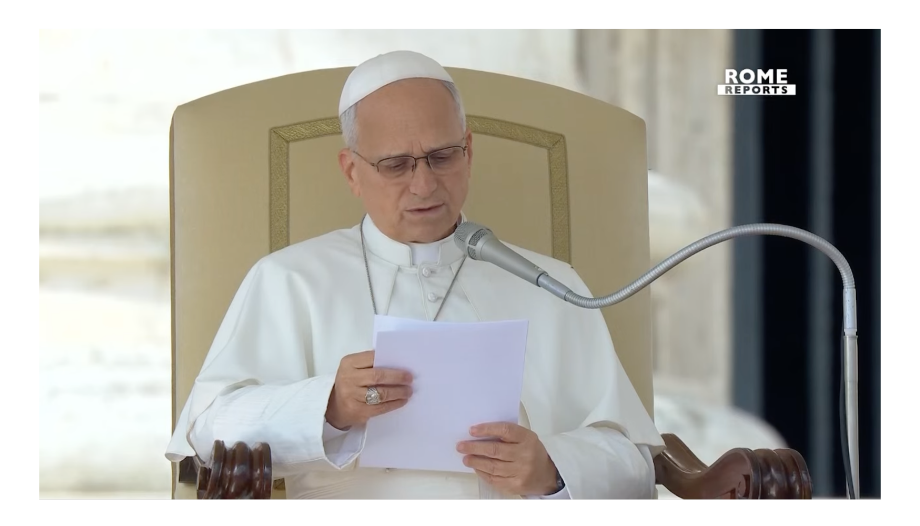
Pope Leo XIV emphasized on Wednesday, before a St. Peter's Square filled with pilgrims, that the Christian faith should not be lived in a spirit of confrontation with the world. On a cool morning in Rome, the Pontiff continued his catechesis on the Second Vatican Council, underscoring the importance of education, dialogue with science, and universal access to culture.
In his general audience on Wednesday, October 28, Leo XIV reflected on the relationship between faith and culture, following the teachings of the pastoral constitution. Gaudium et spes of the Second Vatican Council.
Before the numerous faithful who filled St. Peter's Square, the Holy Father recalled the historic contribution of the Church to education, through the creation of schools and universities.
«Medieval universities, as we know, were born from within the Church and contributed decisively to the development of Western civilization,» he noted.
The Pope also explained that cultural and scientific advances raise new questions that invite believers to deepen their faith. At the same time, various cultural expressions contribute to awakening profound questions about the meaning of human existence.
Faith is called to become culture
One of the central themes of catechesis has been the need for the Christian faith to enter into dialogue with different cultures.
«The relationship between faith and culture finds its main foundation in the Incarnation,» explained Leo XIV, who recalled that faith must be part of people's concrete lives.
In this context, he quoted a well-known statement by Saint John Paul II: «A faith that does not become culture is a faith not fully embraced, not entirely thought through, not faithfully lived.».
The Pope has insisted on the universality of the Christian message, which is not exclusively linked to any tradition or society.
«Faith can be embodied in any culture, because it is not specifically identified with any of them,» he stated.
In this sense, he explained that the Church discovers positive elements in different cultures to transmit the Gospel, while at the same time being enriched by the encounter between different human traditions.
Education for all and women's participation
Leo XIV also dedicated a part of his reflection to universal access to education and culture, recalling that the Second Vatican Council urged overcoming illiteracy and lack of instruction.
«The Church promotes culture because it is a good in itself and a service to human beings and to the fulfillment of their vocation on earth,» he said.
The Pope has reminded that people with the capacity to pursue higher education must have the necessary conditions to do so.
Furthermore, he highlighted the importance that Gaudium et spes It grants to female participation in the cultural sphere, citing the «duty of all to ensure that the proper and necessary participation of women in cultural life is recognized and promoted» (GS, 60).
Scientific knowledge and faith must advance together
At another point in the catechesis, the Holy Father addressed the need to integrate the different areas of knowledge.
Leo XIV has reminded us that Christians cannot be content with the answers they receive from Revelation, but must continue to deepen their intellectual and cultural formation.
«On the contrary, their human and scientific knowledge must advance at the same pace as the contents of their faith, which they must continually deepen as they get older and according to the level of their studies,» he stated.
The Pope also addressed a particular exhortation to theologians, recalling the Council's invitation to collaborate with specialists from other disciplines.
This collaboration, he explained, allows theological research to maintain contact with the reality of its time and contribute to facilitating a deeper understanding of the faith.
Do not live your faith with hostility towards the world
In the final part of the audience, Leo XIV stressed the need to maintain an attitude of dialogue with contemporary society.
«Brothers and sisters, the Constitution Gaudium et spes »He recommends that we not live our faith with a spirit of opposition or hostility towards the world, culture and its human expressions," he said.
The Pope also recalled the Council's invitation to Christians to try to understand the ways of thinking and feeling of the people of their time.
In his closing remarks, the Holy Father summarized the importance of this dialogue between faith and culture for Christian life and evangelization:
«Achieving a mature and responsible synthesis between faith and culture is indeed a necessary condition for persevering in the Christian vocation, but also an indispensable requirement for bearing witness to the faith before the world and communicating it to others in a credible way.».





 Español
 English
 Italiano
 Français
 Deutsch
 Polski