


 Uruguay se echó también a las calles para recibir al Papa León XIVEl Papa en Casavalle: una tierra de dolor pero viva en la feEl Papa invita desde Montevideo a la oración y ayuno por las vocaciones
The Centenario Stadium in Montevideo hosted Pope Leo XIV's prayer vigil this Saturday, one of the central events of the first leg of his trip through Uruguay, Argentina, and Peru. There, the Pope highlighted the experience of a Church that has had to learn to live its faith as a minority, and which can help Catholics in other countries who are beginning to walk that same path.
Uruguay, one of the most secularized countries in Latin America, had not received a pope since 1988, when John Paul II made his second visit. The free tickets sold out in just three hours, and, according to local authorities, some 70,000 people followed the vigil inside a stadium built for the first World Cup in 1930, and another 30,000 watched from the surrounding area via giant screens.
The arrival at the Centenary
The wait, after hours of queuing in the surrounding area, included music—among others, from Uruguayan singer Lucas Sugo—and the recitation of a Hail Mary for women who wish to become mothers. The stadium welcomed the Pope with chants and the official anthem of his visit.
Pope Leo XIV arrived in the popemobile and, after walking along the base of the stands greeting the attendees, ascended the stage accompanied by the Cardinal Archbishop of Montevideo, Daniel Sturla. In his welcoming remarks, the cardinal used football terminology, so deeply rooted in the country's culture: having the Pope in Uruguay, he said, is “a fantastic goal.” But he cautioned that the faithful had not come only to cheer from the stands, because the game of faith is played “in the neighborhood, in the family, at work.” Sturla also remembered Blessed Jacinto Vera, beatified in that very stadium, who consecrated Uruguay to the Sacred Heart.
Three testimonies
Before the speech, the Pope listened to three testimonies. Federica Ortiz de Taranco, a 31-year-old educational psychologist who coordinates a training group for mothers, spoke on behalf of those going through a “pivotal age” in which many things haven't turned out as expected: studies that are prolonged, jobs that don't materialize, families that haven't yet been formed, or children who haven't arrived. Her question was how to trust in God's plan when it doesn't resemble what was imagined.
Giovanni, 22, grew up in a family where only his grandmother practiced the faith. He came to know God at 20, in the chapel of the University of Montevideo, and was baptized after a year and a half of catechism classes. He described this journey as “a lonely process,” during which many told him he was wasting his life, and he asked how to remain a good Catholic when reality seems to leave him alone. Finally, the Gutiérrez Hernández couple, married for thirty years with five children, wanted to be the voice of families in a country “where there are few marriages and fewer children are born.” Their question, also using a football analogy, was how to “stop the ball” and recover the time that fast-paced life steals from family.
Bethlehem, small but not insignificant
Leo XIV focused his reflection on the advance of secularization and an increasingly widespread religious indifference. In contrast, he highlighted those who persevere: parents who pray with their children, teachers who strive to bear witness to the faith, young people who follow Christ even when they feel alone, and priests who travel great distances to administer the sacraments. Thinking of them all, he explained, Bethlehem came to mind again and again, the city that the prophet Micah called “small among the clans of Judah” and which, nevertheless, God chose. The Pope's conclusion was clear: “That choice alone is enough to ensure that we do not equate smallness with insignificance.”.
The Nativity scene, in which there was “no room” for Joseph and Mary, served to illustrate contemporary indifference: a life so filled with occupations and distractions that the absence of God ceases to be felt as an absence. The Pope also warned against the attempt to confine faith to the private sphere: “When we try to build a world without God, we run the risk of leaving humanity without a place as well.” This indifference, he added, can gradually creep into the lives of believers as well, and therefore he urged them to keep Christ at the center through prayer, Mass, Confession, and reading the Gospel.
“Why does he live like that?”
Drawing on the story of the Magi, who set out without fully knowing what they were looking for, the Pope reminded the faithful that their way of life can awaken the search for God in those who have not set foot in a church for years.
In this context, he made several specific appeals, beginning with young people: “Young friends, dare to start a family.” And he added: “Don’t be afraid of ‘forever’!” He asked married couples to open their homes to life, even if the world tells them that a child is a burden, and those who feel called to the priesthood or consecrated life should not ignore it for fear of missing out on other opportunities. He also asked them to pay the price of honesty, to forgive when it seems like defeat, and to give time, money, and comfort to serve others, so that those who see them might ask: “Why do they live like this? Where do they get this freedom? Why do they love each other so much?” “To shine brightly, you don’t need to be many, but rather reflect the light of the Lord,” the Pope summarized.
A joy for the whole town
The shepherds of Bethlehem, who were not seeking anything and whom God met in the midst of their darkness, have served as a reminder that the joy of the Gospel is destined for “all people,” not only for those who expect it or for the perfect. The theme of the visit, he explained, is inspired by this announcement of the angel.
In closing, the Pope issued a direct appeal, “Be holy!” and encouraged those present not to settle for a merely correct life or a faith lived out of habit, but to seek Christ in Eucharistic adoration, recalling that Bethlehem means precisely “house of bread.” Finally, he entrusted the Uruguayan people to Our Lady of the Thirty-Three, patroness of the country.
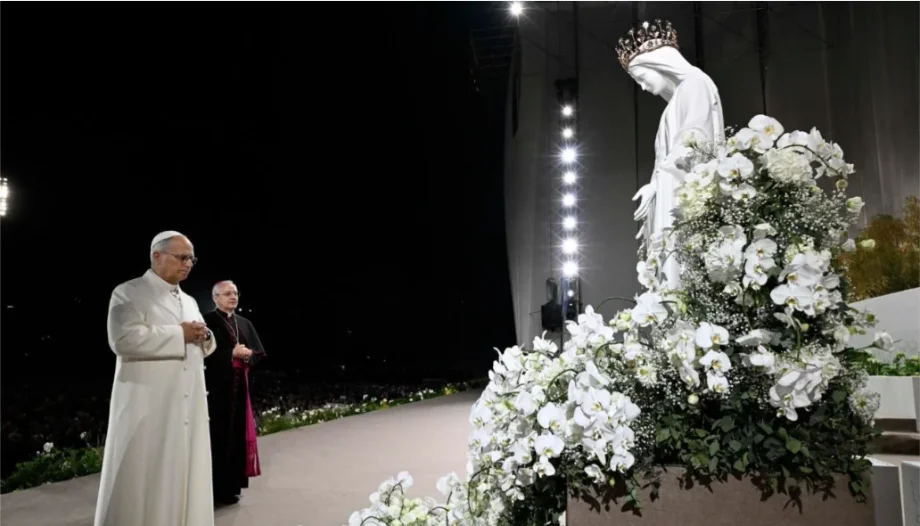
The vigil, during which the Pope also paused to pray before an image of the Virgin Mary, concluded with the Prayer of the Faithful, the Lord's Prayer, and the blessing. Among the gifts exchanged was a commemorative medal for the trip, a work by the artist Carmen Testa, which combines symbols from the three countries visited, from Our Lady of the Thirty-Three to the Obelisk of Buenos Aires and Machu Picchu. Following the meeting, the Pope traveled to the Apostolic Nunciature. This Sunday, he will travel to Florida, where he will celebrate Mass for the feast of the country's patron saint before departing for Argentina.




 Español
 English
 Italiano
 Français
 Deutsch
 Polski