



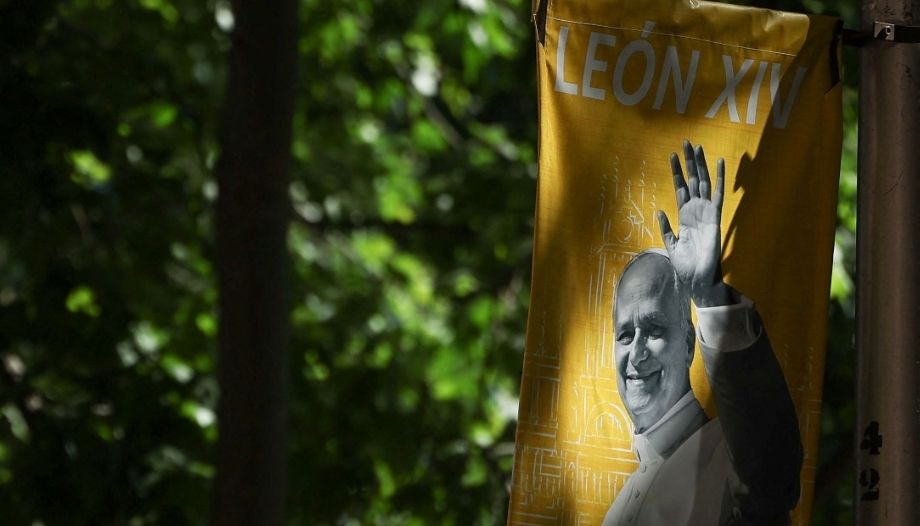
During this Wednesday's general audience, the Holy Father Leo XIV recalled the feast of Corpus Christi, which he also called Corpus Domini, and encouraged “to keep alive the beautiful manifestation of public witness to the faith that are the processions with the Blessed Sacrament”.
The processions with the Blessed Sacrament that take place in the streets of so many countries, he said, “are an expression of popular Eucharistic piety; in this regard, I encourage you to keep alive this beautiful manifestation of public witness to the faith”.
Earlier, addressing the English, Polish and Italian-speaking pilgrims and all the pilgrims and Romans in St. Peter's Square, he referred to the Solemnity of the Most Holy Body and Blood of Christ or, “according to the better known Latin formulation, the Solemnity of Corpus Domini. In the Eucharist we contemplate Jesus, bread broken and given for each one of us,” he stressed.
Corpus Christi and procession, Sunday 7 at Cibeles (Madrid)
Precisely the Pontiff arrives in Spain this Saturday, the 6th, on his apostolic journey, and on Sunday, the 7th, after the Prayer Vigil of the same Saturday in the Plaza de Lima, he will preside the Holy Mass in the Plaza de Cibeles, at 10:00 a.m., and the Corpus Christi Procession through the streets of Madrid.
It will be the central act of this Eucharistic Sunday, which is expected to be multitudinous, given the hundreds of thousands of registrations that are taking place.
“Special worship of Christ present in the Eucharist.”
In the Audience In the general assembly this morning, with thousands of pilgrims who were certainly noisy, the Successor of Peter said to the English-speaking pilgrims: “As we prepare for the Solemnity of the Most Holy Body and Blood of Christ, let us allow ourselves to be strengthened by this divine gift and become witnesses of his love to all those whom we meet.
In his words to the Poles, the Pope encouraged that “beginning with the Solemnity of Corpus Christi and in the days that follow, you will render special worship to Christ present in the Eucharist.
May participation in Eucharistic processions - especially by families, children and young people - be a courageous witness of faith and remind everyone that God is present in the midst of his people and accompanies them in their daily lives”.
Arabs and Italian language: priests and religious of the Middle East. Sacred Heart of Jesus
In his speeches, the Pope addressed at various times “a special word to the priests and religious of the Middle East: I accompany with my prayer and my blessing your ministry and the expectations of your respective countries”.
While he reminded the French-speaking people of “the contemplation of God the Trinity”, in his words to the Portuguese-speaking people he said that in “this month dedicated to the Sacred Heart of Jesus, let us draw near to the source of God's mercy and tenderness, so that the Risen One may transform our hearts, making them more patient, generous and compassionate”.
Three constitutive elements of the Liturgy
Continuing with the catechesis on the Constitution Sacrosanctum Concilium,” the subject of the Pope's catechesis, “today we focus on three constitutive elements of the Sacred Liturgy: the rite, the sign, the symbol,” he told the Spanish-speaking people.
The rite - in which we are called to participate with body, mind and heart - is the ecclesial means which, by giving a definite form to prayer, helps us to attain the divine gifts.
“It is composed of sensible signs that accomplish the sanctification of man (cf. SC 7), such as water in baptism; and of symbols, which help us to give deeper meaning and values to the reality we perceive.
Taking care of the beauty of our celebrations
Symbols are also simple gestures - such as kneeling, giving the sign of peace - or more complex actions such as the constituent acts of each sacrament, which transform both the material elements and those who come into contact with them, generating a sense of belonging, touching the heart and the mind and giving rise to authentic ecclesial relationships,” the Pope said.
Finally, after mentioning the Apostolic Letter ‘Desiderio desideravi’, by Pope Francis, and Romano Guardini, the Holy Father has said that “we need to allow ourselves to be educated by the rites of the liturgy, taking care with delicacy and without arbitrariness of the beauty of our celebrations and committing ourselves to an authentic mystagogy” (note: pedagogical way of introducing into the mysteries of the faith through the liturgy).





 Español
  English
  Italiano
  Français
  Deutsch
  Polski