



 Friends of Monkole seeks to school children from orphanages in D.R. CongoFriends of Monkole' launches campaign to operate on young Congolese with sickle cell anemiaFriends of Monkole Foundation highlights the work of volunteer doctors
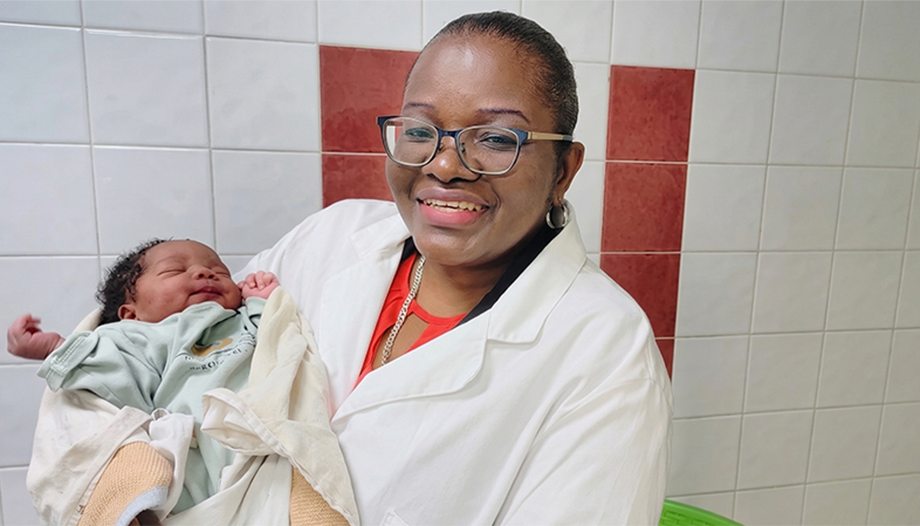
Céline Tendobi (52 years old), affectionately known as Baby Tendobi, is today one of the great leaders in the defense of maternal and child health in the Democratic Republic of Congo.
Her story is not only that of a brilliant doctor, but of a woman who decided to swim against the tide in a country where talent often emigrates and health is a luxury that few can afford.
This woman, who has just celebrated a quarter of a century of saving lives, stresses that “my parents were good Christians, and they educated us in those values; they explained to us that we had to study conscientiously to be able to help the people of our country in the future, always living Christian charity, something difficult in the Congo where almost everyone is very distrustful”.
After finishing her medical studies at the University of Kinshasa, Céline knew she wanted to dedicate herself body and soul to saving lives. Her destination was Monkole Hospital, located in Mont-Ngafula, a suburb of Kinshasa where precariousness is the norm.
In this area, many families survive on just 2 or 3 euros a day, in a national context where the DRC ranks at the bottom of the Human Development Index and has one of the highest maternal mortality rates in the world (more than 400 deaths per 100,000 live births).
Vocation of service
Dr. Tendobi's vocation was precocious and observant. She studied at the Mama Mobutu Center and the Cardinal Malula School Complex, but her real school was the reality of her country: “Ever since I was a little girl, I knew I had to be a doctor because I was so struck by seeing doctors - especially women - treat patients with care. I wanted to do the same.”, recalls in an interview for the podcast Voices from the Congo, a space that brings the reality of this African region closer to the listeners.
For her, medicine was never a transaction, but a delivery: “It was like a passion, like offering what I have inside me to other people. There are many women who have followed the same path. Before there were not many women doctors, there were more nurses, but that is changing.”.
Two worlds
Seeking excellence to serve better, Céline obtained a scholarship to specialize at the Clínica Universidad de Navarra in Spain. The cultural and professional shock was immense. “You quickly realize that the situation is not the same. In Spain there were good quality roads, the means of transportation worked perfectly... At the CUN there were all kinds of devices. For me it was like a paradise”.”he explains.
This contrast is painful when compared to the reality of Kinshasa, a megalopolis of 20 million inhabitants plunged into a brutal traffic chaos, where it can take three hours to travel a few kilometers due to the lack of infrastructure.
Brain drain
However, in the face of the “brain drain” phenomenon - where hundreds of Congolese doctors emigrate every year to France, Belgium or Canada in search of competitive salaries - Céline kept his promise.
“I wanted to go to Spain to get this training and return to my country to give back what I learned. I never considered leaving my homeland. I knew I was in Spain on a mission to then come back and treat the women of my country.”, he states emphatically.
Today, as Director of the Gynecology Department at Monkole Hospital, her day starts earlier than anyone else's. At 7:30 a.m., she is already meeting with the team to assess who has delivered overnight and who is facing complications. By 7:30 a.m. she is already meeting with the team to assess who has delivered overnight and who is facing complications. In a country where postpartum hemorrhage is a frequent death sentence, every minute counts.
“Occasionally we encounter patients who lose blood in the wee hours of the morning and there is not enough in the bank to save them. We have had to resort to urgent donations from our own doctors and nurses to make it happen.”, He recounts, showing the extreme precariousness that they make up for with personal heroism.
Elikia: Hope against cancer
One of its major milestones is the Elikia Project (“Hope” in Lingala).
During her training, Céline watched helplessly as young women with cervical cancer died within weeks of arriving at the hospital because the disease was too advanced.
Cervical cancer is the leading cause of female death in the Congo, ahead of breast cancer.
Thanks to Dr. Luis Chiva, Head of Gynecology and Obstetrics at the Clínica Universidad de Navarra, and other Spanish and Congolese specialists, they were able to set up a screening center in Monkole. “The key is prevention. In Africa there are many difficulties to treat, but with prevention we can prevent the disease from appearing. A woman cannot die giving birth or from a preventable cancer; that can be perfectly foreseen.”. To date, more than 5,000 women have benefited from this program.
Community involvement
The training of local personnel has been a fundamental pillar of the Elikia Project, Its objective is not only to send one-off aid, but to create an autonomous and high quality health structure in the Democratic Republic of Congo.
Many women are afraid to return to the hospital for fear of the diagnosis or because of social stigma. To this end, the project works with:
Local leaders: They collaborate with community and religious leaders to encourage women to complete their treatments.
Family education: The family is often involved so that they understand that preventive treatment is much simpler and cheaper than treating advanced cancer.
Many leaders or influential people appointed by them receive basic training from Dr. Tendobi's team.
They are explained in a simple way what cervical cancer is and how it can be prevented.
In addition, they are provided with tools to demystify fears (such as the fear that the test will cause infertility or that it will be painful).
These leaders become “multipliers” of the message in markets, plazas and neighborhood meetings.
Leaders often introduce women from their own community who have already been screened and are healthy, which generates a much greater impact than any explanatory medical brochure.
Community leaders are key to changing the narrative. They explain that cervical cancer is a disease caused by a virus (Human Papilloma Virus) that almost everyone can have and that detecting it early is an act of family responsibility.
They help explain that “a healthy mother is the engine of the family”.”, appealing to the social value of women in the Congolese structure.
Ultimately, Dr. Tendobi and her team understand that medicine ends at the hospital door, but health begins in the community. Without these leaders, the Elikia Project only reach those who are already informed; thanks to them, it reaches those who need it most.
Thanks to the assistance provided by the Friends of Monkole Foundation, In the case of women without financial resources, positive cases are covered by solidarity funds. Knowing that the treatment will be free or highly subsidized is the strongest incentive for the patient to complete the follow-up.
Follow-up and care
For treated patients, the project establishes a schedule of check-ups (usually after 6 months or a year). The hospital maintains close contact through SMS reminders, a very effective method in the Congo, where cell phone use is widespread even in vulnerable areas.
The organization of screening campaigns in vulnerable communities by the Elikia Project and Monkole Hospital is a high-precision logistical and social operation. It is not just a matter of performing medical tests, but of moving an entire health structure to areas where access is almost impossible.
Under the leadership of Dr. Tendobi, the training to develop this project has focused on several critical areas, including Advanced Screening Techniques. (Screening).
Local personnel (doctors and nurses) have been trained in early detection methods, which are essential in low-resource settings:
Visual Inspection with Acetic Acid (VIA) and Lugol (VILI): Low-cost techniques but require great visual expertise to identify precancerous lesions in the cervix.
Cytology and HPV testing: Training in sampling and, most importantly, in the technical interpretation of the results.
Pope Elikia Project, The program, with the participation of experts in epidemiology and preventive medicine such as Dr. Silvia Carlos, and Dr. Gabriel Reina, specialist in clinical microbiology, has trained the staff in:
Patient follow-up: Creation of databases and protocols to ensure that women who screen positive are not lost in the system and receive their treatment.
Health education: Training of social workers and nurses to communicate the importance of prevention to women in the most vulnerable neighborhoods, adapting medical language to the local reality.
In summary, the Elikia Project has evolved from a medical initiative to a model of health sustainability for the Congo, demonstrating that with prevention and international partnerships it is possible to drastically reduce female mortality even in contexts of extreme poverty.
Monkole: A model of dignity
Monkole, founded in 1992, is today an oasis of 130 beds and 350 employees that breaks the rules of the Congolese healthcare system: it was the first to provide sheets and food to the sick and, above all, to not turn anyone away for lack of money.
“You can't put money first when a life is in danger. At Monkole, the first priority is to save lives, and then we look for the means. If everyone worked in this spirit, putting the patient at the center without social discrimination, we would go much further.”, she points out.
For Céline, the future of the Congo inevitably depends on the education of women. “There are still many women who are illiterate. We have to fight for them to receive training and better understand the situation of their families. In Congo, women are the ones who fight every day to move the country forward.”. And in that fight, Baby Tendobi is undoubtedly your best ally.
Kinshasa




 Español
  English
  Italiano