


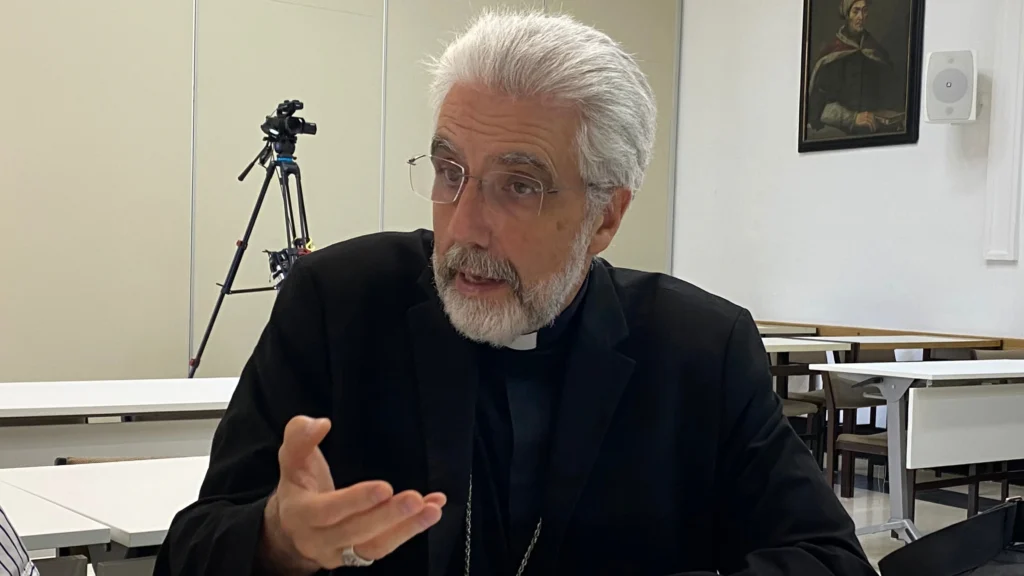
Monsignor Luis Marín de San Martín (Madrid, 1961) is one of the men in Leo XIV’s inner circle of collaborators. An Augustinian like him, before Robert Prevost was elected pope, they used to dine together frequently ever since both were called by Pope Francis to work in the Roman Curia. He was Undersecretary of the Synod, and for nearly four months now, he has been the Almoner to His Holiness and prefect of the Dicastery for the Service of Charity, one of the most influential dicasteries today.
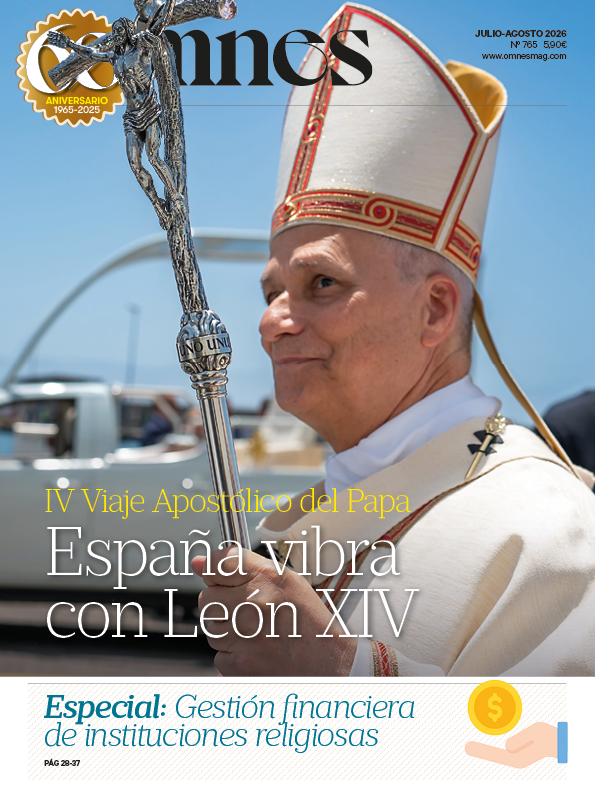
Monsignor Marín, a good friend of To all, He is speaking to the magazine from El Escorial, where he participated in a CEU summer course on the first year of Pope Leo XIV’s pontificate. It is only natural to begin by asking him what the Pope’s recent trip to Spain has meant.
– First, to strengthen our faith; second, to sow the seeds of hope; and third, to foster a missionary spirit.
In other words, he has reminded us of the fundamental pillars of our faith: Jesus Christ, the Church, and the Gospel. At the same time, he has dispelled the mists of pessimism that sometimes envelop us and has pointed us toward a horizon of hope. He has also helped us see the urgency of evangelization, the need to take responsibility, and the beauty of bearing witness to the risen Christ in the midst of the world.
The response from people in general—and from young people in particular—has been impressive. There is a longing for Christ—or rather, I would say, for messages that are coherent, solid, and that provide answers to the questions and problems of today’s world.
It has been a wonderful journey, one that I've been able to experience firsthand.
And you, who are close to the Pope, what do you think this trip has meant to him?
– First and foremost, to reconnect with Spain, a country he knows quite well and has visited many times. And also to gain a better understanding of our reality.
On the flight, I told him, “I think there’s a lot of enthusiasm,” and he replied, “I hope so.” But that enthusiasm has far exceeded all expectations. He has felt very at ease, has connected very well with the people, has felt welcomed and heard, and at the same time, has been strengthened in his ministry as the successor of Peter.
What would you say is the priority of your pontificate? You have said that the priority was “the missionary conversion of the Church.” What does that mean?
– The priority of the pontificate is Christ; Christ is always at the center. To live in Christ, to identify with Christ, and to bear witness to Christ.
One consequence of this reality is the Church’s missionary conversion. For it is clear that, if we live in Christ, we will feel the urgency to manifest and communicate him. Everyone who lives in Christ necessarily feels the missionary impulse, the evangelizing impulse, the call to be a witness to salvation in the midst of the world.
The missionary impulse involves three realities. First, it arises from the experience of the risen Christ.
Second, the risen Christ unites us to the Church. It is a powerful testimony of communion.
And third, the risen Christ brings his message to today’s world. We must bear witness to him in the culture in which we live, in our existential reality. We therefore need a missionary conversion—which means conversion to Christ and a willingness to bear witness to the Gospel in today’s world.
The Sad Split Among the Traditionalists
A few days ago, the Lefebvrians ordained four more bishops in Ecône, confirming their separation from the Catholic Church. What are your thoughts on this? To what extent does this decision hurt the Pope?
– We are deeply saddened by this. Anything that breaks unity, as the Pope says, is like tearing Christ’s robe. And this is very painful, because it causes a deep wound.
The letter that Leo XIV addressed to the prior of the Priestly Society of St. Pius X is very well structured and reasoned. It is clear that it was written from the heart as well as from the head.
Robert Prevost has never been a man of confrontation or division. He has sought to appeal to Christ, to conscience, to Christian love, and to love for the Church. And he has clearly told those who disobey: “That is not the way.” The Pope is, always, the guarantor of unity.
At the same time, it is a very clear letter. Leo XIV does not compromise. He presents Christian doctrine through charity, affection, and closeness. And he does not seek agreement at any cost: this is not about compromises, but about Christian life and consistency.
It is also clear that the problem with the so-called Lefebvrians is not merely liturgical, but much deeper. Benedict XVI attempted to reach an agreement, a major opening regarding the liturgy. It did little good. The fundamental problem is the rejection of the Second Vatican Council (ecumenism, religious freedom, the separation of church and state, interreligious dialogue, and the liturgy). A Council, incidentally, whose documents were all approved by more than 90% of the votes.
The Tradition of the Church is not limited to Trent. There was the Church before Trent, and there is the Church after it. The Tradition of the Church spans from the early centuries through the Second Vatican Council to the present day. It is a living reality that evolves. We must pray and ask the Lord to enlighten these brothers and sisters, but this is a very sad moment. Any schism in the Church causes enormous pain. It is a wound in the heart, in the soul.
A pope like Leo XIV, for whom unity is one of his defining characteristics, must confront precisely this. And, on the other hand—in a different case—there is also the Church in Germany, which has shown signs of a lack of unity.
– Unity is one of the cornerstones of the pontificate: communion. That is, union with Christ and with his body, the Church.
Christians are united to Christ through an existential, experiential, and baptismal union. This union with Christ leads us to union with our brothers and sisters, to communion with the other members of the Church, as the Body of Christ. However, this unity is lived out and expressed through a variety of vocations, contexts, and sensibilities. The deposit of faith cannot change. But neither is it a matter of imposing a stifling uniformity. In this regard, we must be open, for there is room for different expressions and varied approaches on non-essential matters. Always grounded in unity within the Church and with the Church. Anything that breaks ecclesial unity means breaking unity with Christ. And this, as the Pope has said, is a grave sin. We are always with Peter and in Peter’s boat.
But the Pope also calls for hope.
– Yes, undoubtedly for a Christian, the horizon is always one of hope. The Holy Spirit acts within his Church, renewing and enlivening it. May we have enough humility and love to allow ourselves to be guided by the Spirit, who unites us to Christ and calls us to bear witness to the beauty and greatness of the Gospel here and now. This is the true and fundamental challenge—and, at the same time, the source of our hope. And of immense joy.





 Español
  English
  Italiano