



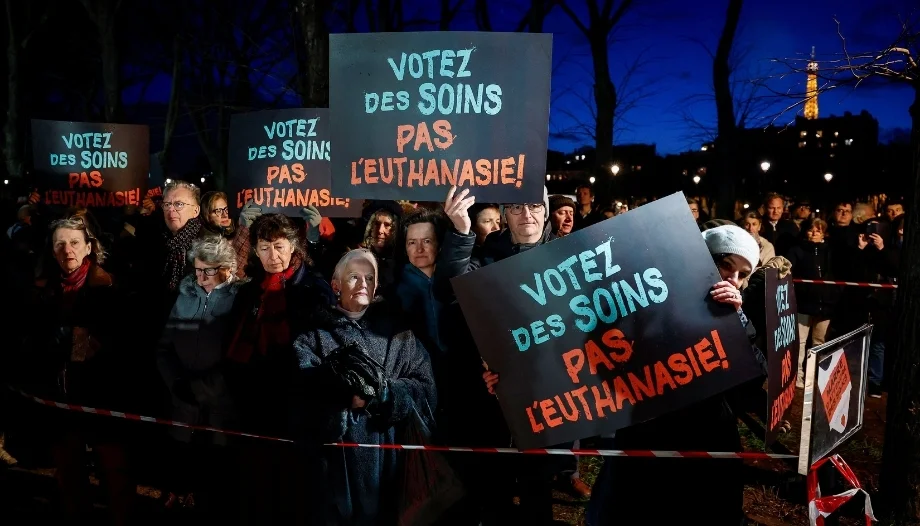
A historic vote by the National Assembly on July 15 legalized assisted dying, including euthanasia and assisted suicide in certain cases.
Cardinal Jean-Marc Aveline of Marseille and president of the conference The Episcopal Church lamented that “members of parliament have enshrined in French law the possibility of causing death.”.
“This decision breaks with the long tradition of care aimed at alleviating suffering and accompanying each person to the natural end of their life,” he said on behalf of the bishops.
The statement, signed by Archbishop Vincent Jordy of Tours and Bishop Benoît Bertrand of Pontoise, vice presidents of the French Bishops« Conference, urged Catholic health care institutions to »refrain from behavior that is clearly morally reprehensible, that are contrary to the dignity of all human life.”.
For the French bishops, “July 15, 2026, marks a major turning point in our country’s history.”.
France's National Assembly Legalizes Euthanasia by Vote
This is the fourth time since May 2025 that French lawmakers have voted in favor of the bill to legalize «assisted dying.» Senators have overwhelmingly rejected it on three occasions, and the percentage of lawmakers supporting the bill has decreased significantly since the first vote, but the decline was not enough to prevent its passage.
On July 15, 291 members of the National Assembly voted in favor, while 241 voted against, with 29 members absent.
The law authorizes assisted dying and, in certain cases, allows a doctor or nurse to administer the lethal substance, thereby legalizing euthanasia in France. The legislation must be reviewed by the French Constitutional Council before it takes effect.
President Emmanuel Macron Celebrates the Vote
The French president enthusiastically celebrated the National Assembly’s vote—which was presented as final—in a post on X immediately after the vote. Emmanuel Macron had openly supported this law. In fact, he had promised to legalize euthanasia before the end of his second five-year term.
“In 2022, I pledged to pave the way alongside the French people,” he said on July 15. “That pledge has been fulfilled.”.
The bishops openly lamented that President Macron had arbitrarily sided with the National Assembly’s decision, despite the numerous controversies surrounding this bill.
“The President of the Republic had called for a calm, informed, and respectful debate, but it is clear that political, ideological, and undoubtedly even economic considerations—disguised as misleading rhetoric—have thwarted this ambition,” the bishops said.
“An issue so fundamental to our social contract warranted a full consideration of the human, medical, ethical, and social consequences of euthanasia and assisted suicide.”
French bishops warn of the ethical and social consequences
For the bishops, one of the greatest dangers of the law lies in the fact that the principle that death can be a medical response to suffering has become part of the country’s legal framework. The choice to die can then be claimed as a right that could be extended to others.
“Experience in other countries shows that the criteria for access to assisted dying tend to become more lenient over time, to the detriment of palliative care,” they noted.
Meanwhile, “the effects of this legislation have not yet been fully assessed, but they are already being felt,” the bishops warned. “Our relationship with vulnerability, old age, disability, and illness will change,” they added.
“The poorest are likely the first to suffer the consequences: to avoid being a burden on their children or grandchildren, older people in precarious situations may feel pressured to die,” the prelates warned.
Catholic healthcare providers could face legal challenges
For the bishops, the most immediate and concrete concern today is that, if the law takes effect, care facilities—primarily Catholic institutions—could face legal action if they refuse to allow euthanasia or assisted suicide on their premises. As currently drafted, the law will require the director of the facility or department to authorize external professionals to perform the lethal procedure.
Therefore, the bishops have announced that they «will closely monitor the referrals to the Constitutional Council» that were announced prior to the vote.
France's Constitutional Council will review the law
On July 14, as France celebrated Bastille Day—the country’s most important national holiday—Prime Minister Sébastien Lecornu surprised many by announcing that he would appeal to the Constitutional Council to review the text of this law, which he personally opposes. He justified this last-ditch effort by citing the lack of agreement between the two chambers, the National Assembly and the Senate. A few days earlier, Senate President Gérard Larcher had announced his intention to take the same step.
The Constitutional Council may approve the bill in its entirety, strike down certain provisions, or issue interpretive reservations before Macron enacts the law. The review requested by the prime minister will focus, in particular, on the absence of a conscientious objection clause that would allow healthcare facilities—such as Catholic nursing homes run by the Little Sisters of the Poor—to be legally authorized to refuse to provide «assisted dying» services on their premises.
While awaiting the outcome of the appeal, the bishops of France have reiterated their call to French Catholics to «bear witness that another path is possible: one of faithful presence and care that alleviates physical or psychological suffering, without ever abandoning anyone.».
Caroline de Sury writes for OSV News from Paris.







 Español
  English
  Italiano