


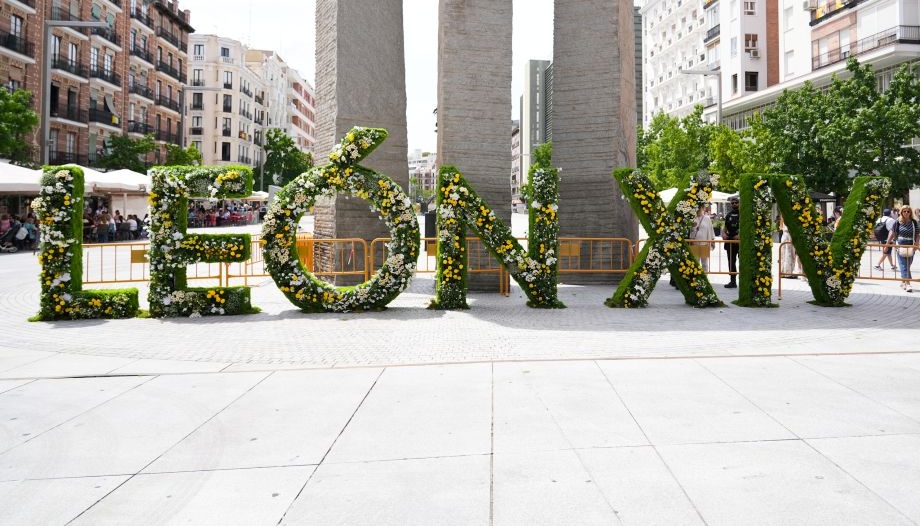
The Movistar Arena today hosted 12,000 people, but not for a concert or a match. To see and hear the Papa. Leo XIV entered accompanied by a round of applause that did not cease throughout his greetings. The Pope showed his gratitude and emotion, even with his eyes shining at some point.
Personalities from the world of communication, art, culture and sports participated in this event, which the Cardinal Archbishop of Madrid emphasized as “our times present a dangerous crack: the lack of questions and meaning. Faced with this, Your Holiness, we are called to seek answers together.
Christ, the heart of the creative impulse
“The relationship between the Catholic Church and art has not only been fruitful: it has been decisive. We are not afraid of being wrong when we say that the Church has been the greatest producer of art in the history of mankind,” said the actor Antonio Banderas, who continued, “at the heart of this creative impulse is the one who crosses centuries, styles and cultures, and who has certainly been the most represented figure in the history of art: Jesus Christ. A Christ who, as the actor from Malaga wanted to point out, is ”a constant presence. Not as a repeated image, but as an icon of peace, love and sacrifice.
The actor concluded by arguing that “this meeting between the church and civil society is not only opportune: it is necessary. We need to continue to create and share, to continue to ask questions. And he closed his words by paraphrasing St. Augustine: ”You say that times are bad. Be better yourselves and times will be better. You are the time.
For his part, the Rector of the Complutense University, José María Coello de Portugal, focused his words on the need to safeguard an education that respects “diversity but also truth, with full respect for the ethics of research” and advocated for universities that are “academically excellent but socially inclusive, environments in which the culture of effort and competitiveness is developed but presided over by full respect for the dignity of each person”.
Coello de Portugal thanked the Pope for “the recent designation by His Holiness for the first time in history of a university professor as a doctor of the Church, in the person of John Henry Newman”, and presented the Pope with two challenges facing universities today: “how to contribute to building a peaceful society and how to lead through education and research the scientific changes inherent in the technological revolution in which we are immersed”.
The academic's speech was followed by an exciting and complex performance by the dancer Sara Baras and her team. The Pope, who wanted to greet all the members of the tablao, showed his affection and admiration for the dancers.
The need for a transformative and profoundly humanistic vision of the company
Antonio Garamendi, president of the Spanish Confederation of Business Organizations (CEOE); Unai Sordo, secretary general of the Comisiones Obreras; Pepe Álvarez, secretary general of the General Union of Workers (UGT); and Ángela de Miguel, president of the Spanish Confederation of Small and Medium Enterprises (CEPYME) shared with the Pope a broad reflection on the world of business, the economy, and the role of AI in the world of work.
In this area, they have defended that “in the social dialogue, Artificial Intelligence ceases to be a tool for labor substitution and becomes a collective project, of shared values, transparency in algorithms and useful to the just transition and respect for the dignity of working people”.
The trade unionists and businessmen have committed themselves to “face what is undoubtedly a real epochal change. Technological transformation, artificial intelligence and global competition are redefining the way we produce, work and relate to each other. And that is why we need to reinforce a transformative and profoundly humanistic vision of the company.
All agreed on the need for a new social pact in today's unstable and fragmented labor environment.
“Accepting our fragility makes us human.”
Among the most awaited were the testimonies of Carolina Marin and Teresa Perales. Both athletes arrived happy. Both Marín and Perales have often declared their faith, especially in moments of victory but also of injury, or challenges, as in the case of the Paralympian, Teresa Perales, who said that “accepting our fragility and our difficult moments does not make us weak, it makes us human. True victory is not being invincible, but learning to get up with the help of others.
Along the same lines, badminton champion Carolina Marín explained that “the opponent is not an enemy; he is an indispensable traveling companion who, by giving his best, forces us to give the best of ourselves. To compete is to grow with the other, never against the other”.
The Pope went downstairs to greet, with great affection, Teresa Perales and Carolina Marin, who gave him a badminton racket.
“The Church wants to be in dialogue with the world.”
After the speeches of these personalities, the most awaited and central moment of the afternoon arrived: the speech of Leo XIV.
The Pope, once again, did not hide his appreciation for Spain, emphasizing that in “this beautiful country it is impossible not to admire the trace of creativity that runs through its history”.
Referring to Spain's rich historical heritage, the Pope asked “what kind of heritage are we leaving to the future and, therefore, what kind of community are we building? And he underlined how ”our society, in fact, possesses an extraordinary capacity to produce, innovate and communicate, yet it seems that we still need to learn to guard the soul of what it generates. Otherwise, we run the risk of being experts in the means and effective in producing, but uncertain about why, for what, with whom and for whom it is produced. In this context, the Church, aware of both her successes and her mistakes throughout history, longs to remain in dialogue with the contemporary world“.
Christ answers the big questions
The Church, the Pope recalled, is an expert in humanity in the face of the decisive question of our time: “What does it mean to be truly human? And it is so, the Pope said, because ”Jesus Christ answers the great questions about human life and its fullness“.
To respond to these questions of our time, the Pope advocated “a social dialogue that can be compared to the art of weaving networks, which involves meeting, listening, dialogue and respect”.
Weaving nets: its three meanings
The image of weaving, the title of the meeting, was a constant theme in the Pope's speech, who wanted to explain that “weaving networks is a dialogue between institutions centered on human dignity that “entails, for example, that the university should not turn its back on the world of work or renounce the truth; that business activity should not see the employee as just another factor in the equation of its interests; that art should not be aimed only at the elite; that sport should not be reduced to a spectacle or turned into a mere business; that technological progress should take into account the elderly, the poor and those who have no voice.
“Our contribution to dialogue, from a Christian vision of life, knows that the Creator has woven human beings with threads of love,” stressed the Pope, who wanted to emphasize how “weaving networks means creating together. And he defended the union that art brings about ”between the material and the spiritual. Finally, the Pope pointed out that “weaving networks means, thirdly, to serve in a disinterested way. And so the Pope recalled the key importance of faith in the shaping of Europe.
As he did at the Vigil with the youth, the Pope recalled his predecessors with that call to audacity: “Do not be afraid, open wide the doors to Christ! Jesus Christ takes nothing from us and gives us everything”, referring to that first and recognizable speech of John Paul II, a memory accompanied by a great applause among the attendees.
But he went further, asking “Who are being excluded in spite of their virtues and abilities? We cannot ignore that the condition of the poor represents a cry that, in the history of humanity, constantly challenges our lives”.
New threads to weave a new society
“Christ restores the common good to its rightful place” emphasized the Holy Father, who ended his speech with a special appeal to sport as “a luminous witness of cohesion and peace”.
The Pope concluded with an appeal to those present to be “new threads to weave new networks that harmonize all areas of life, to weave a renewed society where time is imbued with eternity, culture safeguards memory and favors dialogue, education promotes the search for truth with a critical spirit, art awakens wonder and generates noble emotions, business recognizes the dignity of the person and work continues to be the engine of hope”.





 Español
  English
  Italiano