


 How did the interview with St. Josemaría come about?The campus homily. Context and some featuresFrom Word to Omnes: A history that continues to be written
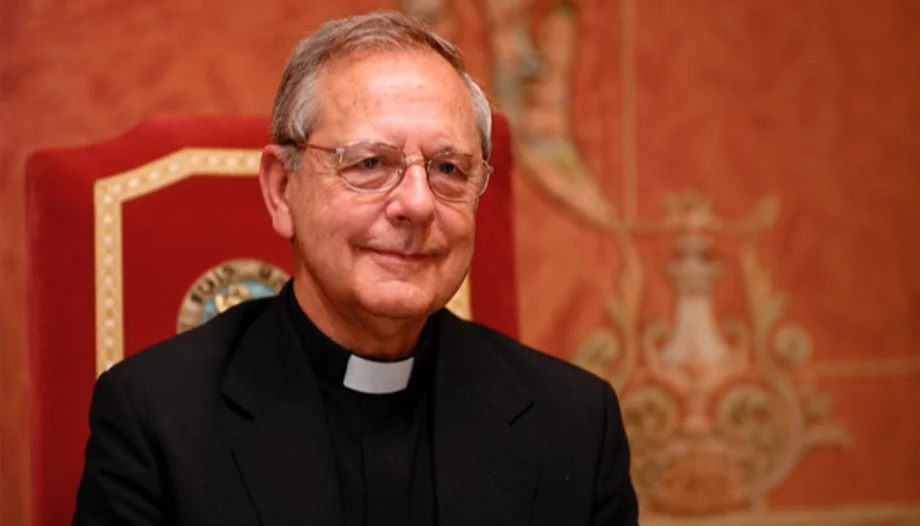
Pedro Rodríguez García, a priest of the Prelature of Opus Dei, theologian, and full professor emeritus at the University of Navarra, has died at the age of 93. Rodríguez was the founder and first editor of the magazine Word, a publication that is the origin of the the current issue of Omnes magazine and from the publisher Ediciones Palabra.
Born in Cartagena in 1933, Pedro Rodríguez earned his Bachelor’s degree in Law and completed doctoral coursework at the Complutense University of Madrid. Between 1956 and 1959, he lived in Rome, where he earned his Bachelor’s and Doctoral degrees in Sacred Theology at the Lateran University. During those years, he spent time with St. Josemaría Escrivá on a daily basis. He was ordained a priest in 1958 and incardinated into the Prelature of Opus Dei.
Upon his return to Madrid in 1959, he devoted himself to teaching theology at the «Studium Generale»of Opus Dei" and to pastoral work in university settings. During those years, he also participated, along with professors Alfredo García Suárez and José María Casciaro, in the launch of the Theology Library under the auspices of the University of Navarra, which sought to promote theological renewal in the context of the Second Vatican Council.
Founder of Palabra
In September 1965, at the start of the final session of the Second Vatican Council, Pedro Rodríguez founded and became editor-in-chief of the magazine Word for four years. The publication began as a monthly journal of pastoral and theological analysis aimed primarily at priests in Spain and Latin America, with the goal of promoting the reception and application of the teachings of the Council.
As the years have gone by, Word It expanded its horizons to become a leading Christian news magazine. The publication also served as the foundation for Ediciones Palabra, a publishing house that has since been actively promoting books with Christian content.
The Interview with St. Josemaría
One of the most notable episodes of his tenure as head of Word was the Interview with St. Josemaría Escrivá published in October 1967. Pedro Rodríguez helped prepare the questionnaire, which ultimately consisted of 21 questions about the Church, the Second Vatican Council, the laity, and Christian life.
The interview, featuring St. Josemaría on the cover, was introduced by Rodríguez himself and later became the first chapter of Conversations with Monsignor Escrivá de Balaguer.
An extensive body of theological work
With doctorates in Theology and Law, Pedro Rodríguez’s teaching and research focused primarily on ecclesiology, with special attention to its ecumenical and spiritual dimensions. Throughout his career, he published numerous research papers and edited source texts.
His most notable works include The Church and Ecumenism, Ecclesiology: 30 Years After «Lumen Gentium», in which he reflects on the evolution of ecclesiology based on one of the fundamental constitutions of the Second Vatican Council, and The Roman Catechism in the Time of Philip II and the Spanish Inquisition. He also produced the critical-historical editions of The Way y Holy Rosary, by St. Josemaría Escrivá, in which he undertook a rigorous study and historical contextualization of two of his best-known works.
A long academic career
Pedro Rodríguez was a full professor at the University of Navarra’s School of Theology beginning in 1974 and has been a professor emeritus since 2003. Throughout his academic career, he held, among other responsibilities, the positions of dean of the School of Theology, director of academic studies, director of research, and chair of the Department of Ecclesiology. He also directed Scripta Theologica, a theological research journal published by the University of Navarra.
His teaching and research focused particularly on ecclesiology, ecumenical theology, the history of theology, and the reception of the Second Vatican Council, as well as on the theology and spirituality of St. Josemaría Escrivá. He was also appointed by St. John Paul II as an expert for the 1999 Synod of Bishops for Europe and led the delegation from the Prelature of Opus Dei at the Third European Ecumenical Assembly, held in Sibiu, Romania, in 2007.
Among his honors are his membership in the Pontifical Academy of St. Thomas Aquinas, to which he was admitted in 1980, and his appointment as a full member of the Royal Academy of Doctors of Spain in 2006. John Paul II also granted him the title of Prelate of Honor of His Holiness.





 Español
  English
  Italiano
  Français
  Deutsch
  Polski