



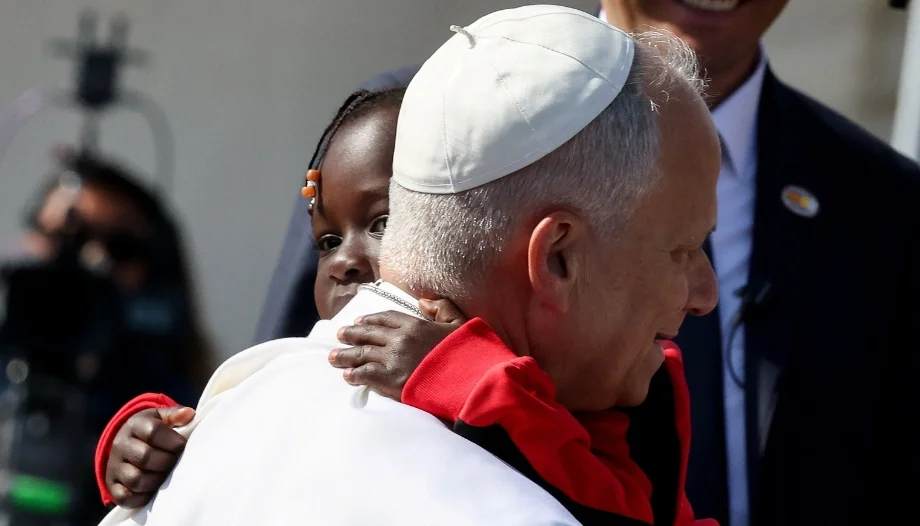
The Dicastery for Promoting Integral Human Development, with the sponsorship of Universidade Catolica Portuguesa and Scalabrini International Migration Institute, has just presented the Guide ‘Mental health and pastoral accompaniment in the context of humanitarian crises’.
The subtitle is ‘Caring for people and cultivating hope in a spirit of brotherhood’.
The document originated in the work of the Dicastery whose Prefect is Sister Alessandra Smerilli, FMA, who has disseminated a Message On the occasion of World Mental Health Day, he places this type of health “as an urgent pastoral priority”.
Guide for members of the clergy, religious, lay pastoral agents….
– Supernatural Guide The report on mental health presents nine lines of action in the current context of prolonged humanitarian crises, and is aimed at members of the clergy, religious, lay pastoral agents and others committed people with direct support in humanitarian contexts.
The humanitarian crises referred to in the introduction include armed conflicts and political instability, forced displacement and migration, poverty and inequality, as well as environmental and climate-related disruptions. In these contexts, mental health has become an increasingly prevalent concern in the lives of individuals, families, and communities, as well as in the daily experiences of those who support them.
Situations of fear, isolation, anguish
It is in this context that the Church, and pastoral agents in general, “face situations of pain, fear, disorientation, isolation, and various forms of anguish that can be prolonged or intense. They also confront the consequences of deteriorated relationships, the weakening of the sense of belonging, and the loss of usual sources of meaning and support.”.
These experiences are rarely lived in isolation. They unfold within the family and community, through relationships that, while they may experience moments of tension, also constitute important sources of care, connection, and support, it is noted.
Guidelines, not a rigid form of support
The arguments and advice, the Guide points out, should not be understood as a rigid sequence or a model to be applied uniformly. “These are interrelated guidelines that must be interpreted with attention to each person, community, and specific situation.”.
Together, they seek to sustain “a form of accompaniment based on human closeness,” guided by knowledge and attentive to the dignity, relationships, abilities, and hopes already present in the lives of those receiving accompaniment.
9 support lines
In summary, the 9-line proposal is as follows:
1. Create spaces of trust and security
2. Listen and accompany
3. Strengthen community ties and sense of belonging
4. Psychological well-being is based on relationships
5. Rebuild meaning and cultivate hope
6. Recognize and promote resilience
7. To care with knowledge and discernment
8. Accompanying people with severe mental disorders and their families
9. Encourage mutual support among caregivers
Conclusions: interpersonal relationships, trust, care
The Mental Health Document/Guide notes, among its conclusions, that “we have observed that mental health care lies in interpersonal relationships, in rebuilt trust and in communities that preserve, integrate and protect human dignity,”,
It manifests itself “through silent gestures of accompaniment, the shared sense that is rebuilt after a loss, the bonds of mutual care, and the patient task of restoring the sense of belonging where it has been broken.”.
At the center of this perspective “is the human person, whose dignity comes from God and does not depend on health, strength, autonomy or the absence of suffering.”.
Production and collaborating entities
The development of this Guide was directed and coordinated by Marcio Gagliato, Peter Hanenberg, and Aldo Skoda. The Guide also incorporates the contributions of Joseph Jeyaraj Swaminathan, Cristina Castelli, Francesca Giordano, and George Ehusani for its theological, pastoral, and technical aspects.
In addition, the following organizations participated as collaborators: Brothers of Charity – Rwanda; Camillian International Disaster Service (CADIS), Camillian Fathers and Brothers; Caritas Maiduguri – Nigeria; Caritas Poland; Catholic Relief Services; Order of Friars Minor (OFM) – Italy; International Catholic Commission for Migration (CCIM); Jesuit Refugee Service (JRS); Lux Terra Leadership Foundation – Nigeria; Doctors with Africa CUAMM; Sovereign Order of Malta; Our Lady of Charity of the Good Shepherd; Salesians of Don Bosco; Scalabrinian Missionary Sisters – South Africa; and Missionary Sisters of Our Lady of Africa.





 Español
 English
 Italiano
 Français
 Deutsch
 Polski