


ARTISTIC COMMENTARY
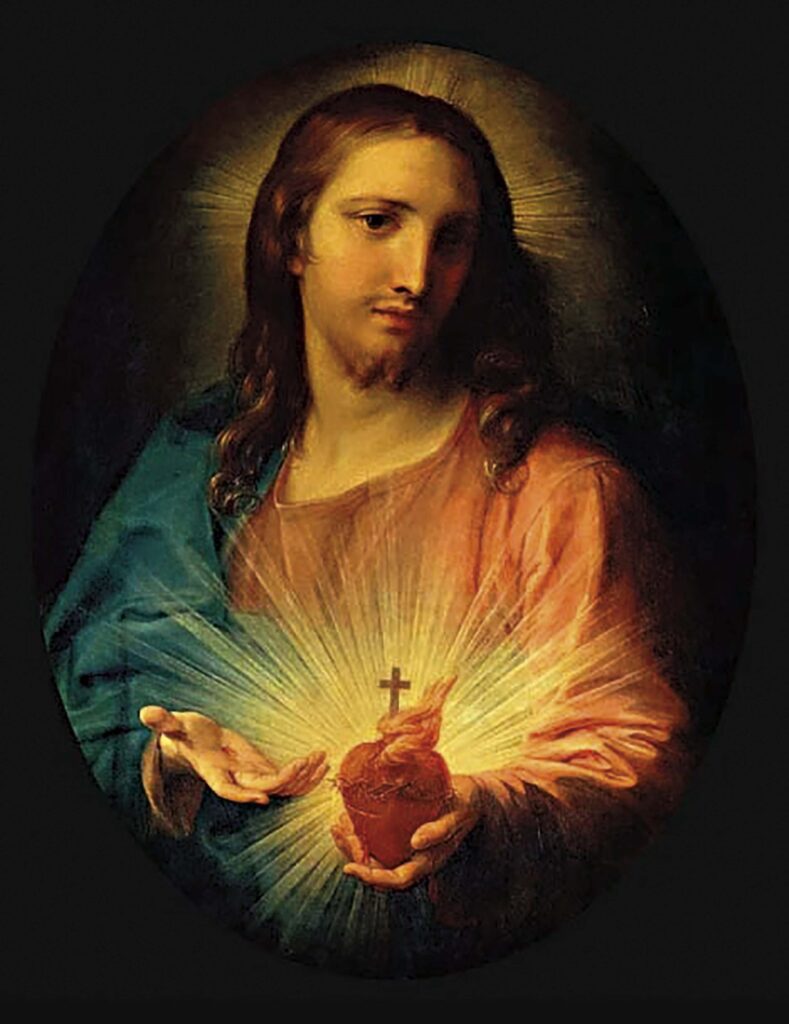
This image of Christ is one of the most widely recognized depictions of Jesus around the world. It shares certain similarities with Christ giving a blessing, by Antonello da Messina (which we discussed earlier), painted three centuries earlier, particularly in its compositional simplicity and the direct way in which Christ addresses the viewer. Against a dark background, Jesus appears as a young, serene, and compassionate figure, his gaze fixed on the viewer. Batoni follows the traditional symbolism of color in the depiction of Christ: the red tunic alludes to blood and martyrdom, while the blue cloak evokes water, the sky, and divinity. This combination has been used for centuries to express both the humanity and divinity of Christ.
The Revelation of Christ's Love
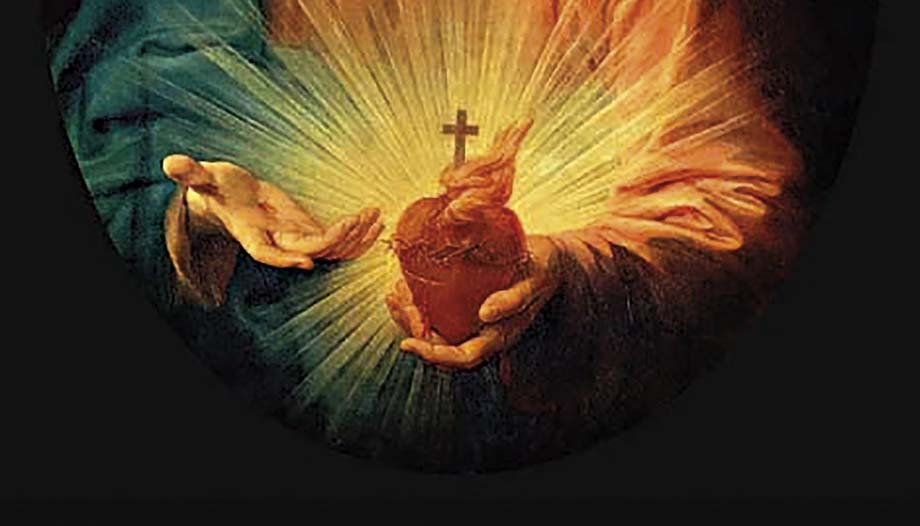
While in Messina’s work Christ is depicted giving a blessing, Batoni chooses to portray a deeply devotional moment: Jesus offering his Sacred Heart. Christ holds his burning heart in his left hand, and with his right hand—on which the nail wound is clearly visible—he points to us and invites us to follow him. The heart is depicted in great detail: it bleeds from a wound, is surrounded by a crown of thorns, and crowned by a cross—elements that symbolize Christ’s redemptive suffering and eternal love for humanity.
In the Gospel of John, it says: “One of the soldiers pierced his side with a spear.” (John 19:34). Christian tradition and the Church Fathers interpret this to mean that the spear pierced Christ’s heart. Batoni visually captures this theological interpretation. The Sacred Heart expresses Jesus’ boundless love and calls us to respond with love in our daily lives. The Christian vocation consists in conforming our hearts to the Heart of Christ: hearts filled with mercy, self-giving, and compassion. Jesus’ outstretched hand, depicted in foreshortening toward the viewer, invites us to contemplate his Heart and remember the sacrifice he made out of love for humanity.
From Mystical Vision to Artistic Model
Batoni’s work is closely linked to the visions of Saint Margaret Mary Alacoque (1647–1690), the French nun who promoted devotion to the Sacred Heart. She described the Heart of Jesus as “a throne of flames, more resplendent than the sun, transparent as crystal, with this lovely wound”. He was surrounded by a crown of thorns, a symbol of the suffering caused by sin, and crowned by a cross, a sign of the burden of the Passion he had taken upon himself since the Incarnation. Batoni, with great creativity, visually renders this description and, at the same time, humanizes the face of Christ, making him seem close and approachable.
Jesus is depicted in a three-quarter profile, gazing directly at the viewer. This intense gaze serves as an invitation to meditate on his redemptive suffering. Light radiates from his heart and partially illuminates his face, while the other half remains in shadow. This duality symbolizes the state of the soul when it turns away from the love and grace of Christ.
Pompeo Batoni was a renowned Italian painter, famous for his portraits of European nobility, especially the English who undertook the Grand Tour in the 18th century. However, he also received important religious commissions, and this painting became his most influential devotional work. The Sacred Heart of Jesus Batoni's work achieved enormous popularity and became the official symbol of devotion to the Sacred Heart, shaping Catholic spirituality in many countries.
The painting remains on display today on the altar of the north side chapel of the Church of the Gesù in Rome, where it continues to inspire prayer, contemplation, and gratitude for Christ's infinite love.
CATECHETICAL COMMENTARY
The Incarnation of the Son of God, as explained in the previous issue of this series, implies that the Word—the second person of the Holy Trinity, consubstantial with the Father in His divine nature—assumes a human nature: the Humanity of Jesus Christ, who is thus fully God and fully Man. In this installment, we will delve a little deeper into the understanding and expression of the Lord’s Humanity, which was briefly touched upon in the previous installment.
This Humanity is particularly well represented in the Sacred Heart of Jesus Christ, where the love of a human heart is united with the Love of a divine person, thus serving as the central organ of Christ’s Humanity and the place where divine Love itself is given to us in human love—that of the Son of God made man. That is why contemplation of the Heart of Christ—as Batoni so expressively captures it in his painting at the Gesù—is a sure path to deepening our understanding of the Lord’s humanity. Hence, Batoni emphasizes Christ’s human features to make him approachable and accessible. In turn, as Saint Teresa of Jesus taught with particular grace, the Humanity of Christ is the sure and pleasant path to a true life of prayer, for it is the Way that leads us to God. Therefore, a mistaken understanding of the Lord’s humanity—in body and soul—poses a serious obstacle to the true knowledge of God and to the proper development of the spiritual life. Throughout history, errors have arisen that have obscured, diminished, or distorted the characteristics of the human nature of the Son of God. Since these errors, though ancient, continue to arise today—albeit in various forms—it is important to recognize them so as not to fall into them, and thus to attain an understanding of Christ’s humanity that truly draws us closer to the Lord’s human identity and to His Sacred Heart.
True God and True Man
One of the earliest errors was to confuse Christ’s humanity with Christ himself—that is, to reduce him to the mere human figure of Jesus of Nazareth, an ordinary man adopted as God’s Son at his baptism. This error, known as adoptionism, holds that Christ’s humanity is merely God’s spokesperson and agent, but is not personally united to God Himself. Every time we speak of Jesus of Nazareth as a mere man, or a simple prophet, or a human teacher of wisdom, we fall once again into this oldest of errors.
This error, in turn, sparked the opposite reaction: Jesus Christ is so divine that his human nature—especially his body—is merely an appearance; he is not a real human being. This Docetism, therefore, would imply that it is not possible to represent, much less paint, God in Jesus Christ, since his body is not real; one could only access Him through spiritual and abstract meditation, as one would an idea inaccessible to the senses. Nothing better to counter this error than the words of Saint Teresa of Jesus: “I could only think of Christ as a man; yet I could never picture Him in my mind. That is why I was so fond of images. Woe to those who, through their own fault, lose this blessing! It seems clear that they do not love the Lord, for if they did, they would take pleasure in seeing His portrait.” (Life 9, 6). It is this experience that justifies and lends such value to paintings like the one by Batoni that we are enjoying.
Arianism held that Christ’s humanity was real and united to divinity, but not to the full, inaccessible, and exclusive divinity of the Father, but rather to a second-order divinity, which would be proper to the Son. Therefore, Christ’s humanity would not be a path to God, but would merely leave us on the threshold of divinity, since the Son is not consubstantial with the Father—that is, of the same divine nature—as we state in the Creed. With a simple phrase—“Jesus Christ is true Man and true God”—the Church shields us from these three errors, which remain more common than they seem.
A Person with Two Natures
The relationship between the true humanity of Jesus Christ and his full divinity is not easy to understand; hence, an excess of rationality or an overemphasis on the cultural peculiarities of each era can lead to imbalances in our understanding of it. Nestorianism, for example, held that Christ’s humanity was found in a human person, Jesus of Nazareth, while his divine nature resided in the Son of God. Thus, there would be one relationship between the believer and the person of Jesus and another with the person of the Son—a distortion that can occur when at times we pray to Jesus as a man and at other times we address the Son as God. On the other hand, Monophysitism held that Christ’s humanity, while not fictitious, was dissolved and rendered nonexistent in the infinity of the divinity of the Word, much like when Christ is contemplated solely in his divine majesty, forgetting the humility and gentleness proper to the human Heart of the Son of God (Mt 11:29).
Nor is it easy to view Jesus’ humanity as a concrete—and, above all, complete—human existence. Apollinarianism viewed the Lord’s humanity as mere corporeality, since his soul, or spirit, was the divine Word. If this were the case, it would be difficult to explain how Jesus grew in true human knowledge of reality (Lk 2:52). On the other hand, Monotheletism stripped Christ’s humanity of its will, since the only will in Him was the divine will of the Son of God. Consequently, his acts of obedience to the Father and of self-giving in the service of humanity would no longer be regarded as examples for any human will, since they sprang from a purely divine will.
Thus, as sometimes happens today, we forget that Jesus Christ has a fully human soul, with human knowledge and a human will, united to the Wisdom and Will of the Word in the person of the Son. For this reason, the formula used by the Council of Chalcedon to define the relationship between the two natures—human and divine—in the single person of the Son of God remains relevant today, just as explained in the previous issue.
A formula that, in a way, is also present in the words with which the Second Vatican Council offers us this excellent reflection on the true humanity of Christ, which we can meditate on so that our understanding of Christ’s humanity may be complete and true: “The Son of God worked with human hands, thought with a human mind, acted with a human will, and loved with a human heart. Born of the Virgin Mary, He truly became one of us, except for sin.” (Gaudium et Spes 22).
Art historian and Doctor of Theology






 Español
  English
  Italiano
  Français
  Deutsch
  Polski
  简体中文
简体中文