


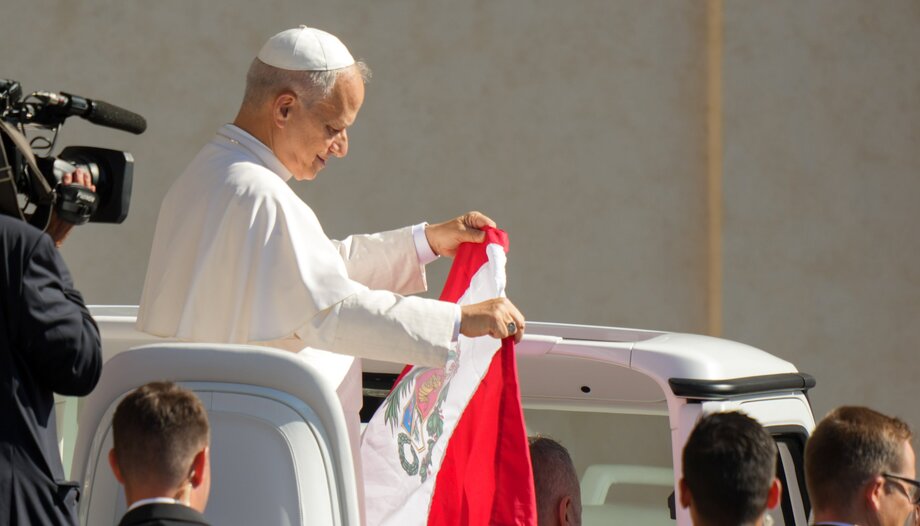
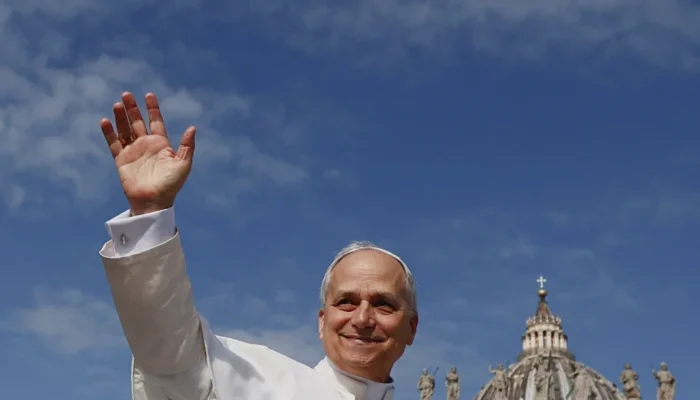
Almost on the eve of his apostolic visit to South America, Pope Leo XIV asked in his Wednesday Audience for prayers for his trip to South America“I ask that you accompany me with your prayers, so that the Lord may bless this mission in those countries that mean so much to me.”.
“Continue to proclaim the Gospel with joy”
“The day after tomorrow (the 6th), I will begin the travel ”I am on an apostolic journey to Uruguay, Argentina, and Peru. I entrust myself to your prayers, so that this journey may strengthen faith, renew hope, rekindle the fire of charity, and be an impetus to continue proclaiming the Gospel with joy,” he told the faithful and pilgrims in St. Peter’s Square.
Heroic Primates of Poland and Hungary, Cardinals Stefan Wyszyński and József Mindszenty
On the feast of Saint Charles Borromeo, the Pope also referred to Cardinals Stefan Wyszyński and József Mindszenty, heroic Primates of Poland and Hungary, who were released seventy years ago.
Recalling what Pope Pius XII wrote on that occasion in the encyclical ‘Laetamur admodum’, I urge you to keep in mind that peace is built on justice, respect for the law and dialogue, and not on violence, the Pontiff pointed out.
Two beatifications on Saturday: “the immense multitude of the Lord’s friends”
At the end of the catechesis, the Holy Father also mentioned two beatifications that will take place this Saturday, November 7. One in Antigua Guatemala, where Augusto Rafael Ramírez Monasterio, a priest of the Order of Friars Minor murdered out of hatred for the faith in 1983, will be beatified.
Meanwhile, in Santander, Spain, the Pope said, “Francisco González de Córdova, a diocesan priest, and 79 companions—priests, seminarians, and lay people—will be beatified. During the Spanish persecution of the last century, they did not fear to shed their blood for love of Christ. These new blesseds represent another piece of the immense multitude of the Lord’s friends.”.
Social dimension of humanity
In the catechesis, The Successor of Peter has resumed the cycle on ‘The Documents of the Second Vatican Council’, and has focused his reflection on the topic: the Constitution Gaudium et spes. Faith and social, political and economic life (GS, 63-76) (Reading: 1 P 2,12-13.17).
The social dimension of humanity is an integral part not only of our human nature, but also of our faith in Christ, the Pope stated. From this perspective, the Council Fathers presented the Catholic vision of economic development, placing work at its center.
Gaudium et spes presents in summary the Christian vision of economic development, which must always be at the service of man and under the control of man, a concept that Saint Paul VI would later place at the center of his Encyclical Populorum Progressio (1967).
In this regard, the Pope has stressed that “calls to commit to eliminating discrimination against the most vulnerable social groups and against migrants are more relevant than ever.”.
Work, the heart of the economy
He then pointed out that “the heart of the economy is work. Through it, man develops as a person, satisfies the needs of his family, expresses his own talent, participates in social life and builds a better world by collaborating in God's creative work.”.
Worker participation, through dialogue and without violence
Work can never be misrepresented to the detriment of people, the common good or creation, he added, also noting that “workers have the right and the duty to participate in decisions that affect their activity, also in an associative way, facing conflicts with dialogue and non-violent actions.”.
Political authority, at the service of the common good
After discussing the economic and labor order, the Pope referred to the political one.
The political community exists for the purpose of the common good, which consists of “the sum total of those conditions of social life by which men, families and associations can more fully and easily achieve their own perfection” (GS, 74).
“And the exercise of political authority must always look towards the common good, which is structured and operates according to local and historical circumstances, but always keeping in mind the good of the entire human family,” he recalled.
“The political community and the Church are independent and autonomous, each in its own sphere. Both, however, though by different titles, are at the service of man’s personal and social vocation,” and they will accomplish this better “the healthier and better the cooperation between them.” (GS, 76).
Formation on the social doctrine of the Church
At the conclusion, before reciting the Lord's Prayer and giving the Blessing, Leo XIV renewed his “exhortation to Christian communities to promote anew the formation on the social doctrine of the Church.”.




 Español
 English
 Italiano
 Français
 Deutsch
 Polski