


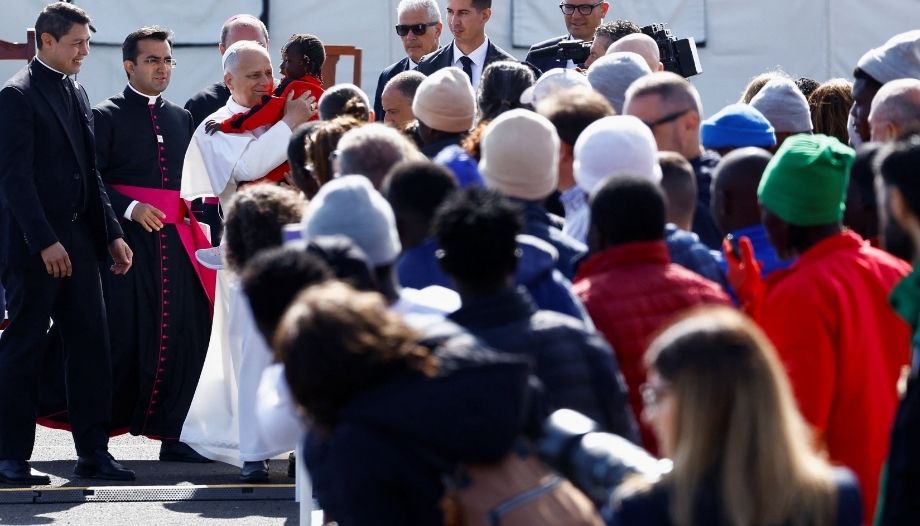
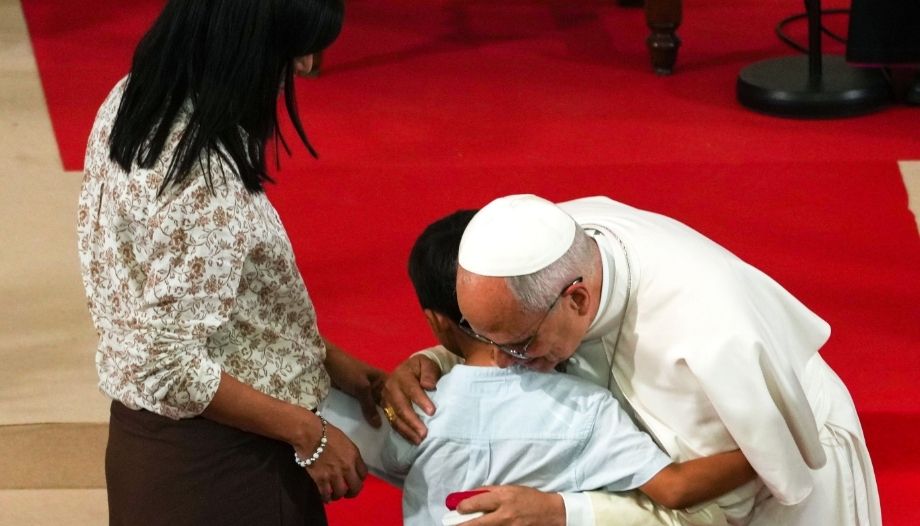
The Holy Father once again expressed his gratitude in the Audience this morning on his apostolic trip to Spain, “a European country with a long and rich Catholic tradition,” he said.
The Pope has been welcomed everywhere “with enthusiasm and a willingness to listen,” and “I give thanks for this to God and to all the Spanish people, to the King and the civil authorities, to the bishops, and to the ecclesial communities. The people of God have greatly comforted me with their joyful expression of their faith and affection.”.
For his part, he added, “I have reassured the faithful and, as Bishop of Rome, I have encouraged them to overcome all forms of division and conflict, and to always foster communion, dialogue, and unity in diversity.”.
Safeguarding the heritage of Spain and Europe
In his reflections, Spain's Catholic tradition has led him to to reflect about Europe.
The participation of large crowds in the events in Spain—which, he said, should not be taken for granted—expresses, above all, “the faith of the Spanish people; at the same time, I believe it demonstrates the widespread need to come together again on a true and profound foundation, one that is neither ideological nor based on partisan interests.”.
“That foundation which, ultimately, only Christ can ensure, and which the Gospel, through the necessary “inculturations,” can bring into the lives of peoples.”.
The Holy Father recalled that in Madrid and Barcelona, we gathered in the great cathedrals as well as in state-of-the-art stadiums, in addition to praying the Holy Rosary at the Abbey of Montserrat and celebrating Mass at the Sagrada Familia, a majestic symbol—a symphony of stone and light that speaks to everyone of the Christian mystery.
Where the Old Meets the New
And he immediately emphasized that “this encounter between the ancient and the modern, between Catholic tradition and contemporary culture, has allowed me to perceive firsthand the very essence of Europe—its inestimable richness—as a reality of the present, not a thing of the past.”.
“This is a heritage that must be carefully safeguarded so that it can be invested in today’s global world with its historical challenges: peace, integral ecology, equitable and sustainable development, and respect for human dignity.”.
Key Points for Understanding the Canary Islands
The Successor of Peter has revealed that it was during the final leg of his journey, in the Canary Islands, that he found “a key to a general interpretation.”.
One key factor has been provided “on the one hand, by the archipelago’s geographical location itself; and, on the other, by the reality of a local Church that welcomes a large number of forced migrants, primarily from Africa.”.
“The phenomenon of migration is complex and requires comprehensive and coordinated action plans,” he continued in his remarks.
And this key to interpretation “helps us understand that we are called to re-read the Gospel in today’s world by sharing the gifts of our respective cultures and, in particular, the fruits that the fruitfulness of Christ’s message produces in them.”.
Dialogue between individuals and communities, brotherhood
One of these fruits is “precisely dialogue among individuals and among peoples,” he noted, “encounter in a spirit of fraternity, which allows us to discover and appreciate one another’s values.” This path is not easy; it requires goodwill and God’s help, but it is the path that leads to the civilization of love.
“Let’s lift up our eyes! Let’s learn from Jesus”
“Dear brothers and sisters,“ the Pope concluded, ”the theme of this apostolic journey was ‘Lift up your eyes’ (cf. Jn 4:35).” These are the words Jesus addressed to his first disciples to teach them to see in people and in crowds the desire for life, for truth, and for fulfillment.”.
“The Lord repeats these words—to me first of all—and, by His grace, I have experienced this during the journey. Today I would like to share this invitation with you: let us lift up our gaze! Let us learn from Jesus to look at our neighbor, at people, and at the world “through the eyes of God”—that is, with love, respect, and compassion.”.
Iran-United States: “”It is always better to do so through dialogue and negotiation"
Last night, as he was leaving Castel Gandolfo to return to Rome, the Pope answered a few questions from our correspondents, on the G7 meetings and the preliminary peace agreement between the United States and Iran.
“Negotiations… Thank God, at least there is this Memorandum, which, they say, will be officially signed on Friday,” the Pope remarked. “There are still several points to be worked out, but it is always better to do so through dialogue and negotiation than to return to war.”.
“The hope is that ”this will truly be a solution to the war, that the war will truly be over, and that we can move forward for the good of all. Eliminating nuclear weapons, of course, seeking the good of all peoples, and finding ways to resolve the problems—including economic and social ones—that have arisen during this time,' he said.".
This morning, he reiterated the same point at the end of the hearing, noting that he views the agreement with satisfaction, and thanked all the participating countries for their efforts.
In contrast, he has reacted to the news about Ukraine and has called on people to pray “for this war to end” and “for avenues of dialogue to open up, making a just and lasting peace possible.”.






 Español
  English
  Italiano