



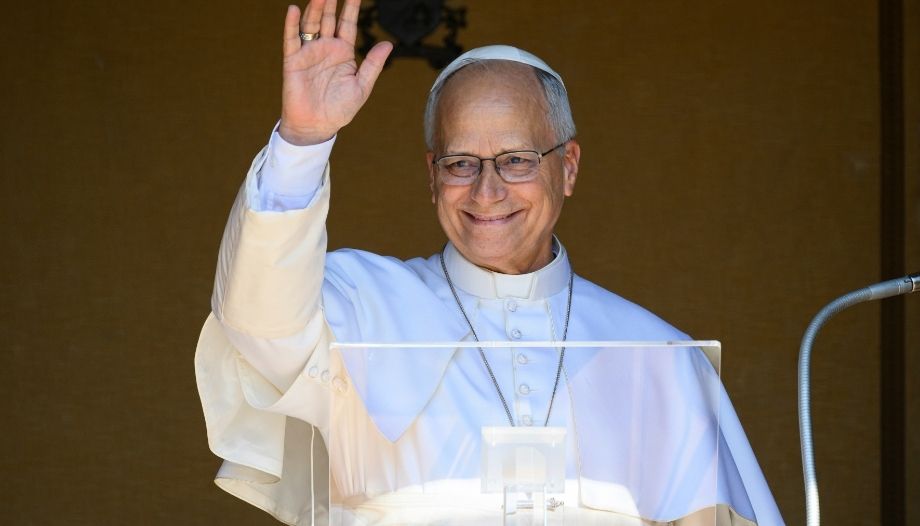
Music is an integral part of the liturgical action; it is not merely a decoration for the celebration. The musical tradition of the universal Church is a treasure of inestimable value that fosters communion, the Holy Father emphasized during his catechesis on this Wednesday in August at St. Peter’s Basilica, in the presence of 5,000 faithful and pilgrims.
Among them, those from Lebanon greeted the Pope with particular joy when he mentioned their country in his message to the Arabic-speaking pilgrims, as did the Poles—as is customary—and the English- and Spanish-speaking pilgrims, who are also typically the loudest.
Sacred music, which is closely linked to the liturgical celebration, is not merely a decoration
León XIV continued on Wednesday at the Audience his catechesis on the Second Vatican Council's constitution *Sacrosanctum Concilium* (SC), specifically Chapter 6, which is devoted to sacred music.
He began his remarks by referring to paragraph 112 of the document. “The musical tradition of the universal Church constitutes a treasure of inestimable value, which stands out among other artistic expressions, primarily because sacred song, together with the words, constitutes a necessary or integral part of the solemn liturgy.”.
He continued: “Sacred music, therefore, will be all the more holy the more intimately it is united to the liturgical action, whether by expressing prayer with greater delicacy, fostering unity, or enriching the greater solemnity of the sacred rites” (ibid.).
Here we find the core of the Council’s teaching, which confirms and elaborates on the ministerial role of music in the liturgy, as previously highlighted by St. Pius X in the Motu Proprio *Inter sollicitudines* (November 22, 1903). “In fact, music is part of the liturgical action, and is not merely an ornament of the celebration,” the Pope emphasized.
St. Augustine: “Singing is the mark of those who love”
In the liturgy, singing and playing music mean praying, attuning one’s heart to that of one’s sisters and brothers and to God, through active participation in the mystery being celebrated, the Pope continued in his reflection.
Music, in fact, expresses the emotional dimension of prayer, as St. Augustine states: ‘Cantare amantis est,’ that is, ‘singing is proper to those who love’ (Sermo 336,1). “This is very important, because it helps us open our hearts to God’s action through grace and allow ourselves to be shaped by it.”.
“Singing, moreover, fosters communion. Through harmony, voices help to unite hearts, overcoming differences among people and bringing everyone together in praise of God. In this way, it becomes an epiphany of the Church, a tangible manifestation of the communion that is part of its very nature,” emphasized Leo XIV.
Some Requirements of Sacred Music
The Pope also mentioned some requirements, which stem from the profound theological significance sacred song, as an integral part of the liturgical celebration.
The first is that, regardless of trends or the personal preferences of the authors, it must be appropriate in every respect for the occasion.
Furthermore, the Pontiff said, “the form, especially in its melodic aspect, must be both noble and simple, of high musical quality and easy to perform, especially when it is intended to be sung by the entire assembly (cf. SC, 121).”.
For the same reason, “the Council recommends that the texts also be appropriate, profound, and at the same time easy to understand, drawing primarily on Sacred Scripture, the liturgical books, and the spiritual Tradition of the Church.”.
Active Participation of the Faithful
The Pope highlighted a passage from Benedict XVI’s exhortation *Sacramentum caritatis* while analyzing the extensive attention that *Sacrosanctum Concilium* devotes to the active participation of the faithful (cf. no. 114).
This “must be understood […] based on a deeper awareness of the mystery being celebrated and its relationship to daily life” (Benedict XVI, Apostolic Exhortation Sacramentum caritatis, 52) in a ‘spirit of ongoing conversion that must characterize the life of every believer’ (ibid., 55).
Specific modes
The Holy Father also recalled the specific way in which this participation of the faithful can be realized through the unique role of sacred music, according to SC:
“The acclamations of the people, the responses, the psalm singing, the antiphons, and the hymns” and “a sacred silence” (SC, 30) “are to be encouraged,‘ with an exhortation ’to each person, whether minister or layperson, to perform ‘all and only what is proper to them by the nature of the action and the liturgical norms’ (SC, 28) within the harmonious balance among the various ministries, the different contributions, and the moments of silence.”.
Gregorian chant, without excluding other genres
The Council also attaches great importance to the Gregorian chant, without excluding other genres of sacred music from the celebration, the Pope noted.
With regard to inculturation, including in the realm of sacred music, the Pope has summarized the provisions of SC: in particular, it emphasizes “the importance of taking the musical traditions of different cultures fully into account as part of people’s religious and social lives.“ For this reason, it is recommended, on the one hand, that an appropriate ”education in religious sensibility“ be implemented for all (SC, 119) and, on the other hand, ”as far as possible […] to promote the traditional music of their people, both in schools and in sacred celebrations” (ibid.).
Training and practice in seminaries, novitiates, and houses of study
Finally, in a catechesis that was somewhat longer than on other Wednesdays, the Pope stated that composers of sacred music must know and preserve the Church’s musical heritage, citing St. John Paul II, *Quirógrafo on Sacred Music*, November 22, 2003, 3).
It has also reiterated the recommendation of the Council Fathers to “promote the study and practice of sacred music ‘in seminaries, in the novitiates of religious orders of both sexes and in houses of higher learning, as well as in other Catholic institutes and schools’ (SC, 115) and to ensure that musicians and singers receive a solid liturgical formation (cf. ibid.).






 Español
  English
  Italiano
  Français
  Deutsch
  Polski
  简体中文
简体中文