


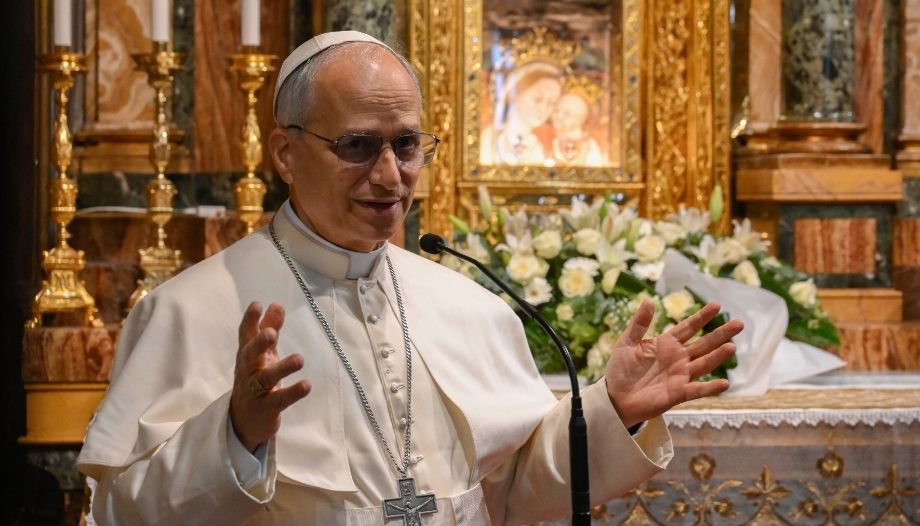
Before more than 5,000 faithful gathered in St. Peter's Basilica, Pope Leo XIV consecrated the Audience on Wednesday, regarding the Liturgical Year, while commenting on the Second Vatican Council’s constitution ‘Sacrosanctum Concilium.’.
In his address in various languages, the Pontiff has stated that “celebrating the Eucharist is essential for sanctifying Sunday,” since, according to the Council Fathers, listening to the Word and participating in the Body of Christ entails the festive gathering of the faithful.
In his remarks to Portuguese-speaking pilgrims, for example, he encouraged them to “sanctify Sunday by participating in Holy Mass, not just by attending virtually”
This assembly “cannot be replaced by a merely virtual presence, nor can it be reduced to a merely passive gathering,” he noted. The liturgical assembly, in fact, takes place through the active participation of brothers and sisters, gathered together to “give thanks to God, who has brought them to new life through the living hope of the Resurrection of Jesus Christ from the dead.”.
The Foundation of the Liturgical Year: Sunday
“The liturgical year should be understood as a constant renewal of the work of salvation that Christ carries out throughout history. Throughout this annual cycle, the Church remains in touch with the Lord’s redemptive action, so that the faithful may be filled with the grace of salvation.”.
Leo XIV quoted Pope Pius XII in the encyclical Mediator Dei, when he wrote that the liturgical year “is not a cold and lifeless representation” of the past or the “recreation of a reality from times gone by,” but rather “Christ himself who perseveres in his Church” and continues his “journey of mercy” so that “the souls of men may come into contact with his mysteries,” which are present and constantly at work.
The Pope went on to emphasize that the encounter with Jesus, who died and rose again for us, is the goal the Church pursues and the center of every celebration. The Council Fathers established Sunday—the “dies Domini,” “the Lord’s Day”—as the foundation of the liturgical year.
In his Apostolic Letter *Dies Domini*, St. John Paul II taught that Sunday is the Lord’s Day, the Church’s Day, humanity’s Day, and, finally, ‘the day of days,’ since Sunday is the weekly Easter.
“Even in those languages where the reference to the ‘day of the sun’ has prevailed (Sunday, Sunday ), one can glimpse the connection with Christ: «Christ is the true »sun of righteousness’ who enlightens every person!” said the Pope.
At the beginning of his catechesis, Leo XIV recalled that the term “liturgical year,” used to describe the annual sequence of Christian celebrations, was introduced into the Church by the Servant of God, Abbot Prosper Guéranger (1805–1875), and since then, it has been defined and explained in the papal magisterium.
Assumption of the Blessed Virgin Mary and Commemoration of Martyrs and Saints
Before concluding his catechesis, the Successor of Peter noted how each celebration has been added to the liturgical year, intertwining “the faith and devotion of the Church”: the celebration of the weekly Passover since the second century A.D.; then the annual Easter, “the greatest solemnity”; Pentecost 50 days later…
“The subsequent development of the Christmas season, modeled after the Easter season, has allowed us to relive the mysteries of the Incarnation of the Word of God, of his birth, and of his manifestation to the world.”.
Similarly, the inclusion of the veneration of the Blessed Virgin Mary and the commemoration of the martyrs and the other saints. He noted that “the liturgical year thus represents, in a sacramental way, the teaching of the history of salvation, guiding the faithful from the expectation of the Messiah to the fullness of the Paschal Mystery and the anticipation of future glory.”.
Assumption of the Virgin Mary, Saint Maximilian Kolbe
In his remarks to the Polish pilgrims, the Pope recalled the Solemnity of the Assumption of the Blessed Virgin Mary, which the Church celebrates on August 15, and the feast of St. Maximilian Kolbe on the eve of that day.
“August is a month filled with important anniversaries for you. Through Mary’s intercession, victory was achieved on August 15, 1920, in the Battle of Warsaw, which changed the course of Polish and European history. On the Vigil of the Assumption, we celebrate the liturgical memorial of Saint Maximilian Maria Kolbe, who offered his life for a fellow prisoner in the German Nazi camp at Auschwitz. May the memory of these events guide us along the path of peace shown by the Immaculate Conception. My blessing to all!”
Solidarity with the people of Colombia
Addressing the Spanish-speaking pilgrims, the Holy Father he reiterated his “solidarity with the Colombian men and women who suffered the effects of the recent earthquake, which caused numerous deaths and injuries, as well as extensive property damage. While I pray to the Lord for the eternal shame of sinners, I offer my prayers for their families and for all those affected by this tragedy. I express my gratitude to all those working on rescue efforts and providing assistance to the victims.”.
After the final blessing, the Pope said, “In a few days we will celebrate the Solemnity of the Assumption of the Blessed Virgin Mary. I am pleased to urge you to constantly direct your prayers to the Mother of God, following her example by fully embracing the vocation to closeness with the Lord and concern for others. My blessings to all of you!”.





 Español
  English
  Italiano