


 Claves para entender mejor "Amoris Laetitia" y su polémicaGabriella GambinoIt is important not to leave families on their own".Celebrating "Amoris laetitia" to rethink the family
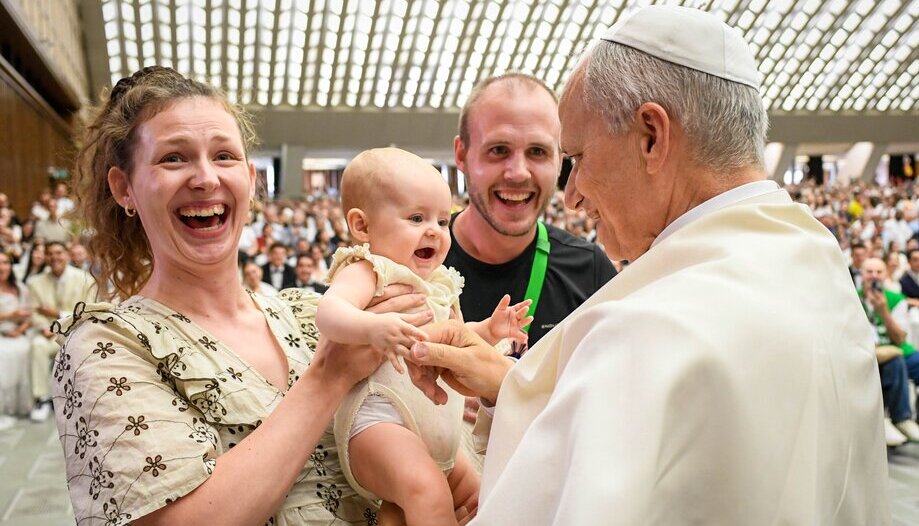
The Paul VI Hall in the Vatican will host the meeting “Ten years after Amoris laetitia”Announcing the Gospel with Families Today,“ from October 7 to 14, will be presided over by Leo XIV, who will participate in several of the meetings. The Pope’s desire is “to move forward, through mutual listening, toward a synodal discernment on the steps to be taken to announce the Gospel to families today, in the light of…” Amoris laetitia".
The meeting will be attended by the 15 heads of the Eastern Churches and the 115 presidents of the episcopal conferences from around the world (some of them represented by a delegate). Also present will be 22 personal guests of the Pope, including, as the only Spaniard, Cardinal José Cobo.
In total, some 248 bishops will participate, along with some families and experts. This presence indicates the importance the Holy Father has given to the meeting, which will analyze, ten years later, how the situation has developed. Amoris laetitia. This apostolic exhortation of Pope Francis’ It raised considerable controversy on some points, specifically when talking about divorced couples.
The meeting was presented at a press conference in the Vatican with the participation of three of the coordinators: Professor Gabriella Gambino, Undersecretary of the Dicastery for the Laity, Family and Life; Orietta Rachele Grazioli, Professor of Canon Law and Comparative Family Law at the John Paul II Institute for Marriage and Family Sciences; and Fr. Giacomo Costa, SJ, consultant to the General Secretariat of the Synod.
Gambrino emphasized that today “the reality of family ministry on the five continents is more complex than ever and faces diverse situations and problems regarding marriage and family.” He explained that “the tenth anniversary of the exhortation is the starting point for reflection, but at the heart of the meeting lies” in proclaiming the Gospel to families today, that is, how to vigorously renew pastoral care and ensure that families participate more fully in the life and mission of the Church.
He warned that, “in many ecclesial contexts, the family still runs the risk, even today, of being considered a passive recipient of pastoral action: a mere sector of pastoral care entrusted to a commission in the parish or diocese.” He recalled that Leo XIV exhorted that “evangelization should truly become an ecclesial act, in which pastors and families feel co-responsible and participate together in the proclamation of the Gospel.”.
Worrying figures
The professor provided some figures on cultural transformations surrounding the family. For example, in Poland, religious weddings celebrated in the last five years have decreased by 45%. In Australia, between 1970 and 2024, they fell from 88% to 16%. “These are signs that, in the diversity of contexts, highlight the urgent need to accompany the decision to marry and to more decisively support the transmission of faith within the family,” she stated.
“The starting point for family ministry should be a reflection on vocation,” he asserted, quoting some words of Leo XIV to the youth in Spain“Marriage is also a vocation. Don’t be afraid to get married and start a family!”.
The meeting, he explained, is addressed only to the heads of the Eastern Churches and the presidents of the episcopal conferences, “because they are responsible for promoting and supporting pastoral action in their respective countries and in the local Churches. Therefore, the Holy Father wishes to listen to them directly and engage in dialogue with them in discernment.”.
Invited families
Along with church leaders, several families will be present, reflecting the diverse geographical backgrounds. Three couples come from Latin America: Brazil, Peru, and Costa Rica. Among the 26 participating experts, only one Chilean and one Argentinian are from the Spanish-speaking world.
Father Costa explained that “we can consider this meeting as a kind of evaluation assembly” of the Amoris laetitia. The aim is to examine what has been implemented in the lives of churches and families, “what we have learned, the difficulties encountered, and the new questions that have arisen.” He explained that the specific topics to be addressed at this meeting are not yet known, as the bishops themselves will determine them.
The fruits of these five days will be compiled in a summary report—not a new final document to replace the apostolic exhortation, but a synthesis of the work. It will then be submitted to the Pope and, although only a working document, will also be made public.






 Español
  English
  Italiano
  Français
  Deutsch
  Polski
  简体中文
简体中文