



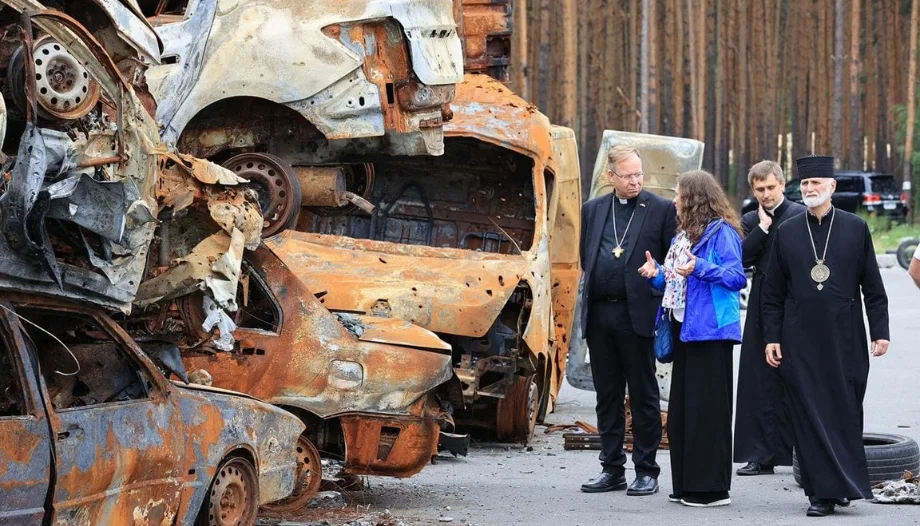
At a breakfast briefing organized by Caritas, the president of Caritas Ukraine, Tetiana Stawnychyse has highlighted that, according to UN data cited by Caritas Ukraine, about 11 million people will need humanitarian aid in 2026 in a context of “long-lasting and high-intensity” conflict.
There is a sense of «forgetfulness» about the war in Ukraine. The international community has begun to put the conflict on the back burner in the face of the emergence of other geopolitical issues, so that support with funds for humanitarian aid is becoming smaller and smaller.
During the press conference, the organization's officials described what they call a “crisis within a crisis”: continued attacks on energy infrastructure in the middle of winter are leaving billions of people without heat, electricity and even water. The bombings are concentrated in densely populated cities and particularly affect those living in high-rise buildings, the elderly or those with reduced mobility, and families with children.
“If you live on a 15th floor, with no light or elevator and no heating, daily life becomes almost impossible,” they explained.
Farther from the front, but not safe
Although there are relatively more stable areas in the west of the country, the war is not limited to the front line. In cities such as Kiev, massive attacks are recorded every few days, forcing the population to wake up in the early hours of the morning to sirens and to check their cell phones to find out if they are drones or missiles.
In these areas, Caritas focuses its work on sheltering internally displaced persons, providing housing, schooling, psychological care, legal advice, access to healthcare and support in finding employment. So-called crisis centers provide individualized accompaniment to stabilize evacuated families.
The frontline widens: drones and evacuations more dangerous
The organization warned that the area considered most dangerous has gone from 10 to 25 or 30 kilometers from the front line, due to the use of drones that chase civilians and have even attacked humanitarian vehicles. This complicates both food distribution and evacuations.
“Operations are increasingly risky,” they noted.
Mental health: a growing priority
After almost four years of conflict, the psychological toll has become one of the main challenges. Caritas stresses that the war “has not been normalized”, although the population has learned to live with it.
The entity develops individual and group psychosocial support programs, especially with minors who have spent years with online schooling and little socialization. It also promotes therapies through art, work with families and training in non-violent communication to reduce community tensions.
It also collaborates with public initiatives such as the Resilience Centers, promoted by the Ukrainian government, and maintains specific programs for war veterans, with physical rehabilitation after amputations, emotional support and social integration, especially in rural areas.
Volunteerism that heals
One fact highlighted by the organization is that 40 % of the volunteers in the first year of the invasion were displaced people who had previously received assistance. “Helping others also helped them heal,” they explained, highlighting the value of volunteering as one of the keys to staying healthy and integrated with the community.
Caritas acknowledged that in Russian-occupied areas, activity is extremely difficult. There are no active parishes and several religious figures have been expelled. They tell the story of two parish priests who were arrested and taken to prison in war camps for almost two years: «the situation is very oppressive in the occupied territories».
In Mariupol, at the beginning of the invasion, an office of the organization was attacked and two workers and their families were killed. «When this happened in 2022, there was a very strong culture of rejection towards Russia, and towards a logical hatred. But Caritas being an institution of the Church, in the face of tomorrow, we are working in the sense of trying to heal those wounds, in the face of the relationship with the citizens of Russia.».
«It is a promotion of mercy, of forgiveness, even if it is difficult right now, impossible. Peace is a long process, it is not a moment, and it is being built».
International support and Spanish collaboration
From Spain, Caritas Spain maintains a continuous collaboration with its Ukrainian counterpart. According to its leaders, in these four years almost 19 million euros have been allocated to «save, rescue, protect and accompany the most needy people in Ukraine, as well as to rebuild those communities that need so much».
Despite the general fatigue, the final message was one of resistance: the population “is exhausted, but it is still standing”. The organization insists that maintaining international solidarity is key in the face of a scenario which, they assure, has been the most dangerous of the four years of war and could worsen if humanitarian funds are reduced.
“Peace is a long process,” they concluded, “and right now the priority is to sustain people and preserve their mental health so that we can rebuild the country when that time comes.”.




 Español
  English
  Italiano