


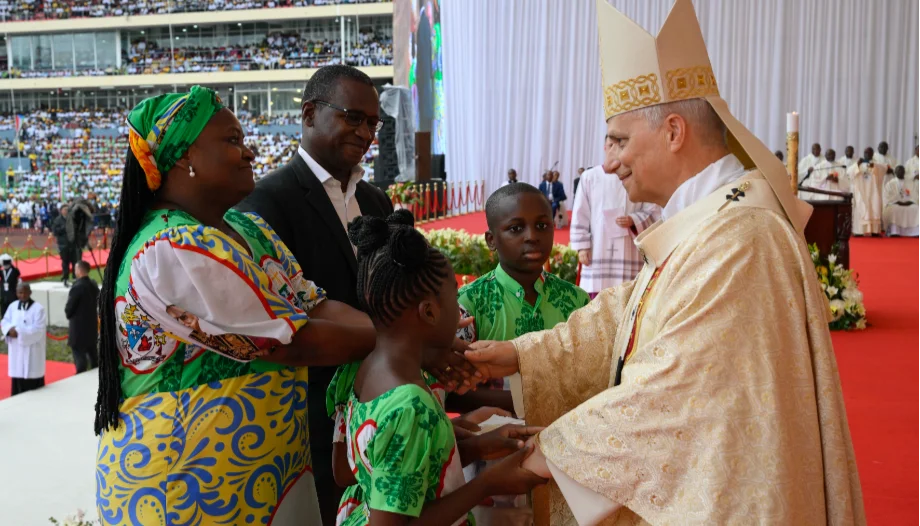
Already in May 2025, the month of his election, Leo XIV thought of making his first papal trip to Africa. It could not come to fruition, as he finally made his first trip to Turkey and Lebanon. But better late than never: from April 13 to 23, the American Pope visited Africa, beginning with the cradle of St. Augustine, today's Annaba, in Algeria. From Algeria, in the north, he visited Cameroon, in the center of Africa; then Angola, to the south; and finally, to the west, Equatorial Guinea.
His sons and daughters in the whole continent, not just in the four countries, followed his visit with great enthusiasm. They were eager to hear his voice and willing to heed it. Here are five messages from the pope that Catholics in Africa will remember from the apostolic visit.
A plea of peace
The theme of peace is ever-present in Pope Leo’s teaching. It has been commented that the theme of peace will define his pontificate. Visiting the African continent, ravaged as it is by armed conflict, Pope exhorted the faithful and also civil authorities on the need to work for peace. Peace, he said in Yaoundé (Cameroon), “cannot be decreed: it must be embraced and lived”.
True peace is «unarmed» and «disarming». It is unarmed because «it is not based on fear, threats or weapons». It is disarming «because it is capable of resolving conflicts, opening hearts and generating trust, empathy and hope». It must not be reduced to a mere slogan, but «must be embodied in a way of life that renounces all forms of violence, both personal and institutional».
In Algiers (Algeria), the pope proposed intercultural and interreligious dialogue as an enriching path to peace and unity. Noting the special identity of Algeria as a “bridge between North and South, and between East and West”, he exhorted us to foster “mutual enrichment among peoples and cultures” and in this way “multiply oases of peace”.
Leadership means service
The pope spoke clearly on the grave duty that politicians and civil authorities have to those they govern. In Yaoundé, the pope urged for the breaking of the “chains of corruption” which “disfigure authority and strip it of its credibility.” Speaking in Algiers, Pope Leo called for leaders to be protagonists of peace and justice by safeguarding the dignity of all and opening themselves “to be moved by the pain of others, instead of multiplying misunderstandings and conflicts.” They are called to lead by fostering cooperation towards the common good, not seeking to dominate. Leadership is about service to others, “dedicating oneself, with a clear mind and an upright conscience, to the common good of all people in the nation.”
In Luanda (Angola), the pope counselled rulers not to be afraid of disagreement. They should not “suppress the ideas of the young or the dreams of the elderly; but know how to manage conflicts by transforming them into paths of renewal”.
With pointed focus, Pope Leo warned against an “idolatrous thirst for profit” and a “logic of extractivism” that leaves many dispossessed. He counseled instead for “true profit” which is the result of “integral human development”.
Christ satisfies our hunger and thirst for justice
Pope Leo acknowledged the great hunger and thirst for justice that is witnessed world over. “We are living, in fact, at a time when hopelessness is rampant and a sense of powerlessness tends to paralyze the renewal so deeply desired by peoples. There is such a hunger and thirst for justice! A thirst for getting involved, for a vision, for courageous choices and for peace!”.
Every human heart yearns to be liberated. In a homily in Suarimo (Angola), the pope proclaimed that “we were not born to become slaves either to the corruption of the flesh or that of the soul: every form of oppression, violence, exploitation and dishonesty negates the resurrection of Christ, the supreme gift of our freedom.”
In Christ, this hunger ultimately satisfied: “Through Jesus’ Passover, the definitive exodus, every people is set free from the slavery of evil. As we celebrate this saving mystery, the Lord calls us to make a decisive choice: “Whoever believes has eternal life.”” (Homily at Malabo, Equatorial Guinea)
The hopeful young are priceless treasures
The pope passionately addressed the young who came out to meet him. In Yaoundé, he referred to them as the “hope of the country and of the Church”, noting that “their energy and creativity are priceless treasures.” The young are indispensable in the quest for peace. “When unemployment and social exclusion persist, frustration can lead to violence. Investing in the education, training and entrepreneurship of young people is, therefore, a strategic choice for peace. It is the only way to curb the outflow of wonderful talent to other parts of the world. It is also the only way to combat the scourges of drugs, prostitution and apathy, which are devastating too many young lives in an increasingly dramatic way”.
Their hunger for hope, Pope Leo told the youth, is filled by the Christ who promises a “future of hope”. Not an “unknown future that we must passively await, but rather one that we ourselves are called to build with God’s grace”. (Homily at Mongomo, Equatorial Guinea)
Their thirst for hope, Pope Leo XIV told young people, is quenched by Christ, who promises a «future of hope.» Not an «unknown future that we must passively await, but one that we ourselves are called to build with God's grace.» (Homily in Mongomo, Equatorial Guinea)
Pope Leo invited the young to embrace the vocational call to be “priests, religious sisters, religious brothers, or catechists” or married people in holy matrimony. “Be prepared”, he exhorted, “to embrace this calling as a journey of true love that grows in freedom; as a journey of hope, born from the knowledge that God will never abandon you; and as journey of holiness, in which you always seek the good and happiness of others.”(Address at Bata, Equatorial Guinea)
The mission of the university
At the Catholic University of Yaoundé, Pope Leo outlined the mission of the university “at a time when many in the world seem to be losing their spiritual and ethical points of reference”. In these times, “the university stands out as a privileged place of friendship, cooperation and, at the same time, of interiority and reflection. From its very origins in the Middle Ages, its founders set Truth as its goal.”
Learning and research at the university, the pope urged, should be open to the “kindly light” of faith. There is a need “to think about faith within the framework of contemporary cultural contexts and present challenges”.
Universities should be places where useful critique of “new things” is allowed to take place. Universities in Africa are called to “form pioneers of a new humanism in the context of the digital revolution”. The Pope pointed out the dangers associated with emerging technologies, emphasizing the need for authentic human interaction.






 Español
  English
  Italiano
  Français
  Deutsch
  Polski
  简体中文
简体中文