



 “We exist”: the voice of a Christian from the Holy LandIsrael introduces "Saxum Visitor Center" to learn more about the Holy LandWhat is the role of pontifical diplomacy in the Holy Land?
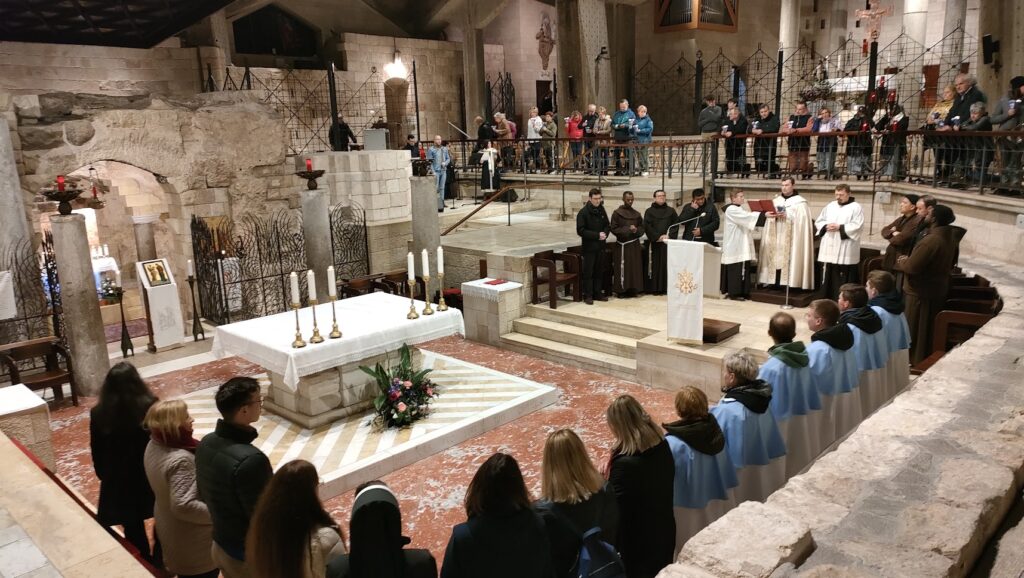
Religious tourism in Israel is growing slowly but steadily, despite the challenging circumstances. In October 2026, 1,800 pilgrims arrived in the Holy Land from Spain, representing a 50% increase compared to the previous year.
A total of 11,400 Spaniards visited Israel between January and October of this year, according to the Israel Tourism Office in Spain. Not all of them were pilgrims; the figure represents tourists in general, although most came for religious reasons. The United States is the leading source of tourists to this Middle Eastern destination.
In a press conference, Dolores Pérez, director of the Tourist Office, highlighted that “now there is a 10-minute wait to enter the Edicule [the small enclosure in the Basilica of the Holy Sepulchre where the Lord's tomb is located]; before, the wait could be up to an hour or an hour and a half.” This is indicative of the low number of pilgrims arriving after the events of October 7, the Gaza war, and the US bombing of Iran, which have significantly impacted visitor numbers. Nevertheless, tourism officials are keen to emphasize the safety and security measures in place for visitors.
It grows slowly
“Pilgrims are our most prominent visitors today. They see the entire biblical route, and if they can’t see it, they don’t come. But today they can,” Pérez noted. “Religious tourism is growing slowly, but it is growing,” he added. In fact, he indicated that among the top priorities of the Israeli Ministry of Tourism is “reviving religious and pilgrimage tourism.” Second is “managing Israel’s international image.”.
Visitors to Israel in 2025 reached 1.3 million, with a strong increase during the fall, surpassing the 900,000 recorded in 2024. In 2023, before the conflict, the number was 3 million. In 2019, it reached a record 4.3 million. The Ministry's Strategic Plan 2030 aims to reach 7 million annual visitors, particularly in anticipation of the Great Jubilee in 2033.
At a press conference held at the Casa Sefarad in Madrid, Israel's acting ambassador to Spain, Dana Erlich, addressed the question of when the best time to travel to the country is. “The region has not been calm since biblical times. We shouldn't wait for a future of tranquility. The best time is now. Life goes on. We move forward. Challenges don't stop us,” she affirmed.

Normality and criticism
In this regard, he asserted that normality and vitality are the norm today in Israeli cities: “The galleries, museums, shops, and streets are full.”.
Erlich, the embassy's chargé d'affaires, following the ambassador's withdrawal in 2024 when Spain recognized the State of Palestine, stated: “We are frustrated with the Spanish government, which seems to like us less. But the feeling is that Spain is a place that Israelis love.” She also acknowledged: “Our image has suffered greatly.”.
For her, “criticisms are sometimes just slogans. They don't reflect the truth. The best way to get to know Israel is to come here.” On the other hand, she acknowledged that “there's no vaccine against fear.”.
On the other hand, he also referred to reports of actions by the Israeli army against Catholic individuals and sites. After emphasizing that Jews, Muslims, and Christians have equal rights under the law in Israel, he asserted that “there have been some dramatic years, with threats against Christian communities in Gaza, while in Israel the Christian community is growing and safe.” “We take religious intolerance seriously,” he added, “and we investigate these incidents. They are not representative of everyday life,” he affirmed.
Dolores Pérez, for her part, highlighted that “globally, the first to come to Israel as a destination are now Evangelicals, followed by Catholics. And in this context, Latin America is showing great enthusiasm for Israel: Mexico, Brazil, Colombia, Chile.” She acknowledged that “what hurts us most is when incidents that don't reflect the overall situation are given headlines.” She also revealed that, to avoid a boycott, some agencies avoid using the name Israel in their programs, focusing instead on the term “Holy Land.” “In fact, this is the concept that pilgrims are drawn to,” she stated.





 Español
 English
 Italiano
 Français
 Deutsch
 Polski