



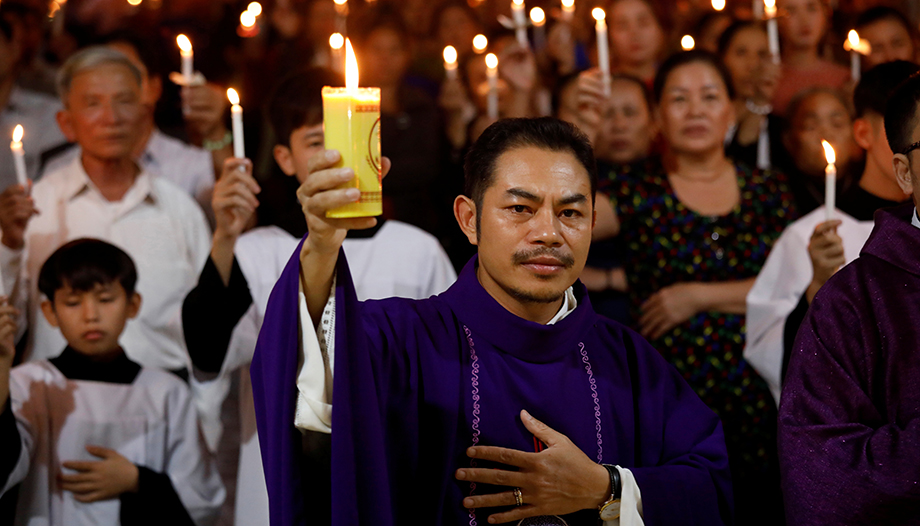
While in many parts of the world secularization is advancing, the Catholic Church in Vietnam shows signs of enormous vitality in a context marked by a communist government and a Buddhist religion followed by approximately half of the population, according to Aid to the Church in Need (ACN) and other sources such as Pew Research Center.
The faithful, mostly Catholic families, show a deep faith in daily life, and maintain an active and growing presence in 27 dioceses, with more than 3,400 parishes and about 5,000 diocesan priests and another 2,000 religious.
At a time when convents and parishes are closing in Europe, Vietnam is experiencing a springtime of faith. With a population of 102 million, the country now has more than 7 million Catholics, making it the fifth largest Catholic community in Asia.
How did it get here? In 1960 the population of Vietnam was 34 million, and now (2026) it has tripled, even with a war in between, which ended in 1975. If Catholics were about 2 million then, and now there are more than 7 million, the “secret” is largely Catholic families with children and the spread of a growing faith.
In these lines we will see a brief X-ray of these aspects: building “fever”, sacramental vitality, the “miracle” of vocations, diplomatic milestones, and what the Vietnamese nun Tham, of the Congregation of the Missionary Sisters of Christ Jesus, explains to Omnes: “...".“The Church in Vietnam has a history deeply marked by suffering and faithfulness. During the persecutions, many Christians gave their lives for the faith. It is the witness of the martyrs”without which hardly anything is understood.
200 new churches by 2025
Catholic dynamism translates into constant pastoral initiatives and a missionary commitment that transcends borders. One of the most visible phenomena is the intense activity in the field of edification.
Vietnam builds an average of 200 churches a year, some of them veritable cathedrals with capacity for thousands of people. These buildings respond to the demand for worship space and reflect the growth of the community.
One of the most striking examples is the Lang Van Church in Ninh Binh, inaugurated in December 2025. With its neo-Gothic style, capacity for 5,000 people and a bell tower of more than 100 meters, it is already the largest Catholic church in Southeast Asia.
It is surprising that this construction “fever”, accompanied by the growth of the Catholic community, is taking place under a communist government. But this has been the government's bet, especially since the pandemic.
Advancement of diplomatic relations
Official publications such as vietnam.es have reported on the audience in April of Pope Leo XIV with the President of the National Assembly of Vietnam, Tran Thanh Man, and his wife, considered to be “great importance". "Both sides seek to establish full diplomatic relations between Vietnam and the Holy See, and to facilitate a visit of the Pope to Vietnam.”, says the information.
In this context, both parties “expressed their satisfaction for the important and substantial progress achieved in the relations between Vietnam and the Holy See, from the meetings between senior leaders of the two countries to the establishment of the Office of the Permanent Representative of the Holy See in Vietnam.”. This is Archbishop Marek Zalewski, the first Papal Representative resident in Hanoi (the capital) since 1975, who assures that “the Church in Vietnam is alive because its people are alive".
Priest David Rolo (Toledo, 1974), a missionary of the Verbum Dei who lives in Rome after working in the Vietnamese country for 6 years, offers Omnes a piece of information: “at the time of the pandemic, the Vietnamese Bishops' Conference appealed to all the faithful to attend to the needs of the people who were suffering.”. And the government recognized the social benefit of the Catholic Church in the country.
Sacramental life
Sacramental life shows equal dynamism, with more than 100,000 baptisms annually and Sunday Mass attendance reaching between 64 % and 90 % in rural areas and dedicated communities, where entire families participate in community liturgical celebrations.
From her own experience, Sister Tham assures us that “the faith lived in families and parishes remains fundamental”. Fr. David Rolo adds that “Catholic families continue to have a good number of children, and there are many young men and women from Catholic families who wish to follow Jesus in the consecrated life or in the priestly life.".
The “miracle” of vocations
Perhaps the most striking aspect of the growth is the flourishing of vocations. The country's 11 major seminaries are operating at full capacity with more than 2,800 seminarians, in addition to some 31,000 religious men and women dedicated to the service of the Church. Priest Joseph Dinh Quang Hoan, from the Diocese of Thai Binh and currently in Rome studying thanks to a scholarship from the CARF Foundation, says: “In Vietnam there are many young people willing to serve the Church. The number of vocations in the Vietnamese Church is very high. In my diocese of Thai Binh, a small diocese, we currently have about 100 seminarians and many religious, nuns and brothers and sisters.".
This abundant number of vocations has enabled the Vietnamese Church to begin exporting priests and religious to Europe and the United States, where they support communities with a shortage of clergy. Hoan himself explains his formative vocation: “Coming to Rome to study is not only my dream, but the dream of many Vietnamese believers. I want to study as much as I can so that I can return to serve intellectual formation in my diocese.”. Hoan also mentions that in his diocese the Sacred Heart major seminary is being built, so qualified teachers are needed to accompany this sustained growth.
Historical roots: the blood of martyrs
Blessed Andrew Phú Yên, the country's first martyr born in 1625, remains a point of reference for the Church in Vietnam. On the occasion of the 400th anniversary of his birth, Pope Leo XIV addressed a message to the more than 64,000 Vietnamese catechists, recalling that Andrew “received baptism, collaborated with Jesuit missionaries, was arrested for his faith and killed at the age of 19 after refusing to renounce Christ. He died saying: ‘Jesus’.’”. The Pontiff thanked the catechists for their dedication:“By your teaching and your example, you attract children and young people to friendship with Jesus.".
Vietnam also has 117 canonized martyrs, among them St. Andrew Dung-Lac and companions, whose witness in times of harsh repression continues to inspire new generations. These martyrs, canonized by St. John Paul II in 1988, correspond to a period of persecutions between 1745 and 1862, during which thousands of Vietnamese Christians were executed for their faith. Fides, OMP Press or Asia News have pointed out that catechists play a key role in evangelization in remote areas where access to priests is limited.
Legacy of Vietnamese cardinals
The Vietnamese Church has also given the Church high-profile cardinal figures. Cardinal François Xavier Nguyen Van Thuan, detained for 13 years in communist prisons between 1975 and 1988, became a symbol of peaceful resistance when he celebrated Mass in secret with three drops of wine and a little water on his hand and wrote The path of hope, composed of 1001 thoughts dedicated to his faithful during his captivity.






 Español
  English
  Italiano
  Français
  Deutsch
  Polski
  简体中文
简体中文