


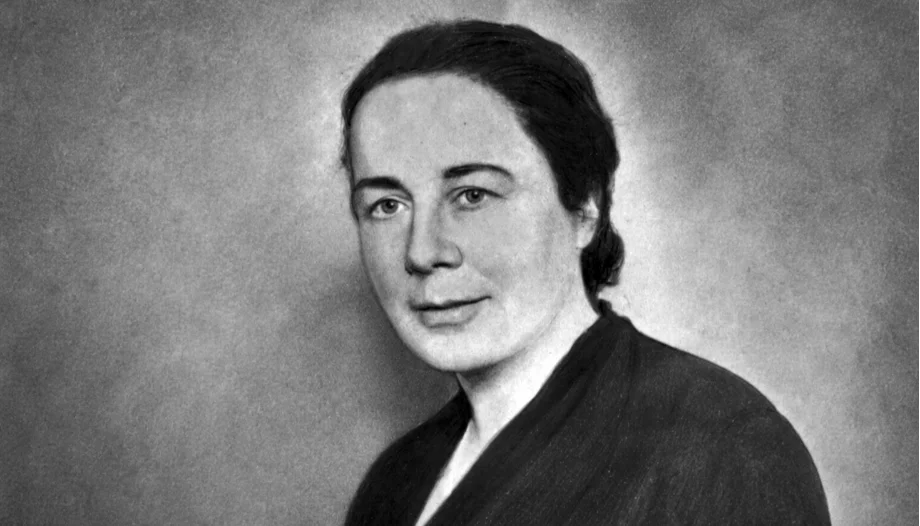
I have the privilege of carrying out a unique rescue mission. For several years now, I have been dedicated to rescuing from oblivion the lives and works of writers who, for reasons that are sometimes quite bizarre, had barely reached the Spanish-speaking public. When I created my own publishing imprint, Topo Sármata Publishing, it was very clear to me that one of her most outstanding authors would be Zofia Kossak, the queen of the historical novel in Poland after Henryk Sienkiewicz. In addition to the literary quality of her work, the fascinating biography of this brilliant writer was a decisive factor. Kossak was not only the author of international bestsellers but also a woman whose life embodied moral resistance in the face of 20th-century totalitarianism.
My first encounter with her took place nearly three decades ago in Koden, a shrine on the border between Poland and Belarus that houses a painted image of Our Lady of Guadalupe of Extremadura. In Happy Guilt Kossak turned the family legend—which tells of Count Nicolás Sapieha’s miraculous healing and the theft of the venerable painting—into a novel, and Ediciones Palabra published my translation of this work in 2023.
A childhood spent among paintbrushes and horses, and a faith that became action
When Zofia was born in 1889, Poland did not exist on maps, having been divided among the Russian, Austro-Hungarian, and Prussian empires. She was born and spent her childhood in the Kosmin manor house, on the banks of the Wieprz River, in the Lublin countryside. She came from a family of distinguished artists, such as her grandfather and her uncle, who were famous for their equestrian and battle paintings. Although she studied at art schools in Warsaw and Geneva, her calling lay not in the paintbrush but in the pen. It was precisely in Geneva, after attending a master class given by a Catholic intellectual, that he realized his faith had until then been merely sentimental, and he decided to delve deeper into theology and philosophy.
Her early years of marriage were marked by the trauma of the Bolshevik Revolution in the Volhynia region (present-day Ukraine). There, Zofia witnessed the destruction of centuries of Polish culture and appalling violence that forced her to flee with her young children in a wagon, revolver in hand, demonstrating from an early age a resolute and courageous character. That tumultuous period gave rise to her literary debut, The Catastrophe (Pożoga), a best-selling book that saved her from financial ruin after she lost all her possessions.
Her husband, Stefan Szczucki, died in 1922 after a painful illness. Now a widow with two children, she moved to Silesia with her parents and fell in love with the region and its people. In 1925, she remarried Zygmunt Szatkowski, who had been her suitor years earlier and had since become an officer in the Polish army and a military historian.
Her spirit of service led her to become involved in the educational movement scout in Poland, seeking to counteract the moral depravity that ideologies of hate were instilling in the youth. He also saw literature as a tool for influencing society through the truth—a truth he defended at all costs, even when it was uncomfortable, as was the case with his novels about the Crusades in the 1930s, which were too realistic for certain Catholic circles of the time.
The Cry Against the Holocaust: The Protest
The outbreak of World War II in 1939 put her integrity to the test. Despite being on the Gestapo’s blacklist for emphasizing in her earlier writings that Silesia belonged to Poland, Zofia threw herself into the underground resistance and became involved in humanitarian aid from the very beginning of the conflict. She devoted herself to assisting prisoners and also cared for their spiritual well-being. A case in point is the numerous occasions on which she risked her life to bring them Holy Communion hidden in a powder compact.
In 1942, shortly after the Germans liquidated the Warsaw Ghetto, Kossak wrote a manifesto titled Protest. In this document, printed clandestinely in thousands of copies, she denounced the fact that the world could not remain silent in the face of the extermination of the Jews. With heart-wrenching honesty, Zofia—who in previous years had expressed critical views toward the Jewish minority in Poland—stated that «anyone who did not help the Jews at that time was neither Polish nor Christian.» It was not a matter of ideological affinity, but of an absolute moral imperative: one could not be like Pontius Pilate.
From this momentum came Żegota, the Council for Aid to Jews, an organization that coordinated the rescue of thousands of people by hiding them in homes and providing them with false documents, all while facing a constant threat of death. Zofia herself risked her life and that of her children in these operations.
From the depths of Auschwitz to a farm in Cornwall
In 1943, fate led her to Auschwitz-Birkenau. Caught with propaganda material, she endured a brutal ten-day interrogation at the infamous Pawiak prison before being sent to the extermination camp—without the Germans ever learning her real name, nor her ever betraying her collaborators. Even there, where despair was the norm, her testimony was described by other prisoners as a ray of hope. Upon her arrival at the Fraulager, organized a series of clandestine literary and cultural gatherings of various kinds with her friends from the intellectual elite to lift their spirits and keep her fellow inmates’ minds occupied.
Months later, when she was sick with typhus and on the verge of death, the Nazis discovered her identity and sent her to the hospital to recover and try to convince her to collaborate with them on their propaganda against the USSR, as the Reich’s situation in 1944 was becoming desperate. She refused, and was therefore sentenced to death, but she miraculously survived thanks to a bribe from the Polish underground just before what seemed like an imminent execution. She never knew that her second son from her first marriage had died in that very same Auschwitz from which she had managed to escape.
When the war ended and the communist regime took power, his situation once again became precarious. As luck would have it, it was a sinister communist leader of Jewish descent, Jakub Berman, who provided him with a passport so he could flee the country and avoid prison or death. Berman’s brother, Adolf, had been secretary of Żegota during the war.
Zofia spent ten years in exile on a modest farm in Cornwall, tending pigs and chickens alongside her husband, while her books were censored and removed from libraries in her homeland and she was stripped of her Polish citizenship. Kossak took refuge there to care for her husband, whose health was fragile after spending nearly the entire war in a prisoner-of-war camp for officers. She gave up writing at a time when her name was being mentioned as a Nobel Prize contender and Hollywood was interested in adapting her works for the screen.
The Return: Integrity Over Honors
Zofia returned to Poland in 1957, thanks to the help of other writer friends. She settled into the small gardener’s house, the only thing left of her former estate in Silesia. Her popularity among readers remained undiminished, but her relationship with the communist state was one of constant tension; in fact, the security services and their informants continued to monitor her for a long time and tried to use her to sow divisions among Catholics.
In a gesture of principle, he turned down a state award that included a substantial monetary prize because the government was boycotting the celebrations marking the Millennium of Poland’s Baptism. At the age of 70, he chose to continue battling bureaucracy to obtain coal and paper for writing rather than compromise his convictions.
The Unarmed Warrior: The Fifth Crusade, St. Francis, and Peace
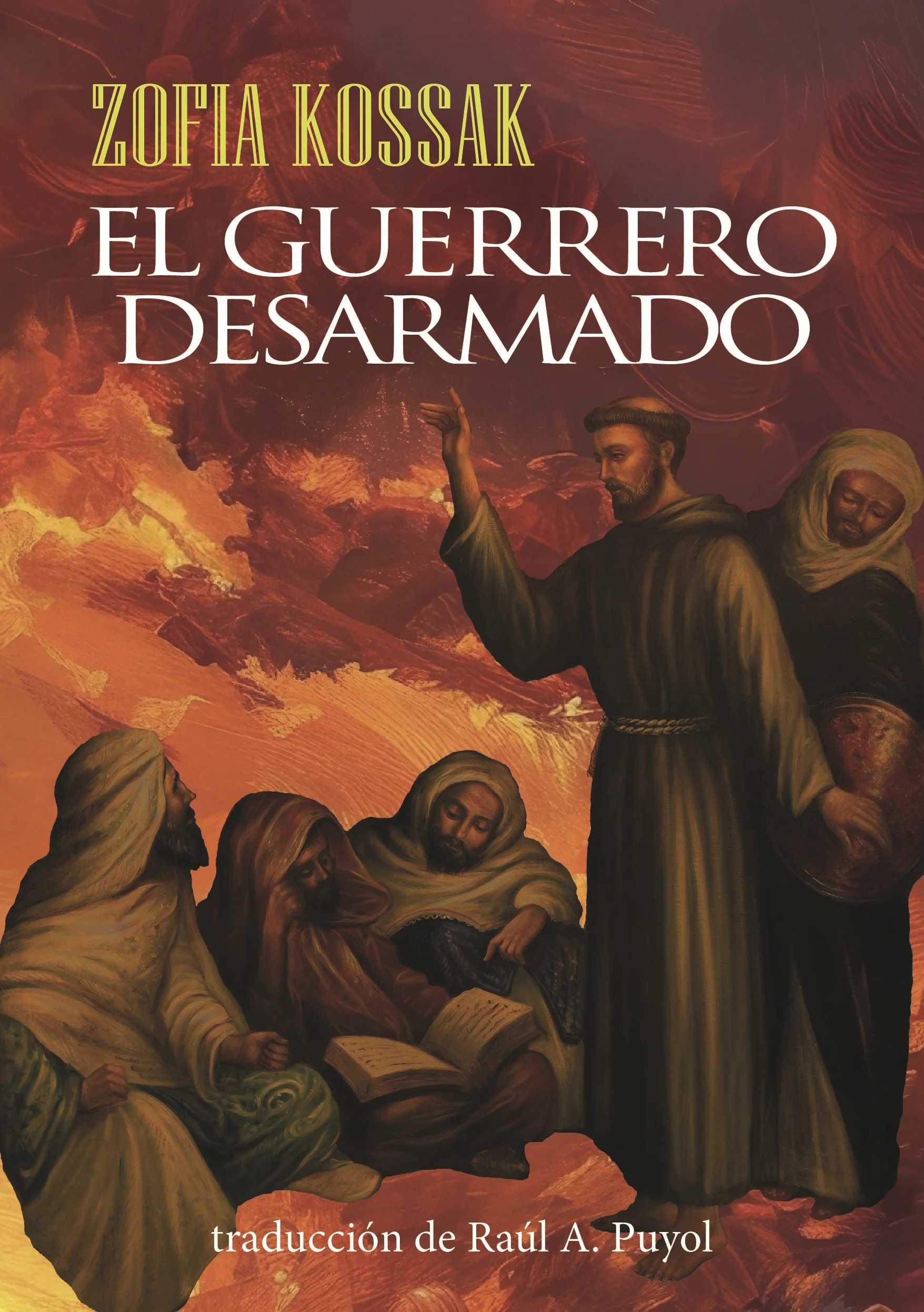
The latest novel to be published, The Unarmed Warrior, is part of her literary maturity. It is a novel whose main protagonist, alongside John of Brienne, King of Jerusalem, is St. Francis of Assisi, whose 800th anniversary of death we are commemorating this year. The title is a statement of principles: in contrast to the force of arms and the brutality of the military expeditions she herself portrays in her Crusades trilogy, Kossak presents the figure of the saint who conquers through humility and poverty.
It was a resounding international success, selling 700,000 copies in the United States. Translated from English into Spanish, it was published in Argentina in 1945 under the title Blessed are the humble, but it never made it to other Spanish-speaking countries. The fact that this work is now returning to bookstores is an act of justice for an author who believed that life is never black and white, but rather a complex web of nuances where the only valid compass is compassion.
Zofia Kossak passed away in 1968. After returning from the commemoration of the anniversary of the liberation of Auschwitz, her heart gave out, and she never regained her health. Years later, Yad Vashem posthumously honored her as Righteous Among the Nations. Her life and work—as I have been able to recall with the help of various Polish institutions during recent tributes in Spain and Mexico—continue to inspire us to understand that, even in the darkest of times, inner freedom and moral courage are weapons that no totalitarian regime can defeat.
The Unarmed Warrior
Translator





 Español
  English
  Italiano